
Learning Objectives
- Learn how to use Roman numerals to analyze harmonic progressions.
Harmony III: Harmonic Analysis
Harmonic Analysis
We can now apply our knowledge of chords, keys, and Roman numerals to do some simple harmonic analysis. Harmonic analysis allows us to see what chords are used in a piece of music and will help us to begin to understand harmonic progressions.
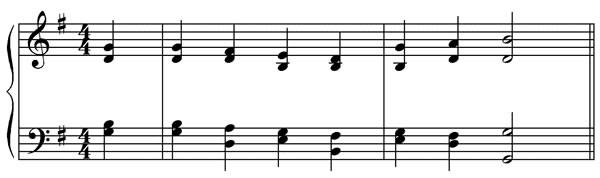
Consider the score excerpt shown below, which gives the opening phrase from the hymn tune known as "Old Hundredth" from the Genevan Psalter (1551), written by the French composer Louis Bourgeois. How would we analyze the chords in this example?
Step 1. Determine the key
In order to use Roman numerals to analyze the harmonies in this piece, we first need to determine what key it is in. There is one sharp in the key signature. But the key signature alone does not give the answer, since every key signature can represent two different keys: one major and one minor. In this case, the two possible keys are G major and E minor. How can we determine which of these two keys is used here?
To find the answer to this question, we will have to look at the music itself. We should look in particular at the bass line (the lowest sounding part), since this part typically provides the foundation for the harmony. Does this lowest part emphasize G or E? There are some Es in the bass line, but the phase begins and ends on a G. Music often begins and nearly always ends on the tonic, so these are the best places to look to determine what key the music is in.
Another way to determine if a piece is in major or minor is to listen to it. Click on the speaker to listen to this example. Does it sound like it is in major or minor? If you are not familiar with the sound of major or minor keys, it may take you a while to develop this skill, but once you can tell the difference by ear, it is the quickest and easiest way to determine the key. In this case, the key is G major.
Step 2. Reduce the chords to simple triads
The chords in this example are written on the grand staff in open spacing. Also, there are four voices, so some pitches have been doubled. To simplify this musical texture, we will rewrite these chords on a single staff as closely-spaced root position triads. This gives us the following chords:

Step 3. Analyze the simplified chords with Roman numerals
Now that we have these simplified chords, it should not be hard to add Roman numerals to them. To do so, just determine the scale degree of the root of the chord and add the corresponding Roman numeral underneath. For example, the root of the first two chords is G. G is scale degree 1 in G major, so this is a I chord. The root of the next chord is D, which is scale degree 5 in G major, so this is a V chord. The following chord has E as its root, which is scale degree 6, so it is a vi chord. And so on. The complete analysis is provided below:

Note that we did not need to determine what the quality of each triad was because we already know this information. Since we are in a major key, we know that all of the I and V chords are major and that the vi and iii chords are minor. Knowing the types of chords that occur in major keys proves to be quite a time-saver, since we only need to figure out the root of the chord to determine its quality.
Analyzing Inverted Chords
Now let's look at a slightly more difficult example. The example below gives the first phrase from a chorale by J.S. Bach entitled "Vater unser in himmelreich" (Our Father in Heaven Above):
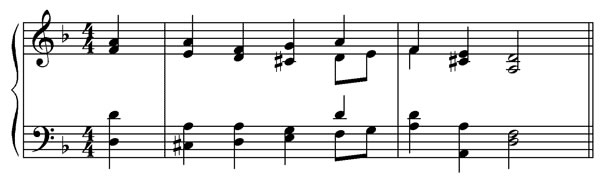
The first step is to determine the key. There is one flat in the key signature, which means that this piece could be in F major or d minor. Look at the bass line. Which pitch is emphasized here? Clearly, this phrase begins and ends on D, which means that we are in D minor. Another clue that the music provides is the pitch C#. Why would this suggest D minor? Because it is a raised leading-tone, leading up by half step to the tonic D. This is something that we would only find in minor keys.
| Remember |
|
Next, we reduce the piece to simple root-position triads. Note that some of the chords in this piece are not in root position. For example, the second chord has the pitches C#, A, E, and A. Stacking these pitches neatly on the staff shows that A is the root, but the lowest note is the third (C#), so this chord is inverted. Several of the remaining chords are also inverted. For now, we will ignore these inversions and focus on the roots of each chord. Here are the simplified chords in root position:

Note that the eighth notes that occurred at the end of the first measure (the E and the G) were omitted here since these notes do not form a complete chord of their own. These are called non-chord tones because they do not belong to the D minor chord that they embellish. We can also call these embellishing notes "passing tones" because they decorate the music by filling in melodic gaps with passing motion. There are many kinds of non-chord tones in music, but a full consideration of them is beyond the scope of this class.
Now we analyze the simplified chords with Roman numerals in the key of D minor, as follows:

Since there were inverted chords in the original music, we now need to add an additional step to our procedure:
Step 4: Add inversion symbols
The final step is to look at the bass line in the original music. If the bass line contains only chord roots (as in our first example above), then you are done. If the bass line contains the third of a chord, then the chord is in first inversion. For first inversion chords, we add the inversion symbol "6" (derived from figured bass). For example, the second chord is a V chord with the root of A, but the bass note here is C#, which is the third of the chord. This chord is therefore in first inversion, and it should be labeled "V6," as shown in the complete analysis below. Two other chords are also in first inversion (viio6 and i6).
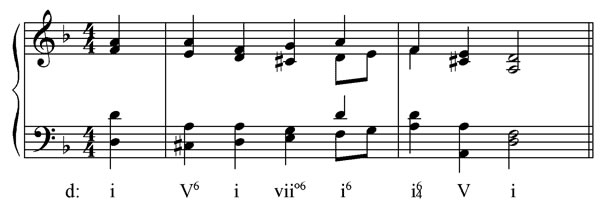
If the original bass line contains the fifth of a chord, then the chord is in second inversion. For second inversion chords, we add the inversion symbol "64" to the roman numeral. The first chord in the last measure is a i chord (D F A), but the bass note is an A, which is the fifth of the chord. So this i chord is in second inversion, as indicated in the complete analysis above.
Although there are a good number of additional complexities that you might face in analyzing different styles of music, this is a good basic approach to harmonic analysis that will work for most tonal music.