
Learning Objectives
- Examine different ways of spacing and doubling the notes in a triad.
Triads VI: Triad Spacing and Doubling
Triad Spacing
When the notes of a triad are placed as close together as possible, the triad is said to be in closed position. When the notes of a triad are spaced out in such a way that they are NOT as close together as possible, they are said to be in open position. Click "Show Me" below to see an example of closed vs. open position. In the first chord shown below, the pitches of the C major triad are stacked neatly on top of each other. This triad is in closed position. The second chord is also a C major triad, but the C, E, and G are rearranged such that there is more space between the pitches. This triad is in open position. Click on "Closed" and "Open" to hear the difference between these two types of spacing.
Closed Vs. Open Triad position
It is common for triads to be spread out using open spacing. Such spacing will change the way a chord sounds, but it does not change the triad's name or its quality—it is still a C major triad, no matter how the notes are spaced. In order to determine the quality of a triad in open position, it is easiest to put the chord back into closed position, eliminating the spacing by stacking the pitches in thirds above the root.
Here are some more examples of chords in open spacing, using the grand staff. Each chord is followed by the underlying triad in closed position. Click on each of the speakers to hear how strongly the spacing affects the sound.
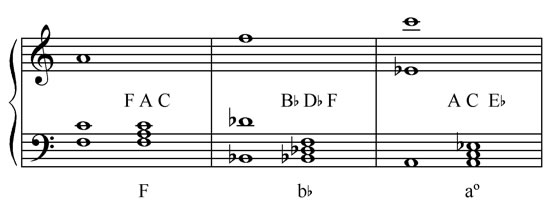
Triad spacing
Triad spacing
Triad spacing
Triad Doubling
In the triads we have seen so far, there have always been just three notes: a root, a third, and a fifth. It is also possible to double some of the pitches in a triad. This is done to create fuller, thicker, more balanced sonorities. The example below illustrates the use of both spacing and doubling on the grand staff. Click on each of the speakers to hear the resulting sonorities (followed by the simpler underlying triads). Even though there are a lot more notes sounding here, each of these chords can be reduced to a simple three-note triad. For example, the A major chord below is spelled A–A–C#–E–A–C#–E. The only three pitches that are used are A, C#, and E.
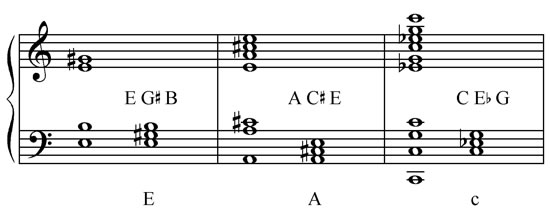
Triad doubling
Triad doubling
Triad doubling