
Learning Objectives
- Learn about cadences and examine the role of the authentic cadence.
- Identify and distinguish between perfect and imperfect authentic cadences.
Cadences I: Authentic Cadences
Cadence
A cadence is a short harmonic progression that occurs at the end of a musical phrase. If a phrase is like a musical sentence, then a cadence is like the punctuation that completes that sentence. As with spoken sentences, the punctuation at the end of a musical sentence can be strong (like an exclamation point) or weak (like a question mark). There are different types of musical cadences, each providing varying degrees of closure. We will first focus on the two most common types of cadences: the authentic cadence and the half cadence. Then we will discuss the other types of cadences (plagal and deceptive).
Authentic Cadence
The authentic cadence (AC) is perhaps the most common and recognizable type of cadence, found in nearly every musical style. It consists of a progression from the dominant to the tonic (V - I in major or V - i in minor), providing a strong sense of closure at the end of a phrase, like the period at the end of a sentence. Here are two authentic cadences: one in C major and one in C minor. Click on the speakers below to hear these cadences played.
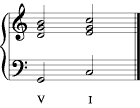
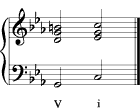
Since an authentic cadence progresses from an unstable dominant to a stable tonic, it provides a much stronger sense of closure and resolution than any other cadence. An important part of this resolution is the motion of the leading tone (TI) to the tonic (DO). In the examples above, TI-DO occurs in the top voice. Note that in the minor key the leading tone must be raised to create a major V chord.
The interactive example below will help to illustrate. First click "Show Me" to hear the complete cadence, then click on the chord symbol "V". Can you tell that this chord is needs resolution? Now click on the chord symbol "I" to hear how it resolves. You can also click individual notes within the chords. For example, click on the two notes in the top (soprano) part. The first note is the leading tone. Can you hear how it wants to resolve up to the tonic?
Authentic cadence in D major
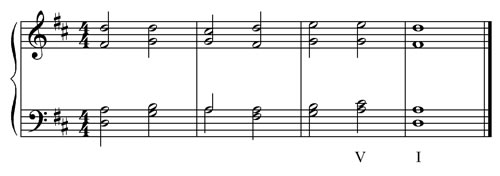
Note that not all V-I chord progressions are authentic cadences—only those that occur at the end of a musical phrase. Remember that a cadence is a resting point in the music, not simply a pair of chords. The example below provides a complete four-measure musical phrase ending in an authentic cadence, so that you can hear the cadence in a fuller context.
| Remember |
|
Perfect and Imperfect
We can further distinguish between perfect authentic cadences (PAC) and imperfect authentic cadences (IAC). The authentic cadences that we have seen so far have all been perfect. Two things are required to make an authentic cadence perfect:
- The soprano (top voice) must end on the tonic (scale degree 1 or DO)
- The bass (bottom voice) must move from scale degree 5 to scale degree 1 (SOL-DO). In other words, both the V and the I chord must be in root position.
If these criteria are not met, then the authentic cadence is imperfect. For example, the first cadence below is imperfect because the soprano ends on scale degree 3 (E) rather than scale degree 1 (C). The second cadence below is also imperfect because the dominant chord (V6) is inverted rather than being in root position. Click on the speakers below to hear these cadences played.
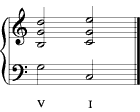
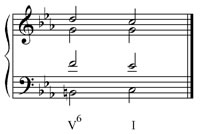
These variants weaken the impact of the imperfect authentic cadence, making it sound somewhat less conclusive than a perfect authentic cadence—perhaps more like a semicolon than a period.