
Objectives
- Relate the social, cultural, and political background during the Medieval period (500-1450) to the function of music during this time.
- Characterize the music of the early Christian church, i.e., Gregorian chant.
- Describe the difference between the Proper and the Ordinary of the Mass.
- Examine the influence of the Cathedral of Notre Dame as a center for organum in medieval music.
- Describe the differences between troubadours and trouvères in medieval secular music.
- Trace the rise of secular polyphonic chansons set to fixed text forms (rondeau, ballade, virelai) in the French Ars nova.
- Define and classify the instrumental music of the medieval period.
- Trace the four major developments that took place in Western music during the Middle Ages: the development of pitch and rhythmic notation; the transition from monophony to polyphony; the initial stages of regularly metered music; and the development of the motet and instrumental music.
Secular Music in the Middle Ages (500-1450)
Music played an important role in medieval society, helping to create a spiritual setting for the church—sacred music—and social entertainment in the court—secular music. In this respect, European music does not differ from that of other world cultures. During the Middle Ages, however, musical changes occurred in secular music that provided the foundation for the music we listen to today.
Composer: Anonymous
-
"Quem Quaeritis"
Composer: Berenguier de Palou
-
"Domna, pos vos ay chausida"
It is difficult to say with certainty how much influence the Church had on medieval secular music because so little of it survives. The practice of notating secular or instrumental music did not become common until the 15th and 16th centuries. Secular music often took the form of songs or dances for particular events.
The earliest surviving pieces of secular music are Goliard songs from the late 10th through the 13th centuries. These songs are named after the Goliards, scholars who wandered from one town to another before great universities were established. The subject matter of these songs is not unlike that of today's popular music: wine, women, love, and broken hearts. Carl Orff (1895-1982), a 20th-century German composer, used texts from the Goliards for his cantata, Carmina Burana.

As secular music became more acceptable, aristocratic poet/composers began to appear in different regions...

Secular songs in the Middle Ages were performed in a particular kind of monophony called monody, which consists of a single melody and minimal supporting accompaniment. The rhythm of these songs was usually set in a dance-like triple meter. From historical writings (if not actual musical examples), we know that jongleurs and minstrels performed secular music in the Middle Ages. Despite the initial disaproval of “respectable” society, these groups of young musicians traveled from city to city and court to court, presenting entertaining shows. Eventually they formed guilds that provided training and protection to its members.
Troubadours
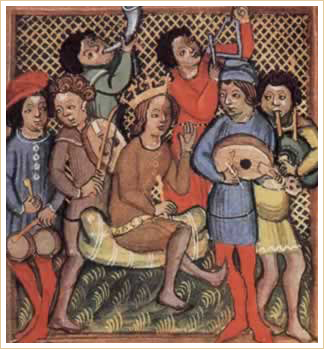
As secular music became more acceptable in the 12th and 13th centuries, aristocratic poet/composers emerged in different regions: troubadours in Southern France, trouvères in Northern France, and the Minnesingers and Meistersingers in Germany. Each group used its own particular regional language in its songs. Later, their activities extended into Southern Spain and Italy. The poems and songs of these groups provide a catalog of early European secular song.
Troubadours composed songs that dealt mainly with chivalry and courtly love that, more often than not, praised women from afar by “placing them on a pedestal.” Troubadour activity was most abundant during the last decades of the 12th century with almost half of all surviving works dating from 1180 to 1220. The most famous names belong to belong to the period from 1170 to 1213. During this time, the love song started to emerge as a separate genre. The master of the love song was the troubadour known as Bernart de Ventadorn.
Bernart de Ventadorn
Bernart de Ventadorn (c.1130-?) was one of the most famous troubadours, a pop star of his day, if you will. It appears from his vida (meaning life)—an at times imaginative troubadour biography—that his father was a baker or a foot soldier in the castle of Ventadorn (hence his name). He was influenced by the traditional courtly customs of troubadour poetry. Though his origins remain hazy, it is known that he later worked in the service of Eleanor of Aquitaine, who married Henry II of England. Ventadorn is said to have entered a monastery in Dordogne, Southern France, where he died in the last decade of the century.
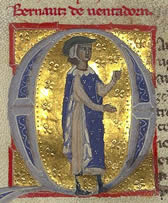
A large number of Ventadorn's troubadour poems survive, as well as a fairly substantial body of monodic music featuring a single melodic line following the rhythm and pattern of the verses. Although scholars disagree regarding the precise number of works in Ventadorn's output, the general consensus is that around 45 poems survive, with music to accompany 18 of them.
Quan vei la lauzeta mover is not only the most famous of Ventadorn's songs, but it is also among the most widely known of the troubadour repertoire. It probably had an influence in the Northern French trouvère repertoire. The poem consists of seven eight-syllable stanzas, with a rhyming scheme ABABCDCD. Below are the first two stanzas:
Composer: Bernart de Ventadorn
-
"Quan vei la lauzeta mover"
Quan vei la lauzeta mover
Bernart de Ventadorn
When I see the lark move
Composer: Bernart de Ventadorn
-
"Quan vei la lauzeta mover" [ 00:19-00:45 ]00:27
Quan vei la lauzeta mover
de joi sas alas contra'l rai,
que s'oblid'e's laissa chazer
per la doussor c'al aor li vai,
ai tan grans enveya m'en ve
de cui qu'eu veya jauzion,
meravilhas ai, car desse
lo cor de dezirer no'm fon.
When I see the lark move
for joy his wings in the sun,
and disappear and swoop
for the delight that comes to his heart,
great envy comes upon me
at one so joyful,
and I wonder that in an instant
my heart does not faint for desire.
Composer: Bernart de Ventadorn
-
"Quan vei la lauzeta mover" [ 00:46-01:12 ]00:27
Ai, las! tan cuidava saber
d'amor e tan petit en sai!
car eu d'amar no'm posc tener
celeis don ja pro non aurai.
Tout m'a mo cor, e tout m'a me,
e se mezeis'e tot lo mon;
e can se'm tolc, no'm laisset re
mas dezirer e cor volo.
Ay, alas! I thought
I knew much
of love and I know so little!
For I cannot forbear to love her
from whom I shall have nothing.
She has stolen my heart and my being,
and for herself the whole world;
and when I am parted from her,
there is nothing other than desire
and my yearning here..
Generally speaking, during the 12th and 13th centuries, troubadours weren't the wandering minstrels of 19th-century imagination. Rather, they were often individuals of high social position: kings, princes and lords, however limited in their domains. Among these poets, there were also those of lower social status; for example, sons of shopkeepers and tradesmen. Regardless of status, troubadours were influenced by the traditions and conventions of the court, but above all, by courtly notions of idealized love, with all its joys and sorrows. Idyllic love was not the only subject in their repertoire, however. Troubadour songs featured all sorts of subjects, from the political to the satirical, from the apologetic to the bawdy.
Troubadours were particularly active between 1140 and 1220. It appears that the devastating Albigensian Crusade of 1209, targeted against heretics in Southern France, may be to blame for the decline and eventual disappearance of their art. The last known troubadour was Guiraut Riquier (c.1230-1284).
Guillaume de Machaut
Guillaume de Machaut (c.1300-1377) was a poet and musician generally regarded as one of the leading French composers of the Ars Nova (New Art) musical style of the 14th century, as opposed to the Ars Antiqua (Old Art) of the previous generation represented by the composers of the Parisian Notre Dame School, Leonin and Perotin.
Three so-called "fixed forms" in 14th and 15th-century poetry and music use an ellaborate pattern of repetition of verses and refrains: the ballade, virelai, and rondeau. Guillaume de Machaut's lyric output comprises approximately 400 poems, including 235 ballades, 76 rondeaux, 39 virelais, and 19 lais (lai is another poetic form that often deals with tales of adventure and romance). The vocal music in the following examples comes from one of Machaut's most extraordinary poems, Le Livre dou Voir Dit ("A True Story"), which features 9,094 lines of verse, arranged in rhyming couplets of eight syllables each. The poem tells the love story between the elderly Machaut and his very young admirer, Peronne. The difference in age is too great, however, and the idyll ends in disappointment. However, they exchange letters and lyric poems, some set to music by Machaut. These pieces of correspondence give us a fairly good understanding of what it was like to be a composer in medieval times. The fact that the majority of the lyrics are not set to music suggests that Machaut normally wrote the text before setting it to music.
Composer: Guillaume de Machaut
-
"Ballade 32: Plourez dames"
Composer: Anonymous
-
"Quant ay Lomon Consirat"
Composer: Guillaume de Machaut
-
"Rondeau 18: Puis qu'en Oubli"
Ploures dames is the first poem that Guillaume de Machaut sends to Peronne in a letter from the summer of 1362. The music is in ballade form.
I am sending you a ballade Ploures dames about the sad state I've been in, and I ask that you learn the song, for it's not difficult and the music pleases me very much.
The text takes the form of a will written on the poet's death bed, in which he leaves his heart to the woman his poetry has always praised.
In a letter dated Oct. 9, Machaut writes concerning a rondeau composition of his:
My very sweet heart, I've made the rondeau where your name is, and I would have sent it to you by this messenger, but by my soul I've not yet heard it, and I'm not accustomed to part with things that I've made until I've heard them. And be certain that it's one of the best things I've made for seven years, in my opinion... And learn yourrondeau (Rondeau 17:Dis et sept cinq) please, for I like it a lot.
Composer: Guillaume de Machaut
-
"Rondeau 17: Dis et Sept Cinq"
Dance Music
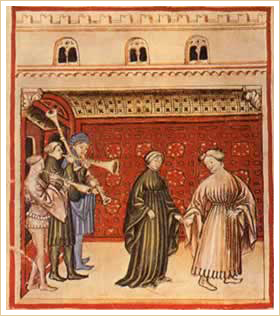
No matter what instruments were used, almost all instrumental music in the Middle Ages was used for dance purposes. Just as Boccaccio raised the vernacular and popular stories of the day to the level of art, so did the great composers and performers of the period shape the dances and songs of the lower classes into lasting works of art. The titles of some dances suggests that this was the first time in history that programmatic titles were used. Consider, for example, Bellicha (The War-like Woman), a piece that comes from a Northern Italian collection of the early manuscripts of such art dance-music, presently housed in the British Library in London. Guillaume de Machaut's Bel Fiore Dança (Beautiful Flower Dance) is another example of the instrumental dances of the time. One of the most popular dances was the saltarello, a lively dance of Italian origin with a catchy and simple structure.
Composer: Anonymous
-
"Bellicha"
Composer: Guillaume de Machaut
-
"Bel Fiore Dança"
Composer: Anonymous
-
"Saltarello No. 1"
Regardless of status, troubadours were influenced by the traditions and conventions of the court, but above all, by courtly notions of idealized love, with all its joys and sorrows...



