
Overview
The history of jazz rightly begins in the city of New Orleans. In this section, we will learn about great New Orleans jazz musicians and their early recordings in Chicago. In the process, will also learn about the emerging Chicago jazz scene and some of the artists from that area who helped develop early jazz musical styles. Finally, we will do a short overview of early jazz in New York.
Objectives
Upon completion of this lesson, you will be able to do the following:
- Define collective improvisation
- Identify early jazz musicians and their contribution to jazz music
- Appreciate the significance of Dixieland jazz
- Recognize the impact Chicago had for musicians of early jazz
- Recognize the growing importance of New York for further developments in jazz
- Define chord substitutions
Jelly Roll Morton
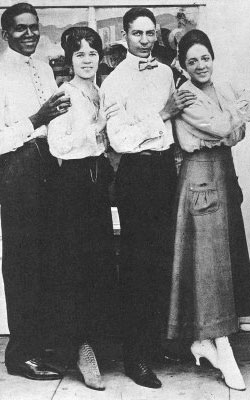
Jelly Roll Morton (1890-1941), composer, pianist and bandleader, is considered one of the first great jazz musicians. While few take seriously his claim — made in later years — that he "invented" jazz, he was certainly among the first to draw together elements of ragtime piano and blues in a new rhythmic manner that suggested swing eighth notes. This was the essence of the "stride style" of piano developed by early jazz pianists, and Morton was a notable contributor. (More about this when we get to Harlem.)
Growing up in a well-to-do black Creole family, by his early teens Morton was among the elite New Orleans pianists who played in the high-class bordellos of New Orleans that catered to white patrons. "The sporting houses needed professors," recalled Morton, of his work at the piano3.
Storyville, known as "The District" by the locals, was a sector of New Orleans near the French Quarter where prostitution was legal between 1897 and 1917. Morton's early performances in The District — which he tried unsuccessfully to hide from his family — set Morton on a career path as an itinerant musician, his travels eventually taking him to both coasts, as well as points in between.
Jelly Roll Morton is considered the first great jazz composer and arranger. His compositions contributed significantly to the jazz repertoire, and his arrangements and recordings proved influential in the evolution of jazz into a soloist's art. One begins to hear the emergence of the soloist improviser even in the midst of the collective improvisation that still pervades his style.
Listen, for example, to Jelly Roll Morton's Red Hot Peppers perform his Black Bottom Stomp ♫, recorded in Chicago in 1926. Clarinet, trumpet, trombone, piano, and banjo each enjoy moments of our attention, emerging as distinct passages during the ensemble performance.



Alicia Keys covered Fats Waller's "Ain't Misbehavin'" for the 2013 movie The Great Gatsby, starring Leonardo DiCaprio and Carey Mulligan.
