
Overview
In the evolution of jazz, the New Orleans and Chicago styles of the 1920s gave way to the emerging swing style of the 1930s. In this, and the next several sections, we will learn about some of the most influential jazz musicians of this era and how their musical contributions helped shape the jazz style known as swing.
Objectives
Upon completion of this lesson, you will be able to do the following:
- Identify selected swing musicians and their contributions to jazz
- Define charts
- Identify the significance of call-and-response in Fletcher Henderson's compositions, as well as in others‘
- Define antiphonal counterpoint
Fletcher Henderson
Fletcher Henderson (1897-1952) grew up in a middle-class black family in southern Georgia. His mother, a piano teacher, instilled in him an appreciation of classical music, but Henderson never considered music as a career. He graduated from Atlanta University with a degree in chemistry and then moved to New York in 1920. Almost serendipitously, he wound up working as a song demonstrator for one of New York's earliest black-owned music publishing companies. When one of the owners, Harry Pace, founded the first black recording company, Henderson was enlisted to serve a host of musical duties. Ultimately, this led him into the role of band director for the company's various recordings. Before long, Henderson had put together his own band to perform outside the studio1.
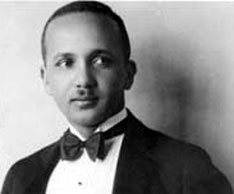
Henderson was a pioneer in the emerging jazz style that would come to be known as swing. His arrangements — or chartsA written arrangement, especially for a big band., as they are called — provided the model for most of the bands that would come to prominence in the latter half of the 1930s.
Henderson's charts divided the band into three sections:
- Reeds (reed section)The section of a big band consisting of saxophones and clarinets (and occasionally flute). : alto, tenor, and baritone saxophones; and clarinet
- Brass (brass section)The section of a big band consisting of trumpets and trombones. : trumpets and trombones
- Rhythm (rhythm section)The section of a jazz combo consisting of piano, guitar, double bass, and drums. : piano, guitar, double bass, and drums
Henderson would pit the reeds against the brass in a call-and-responseA musical “back-and-forth” characterized by alternations between two groups, or between a soloist and a group. that later became a hallmark of the big band style. This back-and-forth between sections is also described as antiphonal counterpoint.
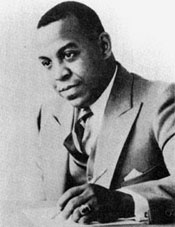
Don Redman (1900-1964) was a conservatory-trained saxophonist/composer who was hired by Fletcher Henderson, and he is largely responsible for much of Henderson's early big band success. Redman's arrangements not only heightened the distinction between written and improvised sections, they also made skillful use of the contrasts between reeds and brass — the innovation that Henderson's orchestra became known for. He was also among the first to develop the voicing-across-sections technique, where players are drawn from the various sections to play a line together. (Duke Ellington adopted and further developed this technique of voicing across sections, as we'll see in the second part of this lesson.)
One of Fletcher Henderson's early hits was his composition The Stampede ♫, arranged by Don Redman. This was early New York jazz, not hiding its debt to the New Orleans style, but leading the way toward the big band sound that would evolve in the next decade.
Notice the arrangement in the opening chorus. Certainly, Jelly Roll Morton had worked out similar ideas, but this arrangement features a more homogenous blending of horns in a number of the passages. Coleman Hawkins takes the solo in the second chorus (0:50-1:23). Here, he is pioneering the development of the tenor saxophone "voice," which was literally a newcomer to the jazz band. Fletcher Henderson, for his part, has ample opportunity to demonstrate his piano acumen in passages of call-and-response, and we hear the strong influence of New York's "Father of Stride", James P. Johnson (Carolina Shout ♫).
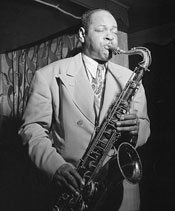
Fletcher Henderson and His Orchestra, The Stampede ♫ (Henderson), New York, May 14, 1926. Fletcher Henderson, piano; Russell Smith, trumpet; Joe Smith and Rex Stewart, cornet; Benny Morton, trombone; Buster Bailey and Don Redman, clarinet and alto sax; Coleman Hawkins, clarinet and tenor sax; Charlie Dixon, banjo; Ralph Escudera, tuba; Kaiser Marshall, drums. Solos: Stewart, Hawkins, Joe Smith, Henderson, Stewart.



"Duke Ellington wrote over 1,000 compositions in his lifetime as a Jazz band-leader, composer and pianist, including Jazz standards, film scores and classical works."
