
Overview
In the early 1940s, a number of innovative and daring jazz musicians began searching for a new style. In after-hours jam sessions, they experimented with new melodic and harmonic vocabularies that challenged listeners and musicians alike. This music would come to be known by its onomatopoeic description: bebop.
In this section, we will first focus on the two principal innovators of this new jazz style: Charlie Parker and Dizzy Gillespie. We will also discover how the swing-style jazz of Count Basie provided a basis for the transition to bebop and the advent of the modern jazz era. In the second half of the section, we will discover other influential musicians who helped shape bebop and modern jazz.
Objectives
Upon completion of this lesson, you will be able to do the following:
- Identify Charlie Parker and Dizzy Gillespie as the principal innovators who contributed to the development of bebop
- Appreciate bebop as a new approach that ushered in modern jazz
Dizzy Gillespie
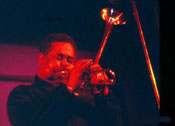
Dizzy Gillespie (1917-1993) grew up in rural South Carolina, where by age 12 he had learned the basics of both trombone and trumpet and was discovering his preference for trumpet. Radio broadcasts of the Teddy Hill Orchestra from the Savoy Ballroom in Harlem, especially the playing of trumpeter Roy Eldridge, inspired Gillespie and provided a model for him to emulate. In his late teens, Gillespie studied music at the Laurinburg Institute in North Carolina.
Gillespie made his way northward by degrees, moving with his family to Philadelphia in 1935 and then (on his own) to New York in 1937. He was soon hired to play in the Teddy Hill Orchestra, and he joined the band for a European tour that year. In 1939, Gillespie landed a spot in Cab Calloway's band, which was then one of the country's most popular bands enjoying a very long run at the Cotton Club for most of the decade.
While traveling as a member of Cab Calloway's band, Dizzy Gillespie met Charlie Parker in Kansas City in 1940. Gillespie was, by this time, well established, regarded by many as the most versatile and virtuosic trumpeter since Roy Eldridge. But when he heard Parker, Gillespie said, "I was astounded by what the guy could do." The two would soon do astounding things together.
The musical collaborations of Dizzy Gillespie and Charlie Parker define bebop. Their performance of Shaw 'Nuff ♫, recorded on May 11, 1945, is one of those definitive collaborations. Built around a conventional 32-bar song form, the piece is framed by a 24-bar introduction ("Intro") that also serves to close the piece (at which point it becomes an "Outro"). During the first and fifth choruses, we hear the tune played in unison by the two horns. The technical precision required to play such an intricate tune in unison is impressive in its own right. More so are the solos that fill the middle three choruses. Bird takes the first solo (0:46) and Dizzy the second (1:13), followed by Al Haig on piano (1:41). Each instrument has its own inherently idiomatic gestures, which contributes to the individuality of the soloist. What's fascinating, though, is the extent to which each instrumentalist renders a similar bebop vocabulary through his particular instrument. In the process, he is expanding the range of his instrument's expressive and technical capabilities. Let's listen Shaw 'Nuff ♫.



Sarah Vaughan entered the talent contest at Harlem's Apollo Theater on a dare from friends. She sang her version of "Body and Soul" and won 1st prize.
