
Overview
In the early 1940s, a number of innovative and daring jazz musicians began searching for a new style. In after-hours jam sessions, they experimented with new melodic and harmonic vocabularies that challenged listeners and musicians alike. This music would come to be known by its onomatopoeic description: bebop.
In this section, we will first focus on the two principal innovators of this new jazz style: Charlie Parker and Dizzy Gillespie. We will also discover how the swing-style jazz of Count Basie provided a basis for the transition to bebop and the advent of the modern jazz era. In the second half of the section, we will discover other influential musicians who helped shape bebop and modern jazz.
Objectives
Upon completion of this lesson, you will be able to do the following:
- Identify Charlie Parker and Dizzy Gillespie as the principal innovators who contributed to the development of bebop
- Appreciate bebop as a new approach that ushered in modern jazz
Bebop, Ballads, and Blues
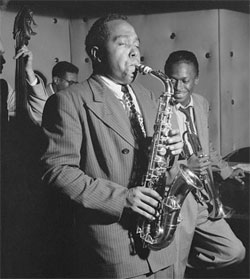
When Parker played balladsSong forms played in slow tempo., he would slow his overall pace. The embellishments surrounding his longer notes were still lightning-fast, but they tended to sound more relaxed in the slower tempo setting.
Charlie Parker's melodic improvisations over the chord changesA term musicians use to refer to chord progressions. in George Gershwin's tune Embraceable You ♫ are a case in point. As he so often did, Parker dispenses with the customary performance of the tune itself and launches into improvisation from the start. There is a strong developmental character to his improvisation here based on an initial six-note motive that is strongly reminiscent of the opening line of Herman Hupfeld's As Time Goes By ♫. Not only do we have an opportunity to hear more clearly and better comprehend Parker's improvisational style, but a rich and extraordinary melodic beauty emerges as well. Let's listen Embraceable You ♫.
Charlie Parker Quintet, Embraceable You ♫ (George and Ira Gershwin), New York, October 28, 1947. Charlie Parker, alto saxophone; Miles Davis, trumpet; Duke Jordan, piano; Tommy Potter, bass; Max Roach, drums.
Charlie Parker never lost touch with his Kansas City roots, and KayCee's bluesy sound lingers in the background of even his most blistering bebop solos. No surprise then, that Bird could compose and perform a slow bluesA genre of vocal music developed among African Americans and derived from field hollers, street cries, and gospel hymns. number such as Parker's Mood ♫. His approach is similar to his ballad style, but we hear a more blues-infused improvisation. What is perhaps surprising, given the relative simplicity of the material, is how powerful and moving the piece is — a testament to the depth and substance of Parker's artistry. Let's listen Parker's Mood ♫.
The Charlie Parker All-Stars, Parker's Mood ♫ (C. Parker), New York, September 1948. Charlie Parker, alto saxophone (as); John Lewis, piano (p); Curly Russell, bass (b); Max Roach, drums (d).



Sarah Vaughan entered the talent contest at Harlem's Apollo Theater on a dare from friends. She sang her version of "Body and Soul" and won 1st prize.
