
Learning Objectives
- Outline the social, cultural, and political impact of WWI and WWII.
- Discuss the growth of the United States as a world power.
- Describe the impact of technological advancements on the development of music in the twentieth century.
- Describe, compare and contrast the main stylistic differences of Contemporary music styles including impressionism, post-Romanticism, serialism, and expressionism.
- Summarize the changing nature and application of the concept of tonality throughout the century.
- Discuss the impact of Claude Debussy's "Prelude to the Afternoon of a Faun" in light of the Symbolist movement in literature.
- Illustrate how the Russian composer Igor Stravinsky experimented with rhythm, new instrumental combinations, and the percussive use of dissonance, and discuss the impactof these techniques on contemporary music.
- Describe the impact of Arnold Schoenberg and the Second Viennese School on 20th-century music.
- Distinguish the main stylistic differences of nineteenth- and twentieth-century composers and styles.
- Describe the musical and political impact of “national schools” of composition that developed across Europe during the 20th century.
- Explain the impact of composer Aaron Copland on American contemporary music.
- Describe the impact of Latin American composers on the larger "art music" scene and repertoire.
- Define and analyze the main differences between jazz, ragtime, and blues.
Music of the 20th and 21st Centuries (1900-Present)
Currents in the New World: United States
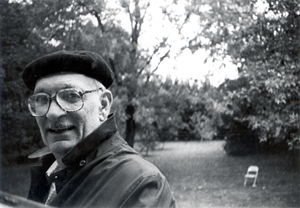
George Crumb
George Crumb studied at the Mason College of Music in Charleston, West Virginia, where he graduated with a bachelor's degree in 1950. After receiving a master's degree at the University of Illinois, Champaign, he continued his studies under Boris Blacher at the Academy of Music in Berlin from 1954 to 1955. In 1959, he received a Doctor of Musical Arts degree from the University of Michigan, Ann Arbor. Despite being a very successful composer, Crumb devoted much of his energy to teaching until he retired from the University of Pennsylvania in 1997. His students include influential composers and teachers in the contemporary American and world music scene: Margaret Brouwer, Uri Caine, Christopher Rouse, Osvaldo Golijov, Jennifer Higdon, Cynthia Cozette Lee, Yen Lu, Ricardo Zohn-Muldoon, Ofer Ben-Amots, and Gerald Levinson.
Like John Cage, Crumb calls for the insertion of objects between piano strings to achieve different timbres. However, unlike Cage, he asks for those objects to be removed and new ones inserted while playing, which calls for a whole new level of activity from the performer.
In his two sets of Makrokosmos (1972 and 1973), Crumb seemingly explores every sound possibility of the piano, inside and out. He composed Volume I in memory of Béla Bartók's Mikrokosmos, which, as you may recall, explored a wide range of technical, rhythmic, and tonal possibilities on the piano. Crumb's work requires so-called "extended techniques" that include plucking strings inside the piano, playing glissandi (sweeps of the hand) across strings, sliding a scrape along a string, as well as whistles and vocal utterances. Each of the pieces in Makrokosmos is tied to a Zodiac sign and to the initials of a person born under that sign. The two volumes are subtitled "24 fantasy pieces after the Zodiac for amplified piano."
Makrokosmos I:
Part I: I. "Primeval Sounds (Cancer)"
Part I: II. "Proteus (Pisces)"
Part III: XI. Dream Images (Gemini)"
George Crumb
In Vox Balaenae (Voice of the Whale), for three masked players (1971) Crumb typically directs the pianist to play pizzicato and produce harmonics by playing directly on instrument's strings, directs the cellist to use non-traditional scordatura tuning to extend the instrument's range, and instructs the flutist to sing and play simultaneously. Crumb writes:
Composer: George Crumb
-
"Vox Balaenae (Voice of the Whale), for three masked players"
From 1962 until 1970, much of Crumb's creative activity was centered on an extended cycle of vocal works based on the poetry of Federico García Lorca. The composer writes:
Listen to "Canción del Jinete, 1860" (Song of the Rider, 1860), a poem of violence and terror, in which Crumb feels he has "conveyed the demonic power of Lorca's imagination." His interest in exploring unusual timbres is again abundantly evident in this piece. Crumb explains:
Composer: George Crumb
-
"Songs, Drones and Refrains of Death: III. Canción del Jinete, 1860"
Composer: George Crumb
-
"Songs, Drones and Refrains of Death: III. Canción del Jinete, 1860 – Cadenza appassionata"
Composer: George Crumb
-
"Songs, Drones and Refrains of Death: III. Canción del Jinete, 1860 – Refrain 4"
de los bandoleros,
cantan las espuelas.
Caballito negro.
¿Dónde llevas tu jinete muerto?
... Las duras espuelas
del bandido inmóvil
que perdió las riendas.
Caballito frío.
¡Qué perfume de flor de cuchillo!
En la luna negra,
sangraba el costado
de Sierra Morena.
Caballito negro.
¿Dónde llevas tu jinete muerto?
La noche espolea
sus negros ijares
clavándose estrellas.
Caballito frío.
¡Qué perfume de flor de cuchillo!
En la luna negra,
¡un grito! y el cuerno
largo de la hoguera.
Caballito negro.
¿Dónde llevas tu jinete muerto?
of the highwaymen,
the spurs sing.
Little black horse.
Whither with your dead rider?
... The hard spurs
of the motionless bandit
who lost his reins.
Little cold horse.
What a scent of the flower of a knife!
In the black moon
bled the mountainside
of Sierra Morena.
Little black horse.
Whither with your dead rider?
The night spurs
its black flanks
piercing with stars.
Little cold horse.
What a scent of the flower of a knife!
In the black moon,
a shriek! and the long
horn of the bonfire.
Little black horse.
Whither with your dead rider?
As you may appreciate, Crumb's music often juxtaposes contrasting musical styles. References range from western art music to hymns and folk music to sounds of nature and non-Western music traditions. Many of his works include programmatic, symbolic, mystical and theatrical elements, which are often reproduced in beautiful and meticulously notated scores.
Recipient of the 1968 Pulitzer Prize in Music for Star-Child, a 2001 Grammy Award winner for Echoes of Time and the River, the 2004 Musical America Composer of the Year, and one of the most frequently performed composers in today's musical scene, Crumb continues to produce works that enrich the lives of those who come in contact with his profoundly humanistic art.