
Overview
Objectives
- Recall the Jamaican influences on hip-hop
- Recall the role of the DJ and the MC in early hip-hop
- Recall some of the earliest commercial hip-hop and hip-hop-influenced recordings
- Examine the role rock music played in the success of groups such as Run-DMC and the Beastie Boys
Hip-Hop Goes Mainstream continued
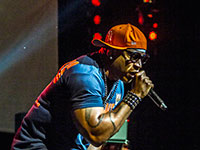
In 1984, Russell Simmons and Rick Rubin founded Def Jam Recordings, which became an important label for many hip-hop groups and still signs many successful acts in the present day. Simmons handled the business, and Rubin managed A&R and production. (Rubin produced hip-hop groups who were not signed to Def Jam as well; Run-DMC was on the Arista label, for example.) The first artist signed by Def Jam was LL Cool J, a fifteen-year-old rapper whose nickname stood for "Ladies Love Cool James.
Releases from LL Cool J such as the single "I Need a Beat ♫" (1984) and his first album, Radio (1985), put LL Cool J, Def Jam, and producer Rick Rubin on the map. Soon, Def Jam signed a distribution deal with Columbia Records, which meant that Columbia would press and distribute the recordings of Def Jam artists.
Another smash hit group produced by Rubin and signed by Def Jam was the white, Jewish rap ensemble of the Beastie Boys. In the early 1980s, Michael Diamond, Adam Horovitz, and Adam Yauch played in a punk rock band. They began experimenting with the sounds of rap, releasing an early single called "Cooky Puss ♫" (1983) and hiring Rick Rubin to DJ for their live shows. When Rubin created Def Jam with Simmons in 1984, he brought the Beastie Boys with him to his new label and produced their early singles such as "Rock Hard" (1985). In 1986, the Beastie Boys—now known as Mike D, Ad-Rock, and MCA—released their first album, Licensed to Ill. Licensed to Ill was the first hip-hop album to reach number 1 on the Billboard album charts, and it became the best-selling hip-hop album of the 1980s.
Licensed to Ill also had enormous crossover appeal with rock listeners because Rubin sampled recordings of rock musicians such as Led Zeppelin, Black Sabbath, and the Clash. Rubin also invited rock musicians to perform with the Beastie Boys. The single "No Sleep Till Brooklyn ♫" features guitarist Kerry King of Slayer playing excerpts of AC/DC’s song "TNT ♫." King also appears on "You Gotta Fight for Your Right (To Party) ♫," which is arguably the most famous song ever recorded by the Beastie Boys.
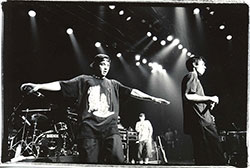
The group’s style of flow is very similar to that of Run-DMC, because the three rappers traded off individual lines and would join together on final words or the ends of phrases. The flow is rhythmically regular to the point of sounding sing-song, but the rappers’ aggressive style of delivery and overtly nasal tone provides a hard edge.
The rock-influenced sounds of early hip-hop groups such as Run-DMC and the Beastie Boys helped create crossover appeal in and commercial success for the genre. By the 1990s, hip-hop would become the best-selling genre of music on the market.

“My definition of hip hop is taking elements from many other spheres of music to make hip hop. Whether it be breakbeat, whether it be the groove and grunt of James Brown or the pickle-pop sounds of Kraftwerk or Yellow Magic Orchestra, hip hop is also part of what they call hip-house now, or trip hop, or even parts of drum n' bass.”

“How you act, walk, look and talk is all part of Hip Hop culture. And the music is colorless. Hip Hop music is made from Black, brown, yellow, red and white.”

"Joseph "Run" Simmons turned to television after the group called it quits. He and his family were the subject of an MTV reality show called, "Run's House.""
