
Learning Objectives
- Recognize the differences between the Medieval and Renaissance periods in terms of society, religion, art, science, and freedom.
- Explain how Renaissance musicians made their living.
- Use relevant musical vocabulary to analyze Renaissance a cappella singing.
- Distinguish the characteristics of Renaissance music, and differentiate between Renaissance music and Medieval music.
- Illustrate how composers used the motet, a sacred genre with a Latin devotional text, to experiment in musical style and texture.
- Describe how Renaissance composers set texts from the Ordinary of the Mass for their polyphonic Masses.
- Describe how instrumental dance music was performed by professional and amateur musicians.
Renaissance Period (1450–1600)
Instrumental Music
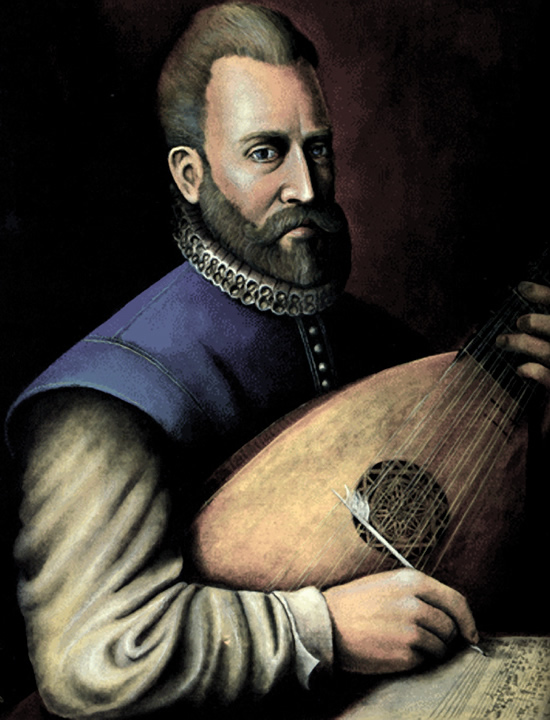
John Dowland was one of England’s leading composers for lute, and many consider him among the most important and influential musicians of the Renaissance. In addition to solo pieces, he wrote large quantities of what are known as lute songs, for voice with lute accompaniment. These songs could also be sung and played by various combinations of instruments and voices. His First Book of Songs or Ayres (1597) was the most reprinted music book of its time. Dowland worked in Paris and Germany, and from 1598 to 1606 he was lutenist to Christian IV of Denmark. In 1612, after many failed attempts (perhaps because he was a Catholic in a Protestant land), he was finally appointed as a lutenist in the court of James I of England, a post he held until his death.
The lute, bowl-shaped and without the vihuela’s guitar-like flat back, was the English counterpart to the vihuela. It was one of the most popular instruments in Europe up until the end of the 1700s. Lute music was usually written using a complex system of notation known as tabular notation or tablature, in which numbers and letters of the alphabet represented pitches through finger placement on the instrument’s neck and frets. To this day, there are many societies around the world devoted to the study of the lute, including the Lute Society of America.
As you listen to the following lute piece, dedicated by composer John Dowland to Queen Elizabeth after her death, try tapping along to feel the steady triple meter. This piece is a galliard, a dance genre typically paired with the more stately and slow pavane, which was in duple meter. This piece was not intended for dancing, however, but rather to explore the expressive and technical possibilities of the lute.
Composer: John Dowland
-
"The Most Sacred Queen Elizabeth, Her Galliard"
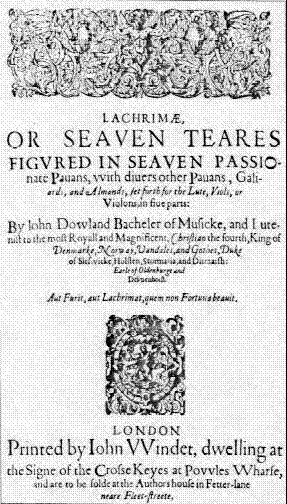
One of Dowland’s best-known compositions is the song "Flow my tears", whose theme served as the basis for the seven pavanes for five viols and lute that make up his Lachrimae or Seaven Teares Figured in Seaven Passionate Pavans, one of the most famous instrumental collections of the period.
Composer: John Dowland
-
"Lachrimae: Flow My Tears"