
Objectives
- Explain how the Classical period (1750-1825) characteristics of order, objectivity, and harmonious proportion relate to the music characteristics of the period.
- Summarize how the American Revolution (1775-83) and the French Revolution (1789-99) profoundly changed political systems and social order.
- Classify the large-scale musical forms in which the Classical masters composed.
- Explain music making in the context of the royal court and the patronage system.
- Define form and absolute music, and relate these concepts to one another.
- Differentiate between the main musical forms of the Clasical-era by summarizing the development of the symphony, sonata, string quartet, and the concerto.
- Define and analyze the symphony, sonata, string quartet, and concerto forms in the context of the Classical period.
- Describe the impact of the major Classical composers Haydn, Mozart, and Beethoven.
- Discuss the impact of Beethoven's thirty-two piano sonatas.
- Compare and contrast the two types of Italian opera: opera buffa and opera seria.
The Classical Period (1750-1820): Joseph Haydn
Two Giants of the Classical Period
What does perfection sound like? Does it even have a sound? Is there such a thing as perfection in an art form that, by its very nature, is asymmetrical? How do you express beauty in music?
There are, of course, no definitive answers to these questions. If we were, however, to begin a quest for answers, the first place to search would be the music of Franz Joseph Haydn and Wolfgang Amadeus Mozart, two great masters of the Classical period.
These composers and their music have a lot in common. For a time, both lived in Vienna, composed in all of the major genres, and expressed an indefinable element of charm or even whimsy in their works. Yet, in other respects, they could not have been more different. One was a venerated gentleman, the other an impudent young man. One held a long, prosperous position with a respected music-loving aristocratic family, the other suffered through tremendous financial ups and downs, partly incurred by his own mismanagement. One was a self-made musician who lived to the ripe age of 77, the other a child prodigy who died at 35. Together they wrote the greatest music of the Classical age and, thus, are considered by many to be two of the greatest composers the world has ever known.

What does perfection sound like? Does it have a sound? Is there such a thing as perfection in an art form that, by its very nature, is asymmetrical? How do you express beauty in music?...

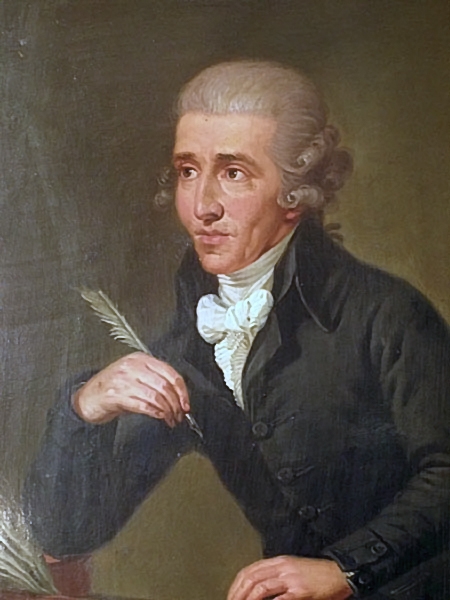
Franz Joseph Haydn (1732-1809)
Franz Joseph Haydn was born in a small Austrian village called Rohrau. While growing up he honed his ear by listening to the folk songs and dances of the village and studying music with his uncle. When he moved to Vienna to be in the choir of St. Stephen' s Cathedral, he began a career that slowly moved him through the ranks of Vienna' s musical circles. After being dismissed from the choir, he obtained a harpsichord and taught himself to play, taking musical jobs whenever they appeared. Soon he made a name for himself playing with Viennese musicians, sometimes on violin in street bands. In 1761, his hard work paid off when he was offered a position with the Esterházy family, a rich and powerful Hungarian noble family known for their patronage of the arts. Haydn held this position until 1790. After that, with his name firmly established, he was able to live a fruitful, independent life, composing well into his seventies.
Haydn was venerated by most of his musical contemporaries; Beethoven moved to Vienna in 1792 in part so that he could study composition with the master. And though the younger man was too impetuous to take instruction, Haydn's music left a strong mark on Beethoven' s style. His contemporaries gave him the nickname Papa Haydn, referring to the man' s approachability and sense of humor rather than to any paternal simplicity in his music.
Haydn's Musical Accomplishments
Haydn, more than any other single composer, is responsible for standardizing Classical forms. His symphonies (which number over 100) and his string quartets became formal models for those who followed. Haydn also created the foremost examples of the Sturm und Drang (storm and stress) period in German/Austrian arts. His choral works (primarily his numerous Masses and two late oratorios) are the first true synthesis of religious text and Classical form.
Haydn first made a name for himself through his symphonies and string quartets. These works are predominantly in the sonata-cycle four movement structure, following the Fast/Slow/Dance/Fast pattern of movements. Let' s listen to a Haydn symphony, and see what it tells us about his music.
His Symphony No. 94, one of the London Symphonies, was written in 1792 during one of two extended stays in that city. This symphony is nicknamed the Surprise because of Haydn' s use of a sudden fortissimo burst shortly after the beginning of the second movement. It is characteristic of Haydn to include little musical jokes in his works, as if he is winking at us through the musical score. Here is the work in its entirety, movement by movement, with a synopsis of each movement' s form and key. Listen for other little musical jokes throughout the symphony:
"Symphony No. 94 "Surprise""Franz Joseph Haydn (1732-1809)
Composer: Franz Joseph Haydn
-
"Symphony No. 94 in G Major, Hob.I:94, "The Surprise": II. Andante"
| Movement | Key | Form |
| I | G major | Sonata-allegro with introduction |
| II | C major | Theme and Variations |
| III | G major | Minuet and Trio |
| IV | G major | Sonata-allegro form |
Composer: Franz Joseph Haydn
-
"Symphony No. 94 in G major, Hob.I:94, The Surprise: IV. Finale: Allegro molto"
Composer: Franz Joseph Haydn
-
"Symphony No. 94 in G Major, Hob. I:94 "Surprise": III. Menuetto: Allegro molto"
Haydn's string quartets are, in some ways, miniature versions of the symphonies, using the same formal structures and thematic devices. However, the quartets represent the first masterpieces in this new genre. Chamber music was not new; the sonata da camera and sonata da chiesa of the Baroque are early forerunners of the quartet. The string quartet, however, presented chamber music with a homogenous sound, with no winds, continuo, harpsichord, brass or percussion instruments for variety. These works rise or fall on musical merit alone. They are to instrumental music what a cappella choral music is to vocal music.
The slow movement of the String Quartet Op. 76, No. 6, written in 1797, shows the maturity of Haydn' s late Classical style, where he uses harmonic colors that have more in common with the Romantic period than with the Classical era. It displays an emotional expressiveness in direct contrast to the detachment of most Classical music. This emotion was probably inspired by the same sources as Haydn' s earlier Sturm und Drang period. During his Sturm und Drang period, Haydn produced subjective, highly emotional works such as the Symphony No. 44 in E Minor, also known as the Trauer (Mourning) symphony.
Composer: Franz Joseph Haydn
-
"String Quartet Op. 76, No. 6"
Composer: Franz Joseph Haydn
-
"Symphony No. 44 in E Minor"
Haydn's string quartets are, in some ways, miniature versions of the symphonies, using the same formal structures and thematic devices...
Haydn also made a significant contribution to choral music. While in London, he wrote six Masses that form the greatest body of work in Mass settings since the works of Palestrina. Also in London, Haydn became acquainted with Handel' s oratorios. At a performance of the Messiah in 1791 at Westminster Abbey, Haydn is purported to have burst into tears after the Hallelujah chorus exclaiming, He is the master of us all! Haydn returned to the continent and composed two oratorios, The Creation and The Seasons in which he created a powerful, personal synthesis of oratorio style and Classical form.
It is characteristic of Haydn to include little musical jokes in his works, as if he is winking at us through the musical score...
Haydn's Musical Style
We have discussed Haydn' s use of humor, as well as the deep emotion that often emerges from his work. Moments, such as the finale to the Surprise Symphony, contain brief passages that probably provided great joy at the work's premiere. We can imagine him sitting back, waiting for a harmonic twist, a surprising entrance or dynamic change that only he knew was coming.
To focus only on the mischievous qualities of his music, however, is to ignore the bigger picture. Haydn's immense skill and imagination enabled him to adapt his own personal style to the strict demands of Classical form. He purposefully used melodic themes, such as this one from the Symphony No. 44, which could be easily divided into musical theme-lets that, in turn, could be developed later within the same piece. Bach had already used the 'theme-let' in some of his works, and Beethoven later perfected the process.
Haydn's immense skill and imagination enabled him to adapt his own personal style to the strict demands of Classical form...



