
Objectives
- Explain how the Classical period (1750-1825) characteristics of order, objectivity, and harmonious proportion relate to the music characteristics of the period.
- Summarize how the American Revolution (1775-83) and the French Revolution (1789-99) profoundly changed political systems and social order.
- Classify the large-scale musical forms in which the Classical masters composed.
- Explain music making in the context of the royal court and the patronage system.
- Define form and absolute music, and relate these concepts to one another.
- Differentiate between the main musical forms of the Clasical-era by summarizing the development of the symphony, sonata, string quartet, and the concerto.
- Define and analyze the symphony, sonata, string quartet, and concerto forms in the context of the Classical period.
- Describe the impact of the major Classical composers Haydn, Mozart, and Beethoven.
- Discuss the impact of Beethoven's thirty-two piano sonatas.
- Compare and contrast the two types of Italian opera: opera buffa and opera seria.
The Classical Period (1750-1820): The Culmination of Form
The Concept of Form
Poise, beauty, elegance, grace, and organization characterize Classical music. These features reflect a desire to create works that are balanced and well constructed. Musical form was particularly important during the Classical era.
You will recall that earlier we defined form as the overall construction of a piece of music. We looked at three basic forms:
- The binary form (or AB).
- The ternary form (or ABA).
- The rondo (usually ABACA or ABACABA).
These forms clearly illustrate the concepts of unity and variety.
As an example, let's go back to the 2nd movement from Beethoven's Pathétique piano sonata. Here it is, in its entirety, followed by each of the sections separately:
"Pathétique Sonata Op. 13"Ludwig van Beethoven (1770-1827)
Composer: Ludwig van Beethoven
-
"Piano Sonata No. 8 in C Minor, Op. 13, "Pathetique": II. Adagio cantabile"
A section
Composer: Ludwig van Beethoven
-
"Piano Sonata No. 8 in C Minor, Op. 13, "Pathetique": II. Adagio cantabile" [ 00:00-01:02 ]01:02
B section
Composer: Ludwig van Beethoven
-
"Piano Sonata No. 8 in C Minor, Op. 13, "Pathetique": II. Adagio cantabile" [ 01:03-01:50 ]00:47
A section returns
Composer: Ludwig van Beethoven
-
"Piano Sonata No. 8 in C Minor, Op. 13, "Pathetique": II. Adagio cantabile" [ 01:50-02:20 ]00:30
C section
Composer: Ludwig van Beethoven
-
"Piano Sonata No. 8 in C Minor, Op. 13, "Pathetique": II. Adagio cantabile" [ 02:20-03:09 ]00:49
A section returns (altered)
Composer: Ludwig van Beethoven
-
"Piano Sonata No. 8 in C Minor, Op. 13, "Pathetique": II. Adagio cantabile" [ 03:10-05:01 ]01:52
Notice that Beethoven achieves unity by repeating the A melody several times. The B and C sections introduce variety through different harmonic and rhythmic structures. It's very interesting to hear the subtle rhythmic difference between the melody in the first two A sections, and its last appearance in the A section. Here, Beethoven was able to use unity and variety simultaneously!

Musical form was particularly important during the Classical era...

How Harmony Affects Form
Regarding the relationship between harmony and form, there are some important points to take into consideration:
- A piece of music usually establishes a key that is called the tonic.
- The composer may change keys, or modulate, but will usually return to the tonic.
- Some keys are closely related to the tonic, while others are distant. The dominant (for a major key) or the relative major (for a minor key) are closest to the tonic.
- The psychological effect of harmonic motion is to create a sense of departure and return in a piece of music.
These harmonic principles guide the direction of the music within a single movement, as well as between the movements of a larger work. For example, if a movement begins, say, in the key of C major, it will move away from that key, arriving at a closely related key (maybe G major) at an important formal point in the piece. At a later point, maybe after several modulations, it will return to the original key of C to end the movement.
If the piece is a multi-movement work (such as an opera, oratorio, or symphony), the second movement may be in a different key than the first. Subsequent movements may also be in different keys, while internally always returning to their own tonics. But the final movement of the work will almost always be written in the original tonic key. Here is a layout of the keys for the four movements of Mozart's famous serenade, Eine Kleine Nachtmusik. Note that Mozart begins and ends the work in the same key:
| MOVEMENT | Tonic Key | Other keys used prominently |
| 1st | G major | D major (dominant of G) |
| 2nd | C major | G major (dominant of C) |
| 3rd | G major | D major (dominant of G) |
| 4th | G major | D major -G minor |
The Classical Forms
Baroque sonatas went through a transformation during the middle of the 18th century. Eventually, though the term sonata came to cover several types of music, what is common to all the types is the sonata form, the Classical period's most important contribution to music.
The sonata form is a musical organizational device that may be used to construct symphonies, concertos, or sonatas. Eventually the structure became so powerful that some composers used the basic principles of sonata form in all of their works. Those principles are:
- The alternation or opposition of two main themes.
- The concept of departure and return repeated over the course of a large work.
Sonata-Allegro form is usually comprised of three sections: They are: exposition, development, and recapitulation. The exposition begins in the tonic key and presents the main musical ideas of the composition. There may be many themes in an exposition, but usually there are two: a main, and a secondary. The main theme is presented in the tonic key, and the second theme in the dominant key (a fifth above the tonic) or in the relative major (if the main theme is in a minor key). In the development section the composer usually explores many different keys and works with the musical elements presented in the exposition. The recapitulation reverts to the material from the exposition with one very important difference: the material that was presented in a second key in the exposition is now presented in the tonic key. That way, the composition ends in the home key, and the work can have a sense of coming to a full, satisfying conclusion.
The first movement of a large Classical work is usually built in sonata-allegro form, the most crucial of the Classical forms. To illustrate this form, we will be listening to the first movement of Mozart's famous Symphony No. 40 in G minor.
"Symphony No. 40 in G minor (1st. Movement)"W. A. Mozart (1756-1791)
Composer: Wolfgang Amadeus Mozart
-
"Symphony No. 40 in G Minor, K. 550: I. Molto allegro"
Exposition
Composer: Wolfgang Amadeus Mozart
-
"Symphony No. 40 in G Minor, K. 550: I. Molto allegro" [ 00:00-03:45 ]03:44
Development
Composer: Wolfgang Amadeus Mozart
-
"Symphony No. 40 in G Minor, K. 550: I. Molto allegro" [ 03:46-04:56 ]01:09
Recapitulation
Composer: Wolfgang Amadeus Mozart
-
"Symphony No. 40 in G Minor, K. 550: I. Molto allegro" [ 04:55-07:47 ]02:52
The exposition is the first section in the movement. In the exposition, the composer states two contrasting themes in separate keys, and at least two secondary themes. Often the exposition is repeated once before moving on. Mozart's G minor Symphony opens with an intensely dramatic theme presented by the strings, leading to a gentler secondary theme shared with the woodwind. The development traces the opening figure through various keys and introduces a strong contrapuntal element. Reached through a descending woodwind sequence, the recapitulation completes the movement, with the second theme now assuming particular poignancy in the minor key.
You can see and hear that the concepts of departure and return are very important in sonata form. We leave the tonic, move through a dramatic development section, and return to the original theme and key. As we move through the piece, the conflict between the two themes of the sonata-allegro form and the sense of departure/return become vital tools used by the composer to infuse the music with emotional vitality.
The conflict between the two themes of the sonata-allegro form, and the sense of departure/return become vital tools used by the composer to infuse the music with emotional vitality...
The Sonata Form Genres
Three genres that used the sonata form emerged in the Classical period: the symphony, sonata and concerto. (Note that some genres of chamber music, such as the string quartet, use the same formal structure as the symphony). Here they are described with the traditional movements listed as they most often appear. The underlying departure and return principle of the sonata form may be found in any of the keys, tempos, and forms of the separate movements of these genres.
(T&V = Theme and Variations)
| Movement |
SYMPHONY
|
SONATA
|
CONCERTO
|
|
| 1st movement | Form | Sonata-allegro | Sonata-allegro | Modified sonata-allegro |
| Key | Tonic | Tonic key | Tonic key | |
| Tempo | Fast | Fast | Fast | |
| 2nd movement | F | ABA form or T&V | ABA form or T&V | ABA form or T&V |
| K | Ton. or rel. key | Ton. or rel. key | Ton. or rel. key | |
| T | Slow | Slow | Slow | |
| 3rd movement |
F
|
Minuet & Trio or scherzo | Sonata-allegro or rondo form | Modified sonata-allegro or rondo |
| K | Related key | Tonic | Tonic key | |
| T | Dance triple meter | Fast | Fast | |
| 4th movement | F | Sonata-allegro or rondo | Not Applicable | N/A |
| K | Tonic | N/A | N/A | |
| T | Fast | N/A | N/A |
Thematic Development
We have seen that composers have always used musical themes to give unity to a piece of music. You may recall, for instance, that Bach's fugues made use of three or four subjects (or themes) and counter-subjects. What was not mentioned earlier, however, is that Bach would frequently manipulate the themes in different ways to give himself more musical material with which to work. For example, a theme might later be presented backwards (retrograde), or upside-down (inversion), or both (retrograde inversion). Here is a short melody by Bach and how it might look in each of those guises:
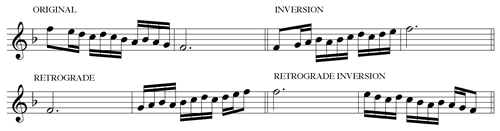
The process of taking a theme and reshaping it into different musical entities is called thematic development.
Perhaps the most famous theme in all of music is the powerful four-note theme that Beethoven employs to open the first movement of his 5th symphony. Through thematic development, the entire exposition that follows is based on those opening four notes. Then, in a stroke of pure genius, Beethoven extends the original theme by adding two notes and giving it to a solo French horn. He then turns this extension around (retrograde) and this, with a slight change, becomes the second theme:
Composer: 0
-
"powerful four-note theme"
Composer: 0
-
"powerful four-note theme" [ 00:43-00:47 ]00:04

What Beethoven achieved here was one of the monumental moments in music history: an entire symphony that is based on one, terse, powerful theme. This is thematic development at its best.



