
Learning Objectives
- Learn the order of sharps in a sharp key signature.
- Identify the keys indicated by sharp key signatures.
- Learn how to build a key signature that uses sharps.
Key Signatures II: Sharp Keys
Sharp Key Signatures
The sharps in a sharp key signature always appear in the same positions on the staff. The example below shows the pattern of sharps in the treble and bass clefs (click "Show Me"). Take a moment to memorize this pattern. You might visually group the sharps into a set of two, a set of three, and another set of two (with the groups slanting down to the right).
Order of Sharps
| The order of sharps |
The order of sharps in a sharp key signature is always F C G D A E B. This means that the first sharp in a key signature is always F#, the second is always C#, and so on. You cannot reorder the sharps in a key signature or start on anything but F#. You might want to use a mnemonic device to remember the order of sharps, such as "Fit Charlie Gets Dinner After Exercising Body" or "Fat Cats Go Down Alleys Eating Birds." (Some other possibilities are listed here.)
| Remember |
|
The Seven Sharp Major Keys
There are seven major keys that use sharps: G major, D major, A major, E major, B major, F-sharp major, and C-sharp major, displayed in the chart below. Many musicians have these key signatures memorized. The chart begins with C major, allowing you to see entire progression from C major, which has zero sharps, to C-sharp major, which has all seven sharps. Note particularly how sharps are added in the order F C G D A E B as you move through keys with more and more sharps.
Name
Scale
Sharps
Key Signature
Listen
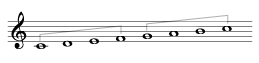
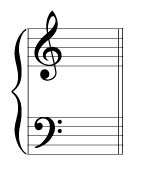
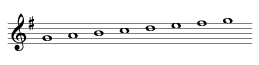
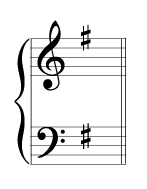
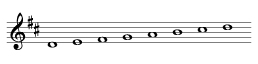
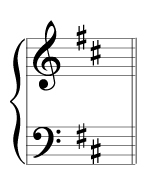
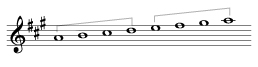
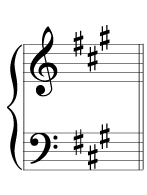
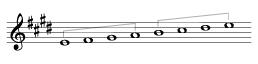
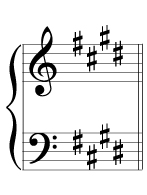
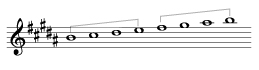
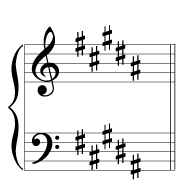
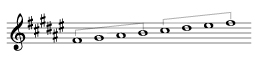
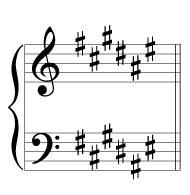
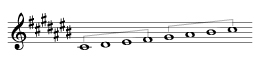
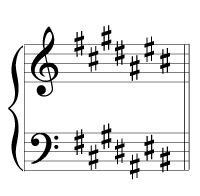
Take a moment now to practice playing the major scales with sharps on the virtual piano below.
Click this small keyboard icon below.

Keyboard x
Identifying Sharp Major Key Signatures
If you would rather not memorize all of the sharp major key signatures, there is another quick and simple way to identify them. Looking again at the chart above, you will note that in each case the last sharp in the key signature is always the leading tone (scale degree 7) in the scale. The tonic (which is the also name of the key) is a half step above the leading tone. For example, the last sharp in the key signature for G major is F#, which is a half-step below G. The last sharp in the key signature for D major is C#, which is a half step below D. And so on. Therefore, in order to identify a sharp major key signature, you can just think up a half-step from the last sharp.
| Remember |
|
Click "Show Me" to see this rule illustrated for the key of A major. Since the last sharp in the key signature is G#, the key signature represents the key of A (the tonic A is a half step above the leading tone G#). After seeing the animation, you can click on the keyboard, the sharps in the key signature, the notes on the staff, or the scale degree numbers to see how all of these elements interact.
Identifying sharp key signatures
Building a Sharp Major Key Signature
To build a major key signature with sharps you can follow these three simple steps:
- Identify the name of the key for which you want to build a key signature, and go to the sharp that is a half step below that note.
- In the order of sharps (F C G D A E B), add all of the sharps up to the sharp you identified in the previous step.
- Build a key signature that includes those sharps and follows the correct order and placement of sharps.
For example, to build the key signature for A major:
- Find the sharp that is a half step below A: G#.
- Add all the sharps up to that point: F#, C#, and G#.
- Build the key signature following the correct order and placement of sharps:
Notation Practice
One good way to learn about key signature is to practice writing them out. Print out the Key Signature Practice Sheet to practice tracing the sharp key signatures described in this lesson. Then, on the blank staves, practice writing out some sharp key signatures on your own. Remember that the accidentals must be in the proper order and position on the staff. Don't worry about tracing the flat key signatures yet. We will discuss them next.