
Overview
As bop continued to evolve, so, too, did the styles and tastes of musicians. While some musicians looked back to more traditional styles of jazz, others continued to explore the new possibilities of modern jazz. This section covers the birth of a new style labeled cool jazz, whose practitioners cultivated a variety of approaches and sounds, even though they all leaned toward an aesthetic of emotional restraint and understatement. We will learn how Miles Davis, Chet Baker, Bob Brookmeyer, Stan Kenton, Lennie Tristano, Stan Getz, and Gerry Mulligan contributed to the beginnings of Cool Jazz.
Objectives
Upon completion of this lesson, you will be able to do the following:
- Identify notable musicians who contributed to cool jazz
- Understand how cool jazz evolved
- Recognize the related style of West Coast jazz
- Appreciate the Modern Jazz Quartet’s role in pioneering third-stream jazz
Lennie Tristano & Lee Konitz
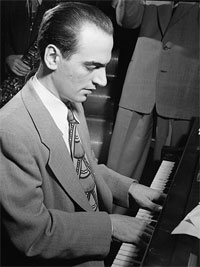
Lennie Tristano (1919-1978) was a pianist, composer, and teacher who developed an alternative to bop that drew upon the style of Lester Young, as well as that of Johann Sebastian Bach. Born and raised in Chicago, Tristano was blinded by the flu as an infant. He grew up studying piano as well as various wind instruments and attended the American Conservatory in Chicago, graduating with his bachelor's degree in 1943.
Tristano performed in and around Chicago and taught jazz privately before relocating to New York in 1946. He is best remembered for his early collaborations with his students, notably alto saxophonist Lee Konitz, a fellow Chicagoan who relocated to New York to continue his studies with Tristano.
Lee Konitz (b. 1927) played alto saxophone in the Tristano quintet. (Konitz also played in Davis' Nonet ♫.) He had studied clarinet from an early age before making the switch to saxophone. By age 20, he had developed extraordinary technical facility and was considered by many the only one who could rival Charlie Parker in speed and agility.
In January 1949, several months before the Miles Davis-Gil Evans recording sessions, the Lennie Tristano Quintet was recording cool jazz of another variety (elements of which would be absorbed with bebop into the straight-ahead sound of 1950s hard bop). Of all the varieties of "cool" to emerge around this time, the Tristano-Konitz collaboration is arguably the most closely aligned with bebop. Detailed, intricate improvisatory lines — while not as jagged and rhythmically start-and-stop as bop — convey a bop-like allegiance to a modern concept of harmony. And yet, it's cool! Let's listen now to the Lee Konitz tune — one of his personal favorites — Subconscious Lee ♫.
The understated qualities of this piece — notably, the lightness of Arnold Fishkin's bass, and drummer Shelly Manne's use of brushes — disguise considerably its radical elements. Granted, it's a 32-bar song form, which is quite customary. But one has to listen carefully even to hear the form. The tempoA term that refers to how quickly the beats pass in a piece of music. is a racing 240 beats per minute, yet it sounds almost relaxed. The key elements of innovation, though, are in the melodic and harmonic construction. In the same way that bebop ushered in modern jazz, Subconscious Lee ♫ probes further, expanding the tonal boundaries and links between melody and harmony with still more chromatic extensions.
After a thoroughly captivating initial chorus (0:00-0:32), we are treated to a succession of full-chorus solos from Tristano on piano (0:32-1:02), Bauer on guitar (1:03-1:33), and Konitz on alto sax (1:33-2:04). All three are virtuosos, and each explores the implications of this fresh musical terrain in ways that suggest a strong collective understanding.



