
Learning Objectives
- Learn the importance of completing each measure with the correct number of beats.
- Examine the function of beams in visually grouping adjacent flagged notes into patterns that indicate the location of the beat.
Meter IV: Beaming
Completing the measure
No matter what time signature is used, each measure in a musical composition must contain a combination of notes and/or rests that completes the measure. For example, in four-four meter, every measure must contain the equivalent of four quarter notes. Any combination of notes and rests can be used as long as that combination adds up to but does not exceed the value of four quarter notes.
| Remember |
|
Here are some possible rhythms in four-four meter. Note that there are four quarter notes (or the equivalent) in every measure. You can verify this by listening to the example and counting to four in each measure. (The rhythms are notated here on a one-line staff, a type of staff which does not indicate pitch. Instruments that are primarily used to play rhythm parts, such as the snare drum, may use a one-line staff.)

Here are some more rhythms in four-four meter. In this example, eighth notes and sixteenth notes have been included as well. Again, each measure contains the equivalent of four quarter notes. But now there are a lot of flagged notes and the location of the beat is visually not quite as clear. In order to improve the legibility of this example, we can convert those flags into beams.

Beams
Adjacent notes with flags (such as the two pairs of eighth notes in the first measure) can be joined together with horizontal lines called beams. Notes that do not have flags (such as the two quarter notes in the first measure) cannot be beamed together. The example below has been entirely rewritten using beams. Carefully compare this example with the version using flags above. These two examples would sound the same (you can verify this by listening to them both). Which one is easier to read?

The principal purpose of beams is to more clearly indicate the location of beats within the measure. Notice how each beamed group in the example coincides with the beginning of a beat (as illustrated by the dotted lines in the example given below). Only notes that belong to the same beat can be beamed together. You would not normally permit a beam to cross over the boundary from one beat to the next. Beaming enhances score legibility, making it easier for musicians to see the beats and to keep their place in the music.

Since the beat in this example is a quarter note, the eighths are beamed together in sets of two and the sixteenths are grouped in sets of four. (If the beat were a half note, then eighths would be grouped in fours and sixteenths would be grouped into sets of eight.)
You can also beam together notes that have different durations. For instance, in the last measure of the example above, eighth notes and sixteenth notes are beamed together. In mixed groups such as these, the main thing to remember is that the number of beams touching the stem determines the note value. For example, when an eighth note is beamed together with two sixteenth notes, only one beam touches the eighth note, while two beams touch the two sixteenth notes. Basically, the number of beams equals the number of flags that the note would normally have (one beam = one flag, two beams = two flags).
| Remember |
|
Incomplete Beams
In some cases it is necessary to use an incomplete beam to group together pitches with mixed durations. For example, here a sixteenth note (with two beams touching the stem) is followed by an eighth note (just one beam) followed by a sixteenth (two beams). The incomplete beams do not extend all the way to the eighth note.

This particular rhythmic figure is a type of syncopation, because it puts a longer note (the eighth note) into a weak position, creating a slight emphasis (or accent) on the off-beat. Syncopation is common in jazz, rock, and popular music because it creates rhythmic drive and energy.
Example
One of the earliest styles of music to use syncopated rhythms was ragtime. The opening of the Maple Leaf Rag by Scott Joplin (1868-1917) makes extensive use of syncopated rhythms, and illustrates several aspects of the use of beams. (Be sure to listen to the example first.)
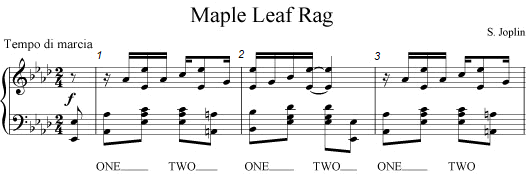
- The two-four time signature indicates that there will be two quarter note beats in each measure.
- The eighth notes beamed together in pairs in the left hand accompaniment (the bass staff) clearly show where the two beats of each measure occur (marked ONE_ TWO_ in the example).
- Beams never cross over a beat or a barline. Each beat in the measure starts a new beam
- The beams in measures 1 and 3 of the melody line (in the treble staff) begin after an initial rest on beat ONE, illustrating how beams are never connected to rests.
- The syncopated sixteenth-eighth-sixteenth figure in measures 1 and 3 of the treble staff is beamed together as beat TWO, with incomplete beams touching the sixteenth note stems only.
- The four sixteenth notes at the beginning of measure 2 are beamed together as beat ONE (with the last note being tied to beat TWO; we will discuss ties in the next lesson).
Now, compare the beamed version of the opening of the Maple Leaf Rag—as Joplin wrote it—with the unbeamed version below. Notice how much harder it is for the eye to group the different note values into beats. Again, this version would sound the same, but it is much more difficult to play.

Maple Leaf Rag
Missed Image:"Maple Leaf Rag"