Learning Objectives
- Examine how the duration of a note may be extended by using a tie.
Rhythm VI: Ties
Ties
A tie is a curved line that extends the duration of a note by combining its duration with the duration of the note that comes next. When two notes of the same pitch are tied, only ONE note is heard; the second note is NOT sounded separately. The total duration of the tied notes is equal to the sum of their durations, as illustrated in the following animation:
Ties
| Remember |
|
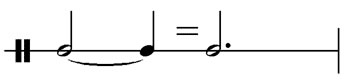
In some cases, tied notes can be rewritten as dotted note values. For example, a half note tied to a quarter note could be rewritten as a dotted half note (as illustrated below). Both would sound the same since they each contain the equivalent of three quarter notes.
Tying Notes over the Barline
One of the most common uses of ties is to allow a note to continue over the barline. For example, in the excerpt below (the theme from the 1970 movie Love Story), the half note in measure 7 is tied to the quarter note in measure 8, creating a sound that lasts for three beats, allowing the note to continue beyond the end of the measure. The same duration could be spelled as a dotted half note, but this duration would NOT fit into measure 7. Also, the half notes tied to the eighth notes in measures 1 and 4 could not be spelled as a simple dotted note. The only way to create this particular duration (lasting five eighth notes) is to tie two notes together (a half note and an eighth note).

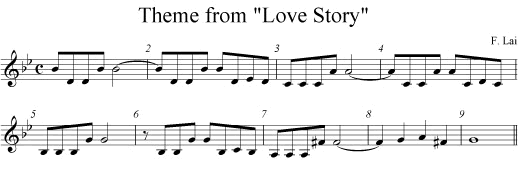
Note that ties should be drawn from notehead to notehead (not from stem to stem), and can be drawn above the noteheads (as in measure 1) or below them (as in measure 7). The direction of the tie is normally chosen to avoid collision with the stems. Rests are never tied together.
An Example
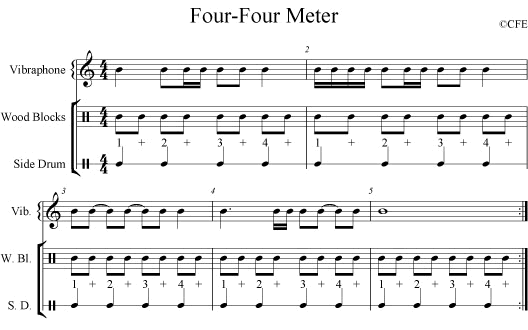
In this example, three rhythm instruments—one pitched and two unpitched—play a short passage in four-four meter. The side drum (on the bottom staff) plays steady quarter notes throughout, representing the beat. The wood blocks play the subdivision of that beat with steady eighth notes. The vibraphone plays a rhythm that uses a variety of note values, including dotted notes and ties, over the foundation laid down by the other instruments. As you listen, note particularly that the second pitch in each tied group is not sounded separately. Only the first note is heard.