
Learning Objectives
- Relate the social, cultural, and political background during the Medieval period (500-1450) to the function of music during this time.
- Characterize the music of the early Christian church, i.e., Gregorian chant.
- Describe the difference between the Proper and the Ordinary of the Mass.
- Examine the influence of the Cathedral of Notre Dame as a center for organum in medieval music.
- Describe the differences between troubadours and trouvères in medieval secular music.
- Trace the rise of secular polyphonic chansons set to fixed text forms (rondeau, ballade, virelai) in the French Ars nova.
- Define and classify the instrumental music of the medieval period.
- Trace the four major developments that took place in Western music during the Middle Ages: the development of pitch and rhythmic notation; the transition from monophony to polyphony; the initial stages of regularly metered music; and the development of the motet and instrumental music.
Medieval Period (476–1450)
Medieval Music: A First Look
Music Theory in the Early Middle Ages
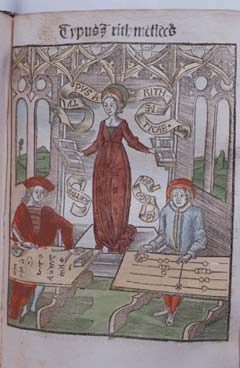
Anicius Boethius (c. 480-524), a Roman philosopher, and later Guido d'Arezzo (c. 1000–1050), an Italian monk, were the first Medieval thinkers to write about the theoretical foundations of music. Boethius's major essay, De institutione musica (Fundamentals of Music), delineated the Greek theory of music. The Greeks had established music, its systems and pitch interactions as a series of mathematical relations upon which scales are built. In the same tradition, Boethius viewed, studied, and researched music primarily as an abstract science. Guido d'Arezzo wrote the Micrologus, a work that documented musical principles essential to the later development of polyphony. The concepts of rhythmic as well as melodic independence of the voices, and the possibility of adding two or more tones to each tone in the original plainsong were, and continue to be, essential to the foundation of musical theory.
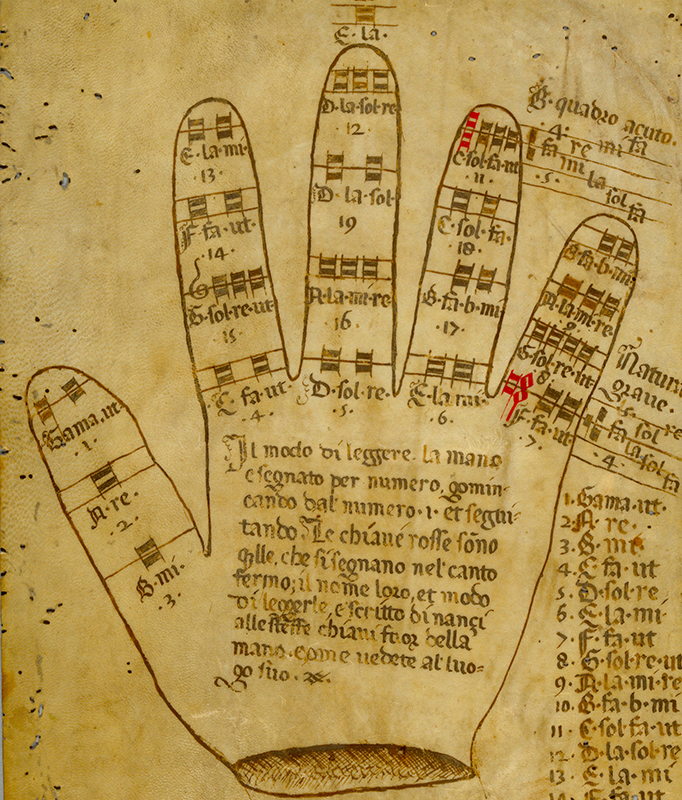
Guido d'Arezzo also invented the Guidonian Hand, a system that made possible the memorization and written transmission of melodies and helped musicians locate the pitches of the musical scale. One of the most important musical theorists of the Middle Ages, d'Arezzo is further credited with adding a fifth line to the musical staff and with the invention of the system of solmization using the syllables ut, re, mi, fa, sol, la. This system is still used, though "ut" is called "do," and the seventh syllable "ti" has been added. As a result of these important developments, musicians could read and perform a piece of music without having to listen to it first.
Musical Characteristics
Form
- In chant, the music followed the words. Many chants were responsorial, which meant that a solo portion was followed by a choral answer.
- Some secular songs had multiple verses (strophes) and were therefore called strophic.
- Imitation was frequently used (for example, in canons or rounds).
- Secular songs of the later Middle Ages often followed poetic forms.
Melody
- Melodies were limited in range, usually not more than an octave.
- Motion was primarily conjunct.
Rhythm
- Chant rhythm was free, allowing the words to determine note duration.
- Secular music used dance rhythms, in both triple and duple meter.
- Polyphonic sacred music used fixed rhythms that were increasingly specific and complex.
Harmony
- Medieval music sounds different to our ears because it is based on modes, not our familiar major and minor scales.
- In medieval polyphony, the movement of independent voices determined the harmony.
Texture
- Chant was monophonic.
- Secular songs were often monophonic, later polyphonic.
- While monophonic chant continued, sacred music also came to include polyphony.
- In secular song, instruments often doubled the voice parts.