
Learning Objectives
- Relate the social, cultural, and political background during the Medieval period (500-1450) to the function of music during this time.
- Characterize the music of the early Christian church, i.e., Gregorian chant.
- Describe the difference between the Proper and the Ordinary of the Mass.
- Examine the influence of the Cathedral of Notre Dame as a center for organum in medieval music.
- Describe the differences between troubadours and trouvères in medieval secular music.
- Trace the rise of secular polyphonic chansons set to fixed text forms (rondeau, ballade, virelai) in the French Ars nova.
- Define and classify the instrumental music of the medieval period.
- Trace the four major developments that took place in Western music during the Middle Ages: the development of pitch and rhythmic notation; the transition from monophony to polyphony; the initial stages of regularly metered music; and the development of the motet and instrumental music.
Medieval Period (476–1450)
Social, Cultural, and Political Background
For the most part, historians agree that the Middle Ages (also known as the Medieval period) began with the fall of the Western Roman Empire in 476 and lasted until the middle of the 15th century.
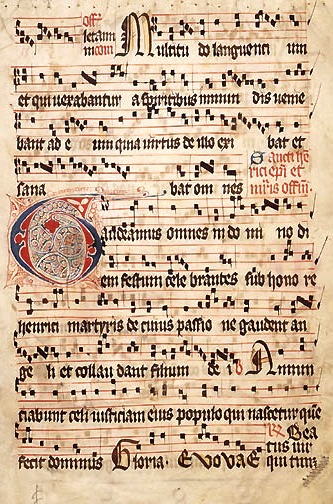
The piece you just listened to, "Laudate deum" ("Praise God"), comes from a body of work known as Gregorian chant. Gregorian chant was named for Pope Gregory I (papacy 590–604), who was long credited with composing the chant but is now considered by most scholars to be the one who organized and codified it as part of a general standardization of Roman Catholic worship. All across the far-flung regions of the former Roman Empire, chants like "Laudate deum" served to unite populations under the common banner of Christianity.
In the early years of the Middle Ages (from roughly the 5th century to the 11th century), the Christian Church was one of the few unifying forces in the Western world. Christianity originated during the 1st century in the Roman province of Palestine, which comprised parts of modern-day Israel, Jordan, and Syria, and it spread quickly to other parts of the Roman Empire. It became the leading religion of the Roman Empire under Constantine in the early 4th century and survived the fall of the Western Roman Empire some 150 years later.
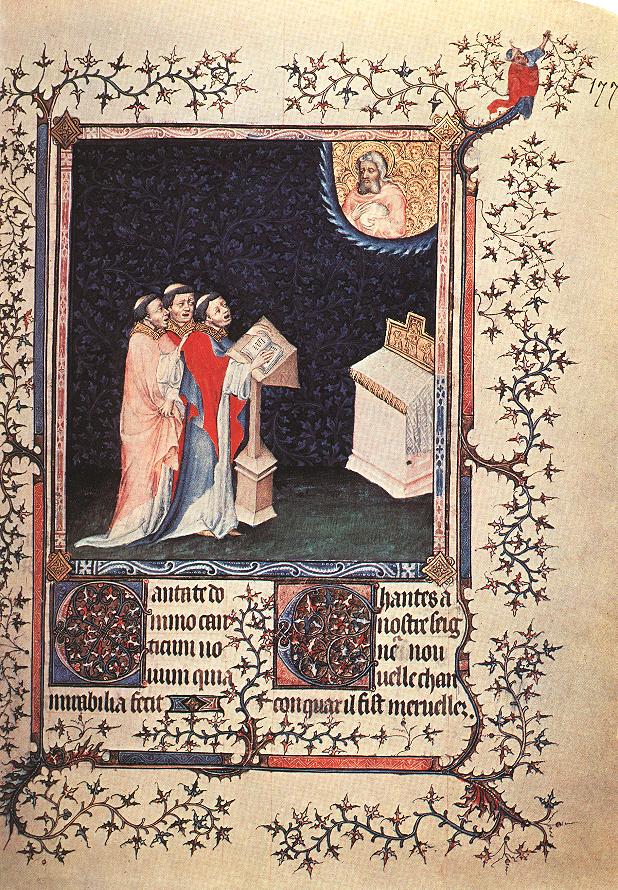
With the rise of Christianity came the establishment of monasteries and their corresponding communities of monks. Monks spent a significant amount of their time in repentance, prayer, and, later on, in scholarly pursuits. The abbeys of the Middle Ages served as retreats for scholars and safe haven for people trying to escape the ravages of famine, war, and the bubonic plague—described by writers of the time as the "Great Mortality"—that scoured Europe during the 14th century, and thus became the primary educational centers of the time. Monasteries and abbeys were crucial to the preservation of knowledge and the development of a written musical tradition. In rooms known as scriptoria (sing. scriptorium), monks painstakingly copied manuscripts from Greek and Roman times and from contemporary sources, preserving knowledge that would otherwise have been irretrievably lost. These scriptoria produced the earliest musical manuscripts, illuminated with finely executed miniature paintings and highly decorative letters. In such manuscripts we can trace the development of music notation, from rudimentary notes called neumes through the additions of staff lines and rhythmic symbols. Music notation also played a key role in the period's most significant innovation: polyphony.