Learning Objectives
- Examine the role of dotted rhythms in music and the importance of subdivision in performing them.
- Learn how to interpret double-dotted notes.
Rhythm VII: Dotted Rhythms
Dotted Rhythms
Dotted rhythm patterns are encountered fairly frequently in music. In order to perform these types of rhythms accurately, it is important to learn how to mentally subdivide the beat, as will be illustrated in this lesson.
| Remember |
|
The example below provides some common dotted rhythm patterns. In each case, the duration of the dotted note value is three times as long as the note that follows (creating a LONG - short pattern). For example, the dotted half note in the first measure is worth three beats, followed by the fourth quarter note beat. The dotted quarter note in the second measure is worth three eighth notes (or 1 1/2 beats). The single eighth note that follows occurs halfway through beat two. Together they make two quarter-note beats. The dotted eighths and sixteenths in the third measure are beamed together into a single quarter note beat (three sixteenths + one sixteenth).

The counting syllables shown below the example illustrate how to subdivide the beat. If the beat is subdivided into two parts (as in measure 2), you would count "ONE and two and three and four and." If you need to subdivide the beat into four parts (as in measure 3), you would count "ONE - e - and - a, TWO - e - and - a, THREE - e - and - a, FOUR - e - and - a." In the example that follows, we will practice subdividing the beat into two parts.
Dotted Rhythm Example
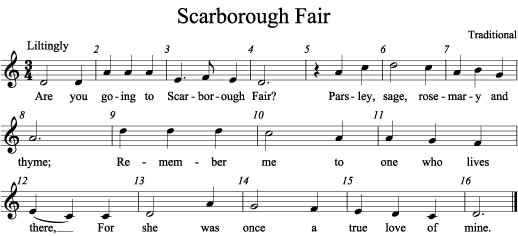
Scarborough Fair is a traditional folk song in triple meter. The "three-four" time signature indicates that each measure contains the equivalent of three quarter notes. Measure 1, for example, contains one half note and one quarter note; measure 2 contains three quarter notes, and measure 5 contains a quarter rest and two quarter notes. Measures 4, 8, and 16 make use of dotted half notes. Since the dotted half is equal to three quarter notes, this note completes the measure by itself. Listen to the song now, counting along with the pulse by saying ONE - two - three, etc.

Now let's focus our attention on the dotted rhythm in measure 3. To better understand how this dotted note works, it will be helpful to subdivide the beat. In the version of the music given below, the underlying pulse level of quarter notes has been added below the music (on the staff labeled "pulse"). Another line that subdivides the beat into eighth notes (two per beat) has been added above the pulse level (the staff labeled "subdiv"). Listen to the melody again, but this time count along with the eighth-note subdivision of the beat, as follows: ONE - and - two - and - three - and, etc.
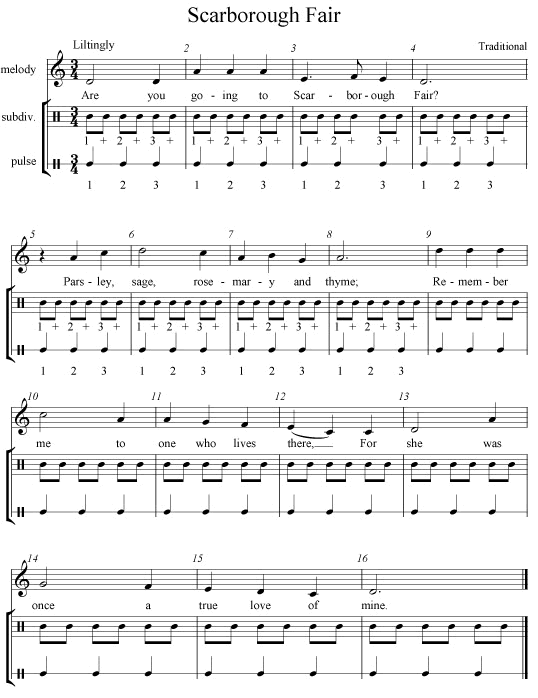
Notice that the dotted quarter note in measure 3 equals three eighth notes in the subdivision line (with the syllable bor of "Scar-bor-ough" corresponding with the "and" of beat two). In other words, it equals one-and-a-half beats. The eighth note that follows completes beat two, and the third quarter note completes the measure. This subdivision of the beat may not literally be performed (as it was in the example above), but a good musician will keep such a subdivision going in their mind as they perform.
Double-dotted notes
All of the dotted rhythms that we have seen so far have used a single dot. When two dots are placed after a note or a rest, the second dot receives half of the value of the first dot. For example, a double-dotted quarter note would be held for its own duration plus half of that value—an eighth note—and then half of the value of the eighth note—a sixteenth note. In other words, it is equivalent in duration to a quarter note tied to an eighth note tied to a sixteenth note, as illustrated in the example below (click "Show Me"). It is possible to continue adding dots in this manner (triple dots, quadruple dots, etc.), each time halving the amount that is added to the overall duration.
Double dots
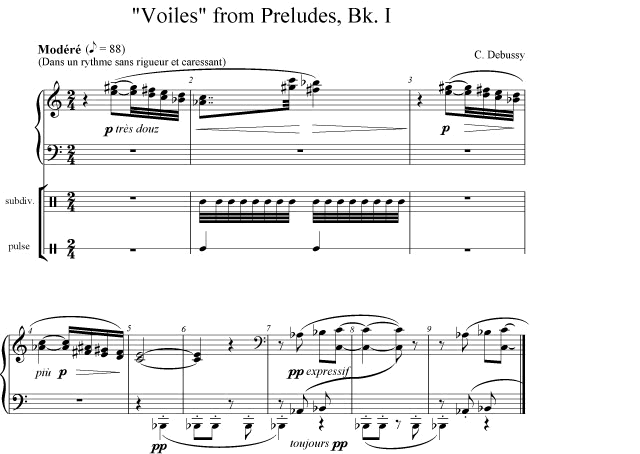
As an example of double-dotted rhythms, see the second measure of Voiles from the First Book of Preludes by Claude Debussy (1862-1918). The double-dotted eighth note in measure 2 is equal to an eighth plus a sixteenth plus a thirty-second note. In other words (using the 32nd note as the smallest common denominator), it is equal to four 32nd notes + two 32nd notes + one 32 note, or seven 32nd notes. In order to show the precise timing of this passage, the thirty-second note division of the pulse is shown below the music. This helps to illustrate that the double-dotted eighth note takes up the first seven 32nd notes of the beat, and the 32nd note that follows completes the beat with the eighth 32nd note. Click on the score to hear this subdivision played with the music.