
Learning Objectives
- Recognize the differences between the Medieval and Renaissance periods in terms of society, religion, art, science, and freedom.
- Explain how Renaissance musicians made their living.
- Use relevant musical vocabulary to analyze Renaissance a cappella singing.
- Distinguish the characteristics of Renaissance music, and differentiate between Renaissance music and Medieval music.
- Illustrate how composers used the motet, a sacred genre with a Latin devotional text, to experiment in musical style and texture.
- Describe how Renaissance composers set texts from the Ordinary of the Mass for their polyphonic Masses.
- Describe how instrumental dance music was performed by professional and amateur musicians.
Renaissance Period (1450–1600)
Sacred Music
The music of the Catholic Church underwent a major transformation during the Renaissance. The term "motet" was preserved in the transition from medieval to Renaissance music, but the character of the composition changed entirely. The popularity of the motet toward the end of the medieval period led an increasing number of composers to extend the boundaries of church music forms beyond what was acceptable, and to alter the original cantus firmus to the point that it became almost unrecognizable. By contrast, the Renaissance motet sounds smooth and imitative to our ears. Renaissance composers of the motet generally abandoned the use of a repeated figure as a cantus firmus.
Josquin des Prez
Josquin des Prez, whose chanson "Faulte d'argent" we previously heard, wrote more motets than any other genre—around 100 of them. In his motet Ave Maria...virgo serena, sections of imitative counterpoint are interspersed with sections of chordal, homophonic texture. The rhythm pulses steadily, without strong patterns or accents to interrupt the smooth flow.
Composer: Josquin des Prez
-
"Faulte d'argent"
Composer: Josquin des Prez
-
"Ave Maria...virgo serena"
Ave Maria, gratia plena
Dominus tecum, virgo serena,
Hail Mary, full of grace,
the Lord is with you, Virgin serene,
Avecuius conceptio
solemni plena gaudio,
caelestia, terrestria,
nova replet laetitia,
Hail whose conception,
full of solemn joy,
heaven and earth
newly fills with happiness.
Ave cuius nativitas.
nostra fuit solemnitas,
ut lucifer lux oriens,
verum solem praeveniens.
Hail whose birth
was our solemnity,
so that like a torch, the rising light
the true sun might herald.
Ave pia humilitas,
sine vero fecunditas.
cuius annunciatio,
nostra fuit salvatio.
Hail blessed humility,
without a man made fruitful,
whose annunciation
has been our salvation.
Ave vera virginitas,
immaculata castitas,
cuius purificatio,
nostra fuit purgatorio.
Hail true virginity,
spotless chastity,
whose purification
has been our cleansing.
Ave praeclara omnibus
angelicis virtutibus,
cuius fuit assumptio,
nostra glorificatio.
Hail foremost among all
angelic virtues,
whose assumption has been
our glorification.
O mater Dei,
memento mei. Amen.
O mother of God,
remember me. Amen.
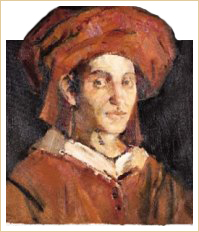
The career of Josquin des Prez (generally referred to as "Josquin" because "des Prez" was a nickname, not a surname) exemplified the dominance of composers from northern France and the Netherlands during the Renaissance. He was employed at several locations throughout his career: Milan, the papal chapel in Rome, in France by King Louis XII, the court of the d'Estes in Ferrara, and finally in his native Condé. He was tremendously admired in his own time and served as a model for young composers for decades after his death.