
Scales: Introduction
Definition
All of the music that you hear around you is based on scales. A scale (from the Italian word scala, meaning ladder) is a collection of pitches arranged in ascending order. Like the steps on a ladder, you can ascend by step through the pitches in a scale. Here is a scale that moves by step from middle C to the C an octave higher. This particular scale is called a C major scale.

The C major scale
If you take a piece of music, for instance the melody "Somewhere Over the Rainbow," and arrange the pitches that it contains in an ascending order within the space an octave, you will find that they form a scale.
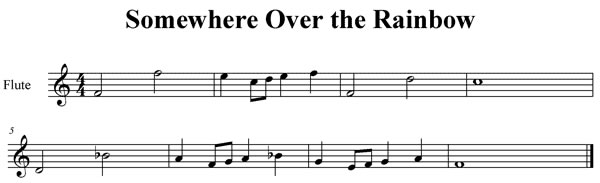
The pitches of "Somewhere Over the Rainbow" arranged in ascending order starting on the first note (F) form a seven-note scale (F, G, A, B♭, C, D, E, and F)—the F major scale:
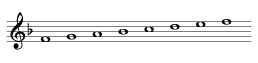
The F major scale

As different as compositions by Palestrina, Bach, Beethoven, Rodgers and Hammerstein, The Beatles, Garth Brooks, Chick Corea, Bob Marley, or U2 might sound to us, they are all based on scales, and sometimes they even use the very same scales.
There are many different types of scales found throughout the world. These scales give compositions from different regions of the world their unique character or flavor. We are most familiar with the types of scales used in own cultures, because we have heard them used throughout our lives. One of the reasons that music from other cultures may sound strange or exotic to our ears is that we are not acquainted with the scales on which it is built.
Since scales are the building blocks of music, it is very important to understand how they are constructed. In the Western music system, scales are created using patterns of whole and half steps. In the lesson that follows, we will briefly review the concept of whole and half steps, and then we will learn how to build scales.