
Learning Objectives
- Relate the social, cultural, and political background during the Medieval period (500-1450) to the function of music during this time.
- Characterize the music of the early Christian church, i.e., Gregorian chant.
- Describe the difference between the Proper and the Ordinary of the Mass.
- Examine the influence of the Cathedral of Notre Dame as a center for organum in medieval music.
- Describe the differences between troubadours and trouvères in medieval secular music.
- Trace the rise of secular polyphonic chansons set to fixed text forms (rondeau, ballade, virelai) in the French Ars nova.
- Define and classify the instrumental music of the medieval period.
- Trace the four major developments that took place in Western music during the Middle Ages: the development of pitch and rhythmic notation; the transition from monophony to polyphony; the initial stages of regularly metered music; and the development of the motet and instrumental music.
Medieval Period (476–1450)
Social, Cultural, and Political Background
Cathedrals
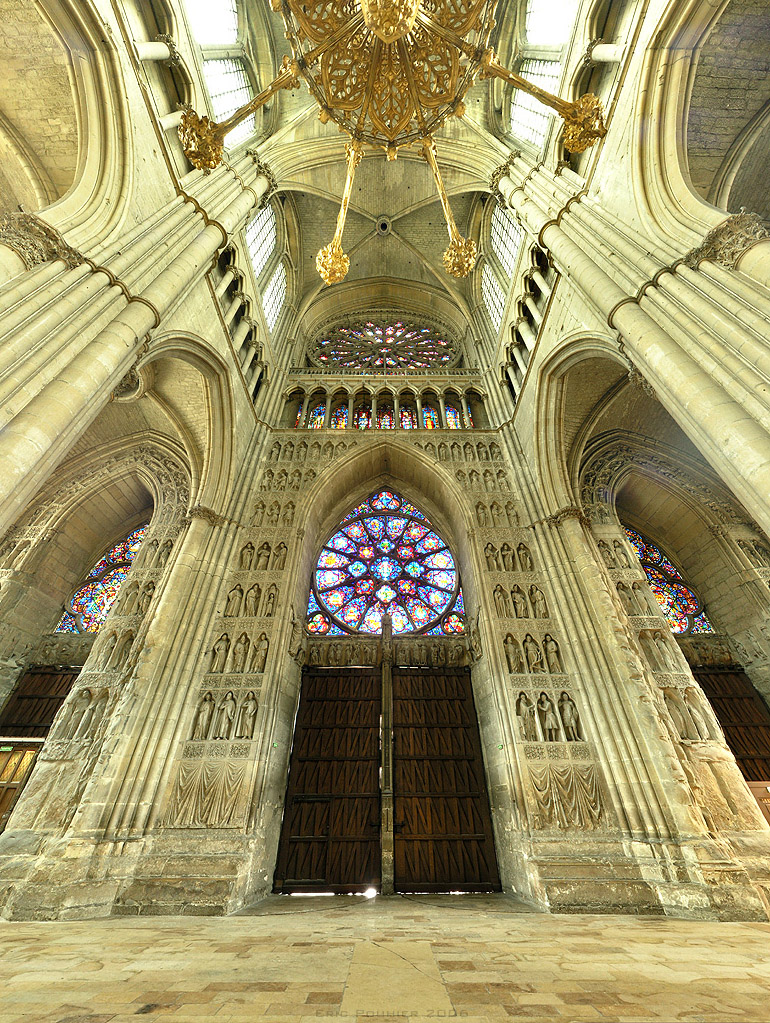
Many of the world's great cathedrals were built during the Middle Ages. Their construction employed numerous artisans and artists who believed that their gifts should be put in the service of God and toward the beautification of God's universe. The primary architectural style of the 12th through 16th centuries is known as the Gothic style. Gothic buildings featured pointed arches in doorways and cloisters, in contrast to the rounded ones from the earlier Romanesque style. This structural change, along with the development of flying buttresses, transferred the weight of the building to the outside walls and allowed for the construction of higher ceilings.
Thus we have the soaring interiors of such famous cathedrals as St. Mark's Basilica in Italy, Santiago de Compostela in Spain, and Notre Dame and Our Lady of Reims in France. In addition to being artistic and architectural marvels, these churches were primary centers for the composition and performance of medieval polyphony.
During the latter part of the Middle Ages, the people of the West gradually became more independent economically, intellectually, and artistically. Villages developed into towns and cities as trade expanded between regions. The growth of towns led to the establishment of universities, especially in England, the Netherlands, Italy, and France. Increased trade led to the rise of merchants and artisans. This small but important new class of workers initiated and pursued economic recovery.
As Westerners' financial independence and education grew, they became less trusting in the complete power of the Church and its ability to control and order daily activities. Further destabilization of the Church's power came about with the Crusades. This series of military campaigns between Europe, the Middle East, and northern Africa brought about an awareness of the larger world. New trade routes were opened to the East, resulting in increased wealth, new ideas, and improvement in the quality of life for many. This climate allowed for rapid growth and development in music, art, and literature. As the merchant class continued to develop, recreation and entertainment away from the scrutinizing eye of the Church became more common. There is a wealth of medieval secular music, giving us insight into medieval notions of love, the enjoyment of life, and all manner of human foibles.
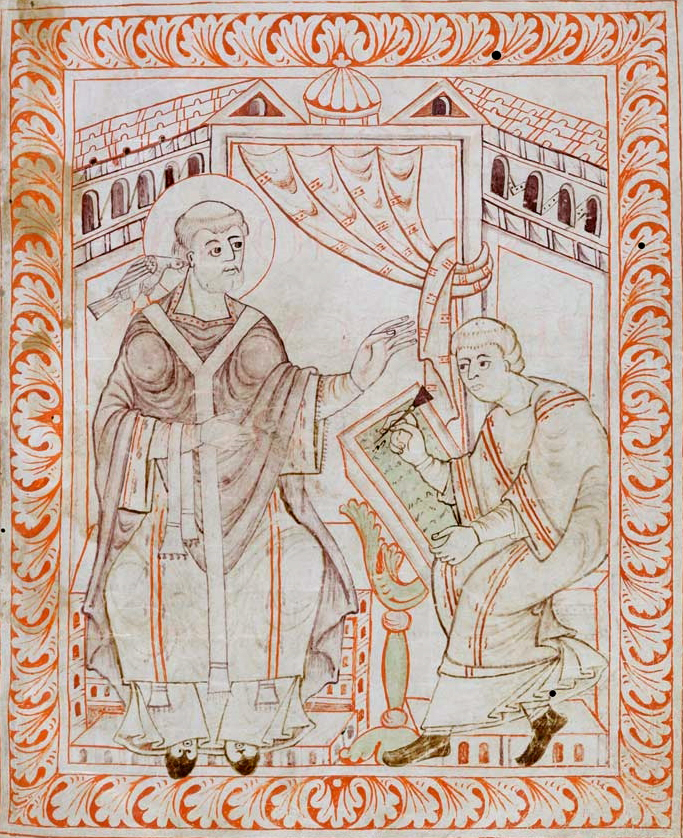
Chants like the example you listened to, "Laudate deum," became very useful in unifying people on a political level as well as on a religious level. On Christmas Day in the year 800, in a collusion of the Church with secular power, Pope Leo III crowned Charlemagne, King of the Franks, the first Holy Roman Emperor. Emperor Charlemagne's consolidation of power included further standardization of the chant repertoire, including promulgation of the notion that Pope Gregory I had received the chant melodies as direct inspiration from God. Charlemagne created schools for the study and promotion of chant, and he played a strong role in the establishment of a flourishing sacred musical culture. In general, under his leadership, there was a great flowering of scholarship, literature, art, and architecture. As a result, his reign is known as the Carolingian Renaissance.
During the 11th century, clashes between the Eastern and Western Roman Empire resulted in a formal rupture between them. The split between the Western, or Latin, wing of the Catholic Church, controlled from Rome by the Pope, and the Eastern Orthodox wing, led by the Patriarch of Constantinople, resulted in linguistic and theological differences and the adoption of dissimilar church policies evident to this day. This break is referred to as the Great Schism. Music and other arts also took different paths. The music we will study in the following sections is the music of the West.