
Overview
Objectives
- Examine two critical types of African American religious music: spirituals and gospel music
- Identify the various historically black colleges and universities
- Identify the musical characteristics of secular popular musics that carried over into early rock and roll, such as the harmonic structure, the topics of the lyrics, the rhythmic character, and the instrumentation.
- Define folk spirituals
- Identify the key figures in gospel music
- Identify the key figures in early rhythm and blues
The Audience for Rhythm and Blues
Louis Jordan’s music appealed to both black and white audiences, but existing segregation practices meant that he often had to perform on two different evenings in the same city or venue: one performance for whites, and one performance for blacks. Even though African American music appealed to white audiences, that alone was not enough to eradicate the existence of segregation or racism. Although record companies thought of "rhythm and blues" as music by and for African Americans, during the 1940s and 1950s, white listeners became increasingly interested in this music. As white teenagers ventured into African American neighborhoods and record shops because the stores in their neighborhoods did not stock the music they wanted to hear. As a result, jukebox operators and retail outlets in white areas began to stock rhythm and blues records in order to satisfy the growing demand for that music among white consumers.
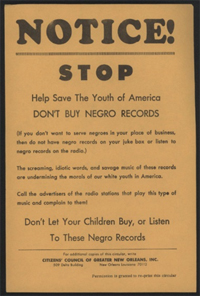
This adoration of African American popular music was not universal among whites during the 1940s and early 1950s, certainly. A flyer distributed by the Citizens’ Council of Greater New Orleans (ca. 1950) reads, in part, "STOP. Help Save the Youth of America. DON’T BUY NEGRO RECORDS.... The screaming, idiotic words, and savage music of these records are undermining the morals of our white youth in America.... Don’t Let Your Children Buy, or Listen To These Negro Records." Clearly, the driving rhythms and rich harmonies of African American music that so appealed to young white people did more than just irritate their parents—the music terrified and infuriated them. As we will see in the following lessons, early rock and roll highlighted many difficult issues of race relations during the 1950s.



During the colonial period in North America, slaves' music-centered worship and gatherings were often banned for being too "idolotrous and wild" and had to be conducted in secret.
