
Objectives
- Relate how Romantic poets and artists abandoned traditional subjects, turning instead to the passionate and the fanciful.
- Relate how the Industrial Revolution impacted the technological development and affordability of musical instruments.
- Analyze how the orchestra grew in size and sound as new instruments were introduced and composers demanded greater levels of expression.
- Illustrate how Romantic composers explored nationalistic folklore and exotic subjects.
- Identify the form of romantic period songs, including strophic, through-composed, and the modified strophic forms.
- Examine the German art song (or Lied) as a favored romantic period genre.
- Discuss how the music of Franz Schubert impacted romantic period music.
- Discuss how the music of Frédéric Chopin impacted romantic period music.
- Trace the ascendance of program music in relation to absolute music.
- Summarize how political unrest throughout Europe stimulated the formation of schools of musical nationalism in Russia, Scandinavia, Spain, England, and Bohemia among other countries.
- Differentiate between the distinct national styles of romantic opera in France, Germany, and Italy.
- Discuss how the Italian nationalist composer Giuseppe Verdi impacted romantic period music.
- Trace how choral music became a popular artistic outlet for the middle classes.
- Discuss how the Russian composer Pyotr Ilyich Tchaikovsky impacted romantic period music.
Romantic Period (1820-1910): The Nationalists Part I
After 1850, new ideas replaced the old. This became increasingly apparent in the compositions of some of the most beloved composers in the history of music including Liszt, Tchaikovsky, Brahms, Verdi, Wagner, Bruckner, Johann Strauss, Faure, Dvorak, Grieg, and Mussorgsky, and later, Debussy, Puccini, Richard Strauss, and Mahler.
There were different opinions, however, about how music should move towards the future and how much of the old ways it should abandon. Composers of the late Romantic period may be classified into three groups: the nationalists, the traditionalists, and the anti-traditionalists. It was the differences between these three groups that led to the monumental changes in music during the opening years of the 20th century. Most composers of the era, however, were influenced to some extent by nationalism.
The Nationalists
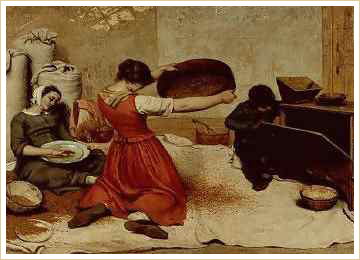
In the second half of the 19th century, increasing numbers of composers turned to folk idioms as the basis for their compositions. These composers used folk dances, melodies, and rhythms to portray the soul of a people. Their music combined the basic characteristics of folk music with the complexity and depth of art music. Their work is not far from the artistic ideals or the realist movement in art.

In the second half of the 19th century increasing number of composers turned to folk idioms as the basis for their compositions...

Austria
While there was no particularly "Austrian" nationalistic movement, one form of popular music is worth noting. Using the waltz, a dance form popular throughout Europe, and especially in Vienna, a father and son, Johann Strauss, Sr. (1804-1849) and Johann Strauss, Jr. (1825-1899) composed some of the world's most enduring and compelling dance music.
Although composers since the time of Haydn had been writing waltzes, everyone agrees that it was Johann Strauss Jr. who wrote the most defining waltz of all time, The Blue Danube Waltz. This famous waltz was, according to Strauss's publisher, the most profitable property in the history of music. Strauss was a prolific composer and an effective self promoter who also toured extensively and frequently with his own orchestra. He toured not only within Austria but also internationally. In fact, in 1872, he received $100,000 US Dollars to conduct one composition fourteen times on a tour of United States.
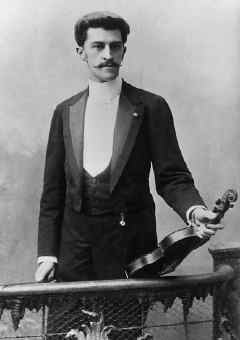
Johann Strauss Jr. was one of 11 children. His father was one of the most popular composers and conductors of dance music. However, he strongly opposed the idea of any of his children pursuing a career in music. As a result, Johann Strauss Jr. sneaked lessons, and managed to become an accomplished musician in his own right, probably surpassing his father's long held reputation. In addition to his numerous waltzes, Strauss Jr. also composed overtures, polkas, and vocal works.
Strauss was a prolific composer and an effective self promoter who also toured extensively and frequently with his own orchestra...
Composer: Johann Strauss II
-
"An der schönen, blauen Donau (The Beautiful Blue Danube), Waltz, Op. 314"
England
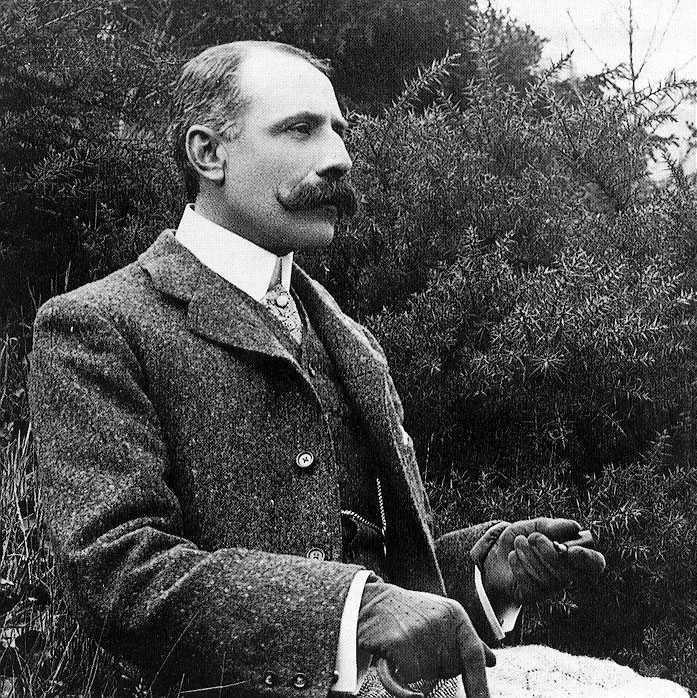
England produced no composers of note after the death of Henry Purcell in 1695. Although Handel spent most of his career in England, Haydn wrote some of his great late works while living there, and Mendelssohn spent many years in England and Scotland, the three of them were Germans by birth. However, the history of native English music changed with Sir Edward Elgar (1857-1934). Elgar's music, such as his this Pomp and Circumstance March, eloquently reflects the self-confident patriotism of Victorian England.
Elgar's music eloquently reflects the self-confident patriotism of Victorian England...
Composer: Edward Elgar
-
"Pomp and Circumstance, Op. 39: Military March No. 1 in D Major, Op. 39, "Pomp and Circumstance""
France
French composers were the first to recognize the need to explore new directions in music. Some of their work may be described as nationalistic, because, like Elgar in England, through mimicking folk songs and specific cultural influences they were able to capture the spirit of French culture. Charles Gounod (1818-1893), Cesar Franck (1822-1890), and Camille Saint-Saëns (1835-1921) for example, each display an elegance of melodic line in their music, which is not unlike the fluidity of the French language. Opting to avoid more harsh, officious, Germanic sounds, these composers chose smaller gestures (chamber music, art songs, smaller orchestras) instead of the massive statements of their German contemporaries like Wagner and Bruckner. Although Franck’s style is the most typically Romantic of those listed here, smaller displays of line and repose are abundant in his chamber music, such as the second movement of his Piano Quintet in F minor (1879). Saint-Saëns' colorful Danse macabre provides a strong contrast to Frank's more somber piece.
Composer: César Franck
-
"Piano Quintet in F minor: II. Lento"
Composer: Camille Saint-Saëns
-
"Danse macabre"
Norway
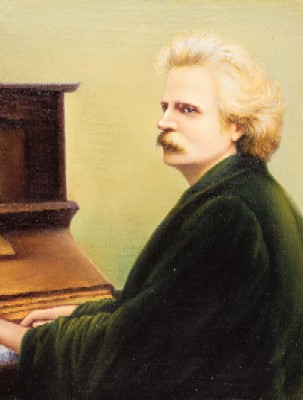
Norwegian music and folklore may be traced back to the age of the Vikings, but Edvard Grieg (1843-1907) is recognized as Norway’s first art-music composer of distinction. Grieg excelled at incorporating folk rhythms and dances into a richly harmonic orchestral palette. The results range from sets of Norwegian dances and folk songs for piano to incidental music for Henrik Ibsen’s play Peer Gynt, which includes The Hall of the Mountain King and Anitra's Dance.
Composer: Edvard Grieg
-
"Peer Gynt Suite No. 1, Op. 46: IV. In the Hall of the Mountain King"
Composer: Edvard Grieg
-
"Peer Gynt Suite No. 1, Op. 46: III. Anitra's Dance"



