
Objectives
- Relate how Romantic poets and artists abandoned traditional subjects, turning instead to the passionate and the fanciful.
- Relate how the Industrial Revolution impacted the technological development and affordability of musical instruments.
- Analyze how the orchestra grew in size and sound as new instruments were introduced and composers demanded greater levels of expression.
- Illustrate how Romantic composers explored nationalistic folklore and exotic subjects.
- Identify the form of romantic period songs, including strophic, through-composed, and the modified strophic forms.
- Examine the German art song (or Lied) as a favored romantic period genre.
- Discuss how the music of Franz Schubert impacted romantic period music.
- Discuss how the music of Frédéric Chopin impacted romantic period music.
- Trace the ascendance of program music in relation to absolute music.
- Summarize how political unrest throughout Europe stimulated the formation of schools of musical nationalism in Russia, Scandinavia, Spain, England, and Bohemia among other countries.
- Differentiate between the distinct national styles of romantic opera in France, Germany, and Italy.
- Discuss how the Italian nationalist composer Giuseppe Verdi impacted romantic period music.
- Trace how choral music became a popular artistic outlet for the middle classes.
- Discuss how the Russian composer Pyotr Ilyich Tchaikovsky impacted romantic period music.
Romantic Period (1820-1910): The Nationalists Part II
Russia
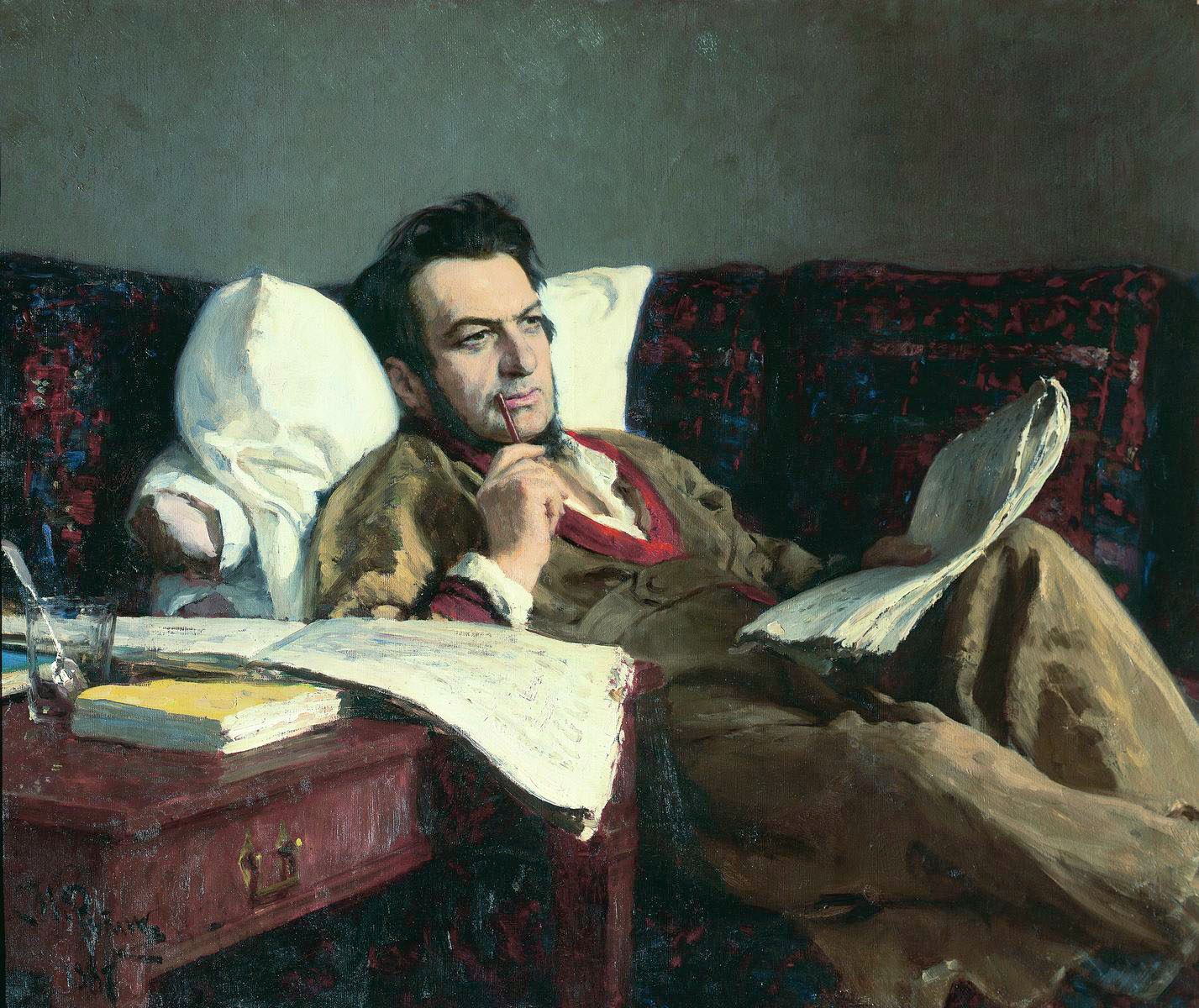
Nowhere is the influence of musical nationalism more evident than in the music of Russia. The development of music in Russia followed a slightly different path than other European countries; this discrepancy was due primarily to the musical and liturgical differences between the Catholic Church and the Eastern Orthodox Church. (You may recall that the final split between the two occurred in 1054 AD, long before advances in Western music had taken place). While Italian and German musicians had always visited to Russia to compose and perform their works, the dissolution of the European monarchies along with the end of the Napoleonic wars brought about an increased exchange of ideas between Russia and the rest of Europe.
In the early years of the 19th century, new compositional activity started happening in the urban centers of St. Petersburg and Moscow. By 1836, the musical scene had blossomed, and one of the first major works in Russia appeared: the opera A Life for the Tsar by Mikhail Glinka (1804-1857). Commonly regarded as the founder of Russian nationalism in music, Glinka’s influence on Balakirev, the self-appointed leader of the later group of nationalist composers, was considerable.
Composer: Mikhail Ivanovich Glinka
-
"A Life for the Czar: Overture"
Art music of the Classical period incorporated the rich tradition of Russian folk music in the work of a group of composers known as The Mighty Five: Mily Balakirev (1837-1910), Alexander Borodin (1833-1887), Cesar Cui (1835-1918), Modest Mussorgsky (1839-1881), and Nicolai Rimsky-Korsakov (1844-1908). Although Balakirev was the only one who received formal music training, all five are considered brilliant composers in their own right. Mussorgsky and Rimsky-Korsakov are arguably the most famous of the five. Rimsky-Korsakov is also well known as the teacher of Igor Stravinsky.
Mussorgsky’s masterpieces are Pictures at an Exhibition and his opera Boris Gudonov. In 1922, French composer Maurice Ravel orchestrated the former, a set of piano pieces based on the sketches of Russian architect Victor Hartmann. The opening number, Promenade, begins with a typical folk-like melody characterized by sudden leaps, repetitive patterns, and a compact range. Other well-known works by Rimsky-Korsakov include Flight of the Bumblebee from The Tale of Tsar Sultan and Scheherazade.
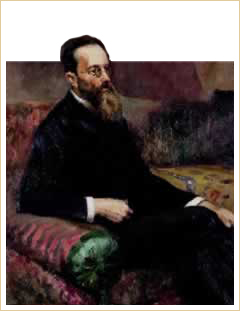
Composer: Modest Mussorgsky
-
"Pictures at an Exhibition: Promenade"
Composer: Nikolai Rimsky-Korsakov
-
"Tale of Tsar Saltan, Op. 57: Flight of the Bumblebee"
Slovakia
For geographical and political reasons, Austrian and German composers such as Haydn, Mozart, and Beethoven exerted a direct influence over the music of Bohemia (now the Czech Republic).
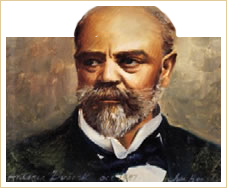
Antonín Dvořák’s (1841-1904) symphonies are firmly rooted in Classical traditions, and, as such, should be considered among the traditionalists. Although a Czech native, his musical language, however, was also influenced by visits to the United States, as may be heard in the slow movement of his Symphony No. 9, From The New World.
Composer: Antonín Dvorák
-
"Symphony No. 9 in E minor, Op. 95, From The New World: II. Largo"
Nationalistic influences are also evident in the music of Czech composer Bedřich Smetana (1824-1884).
His most famous piece, the tone poem Ma Vlast (My Country) includes the Moldau, a musical portrait of the Moldau River that runs through the region along with a depiction of Bohemia's landscape and the spirit of its people. It is amazing to consider that Smetana composed this glorious piece of music after he was completely deaf.
Another brilliant example of the use of Czech folk music may be heard in the symphonic work Taras Bulba, by Leoš Janáček (1854-1928).
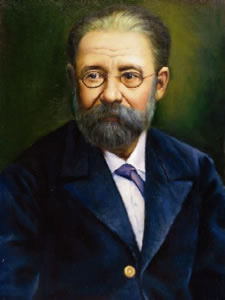
Composer: Bedrich Smetana
-
"Ma Vlast (My Country): No. 2. Vltava (Moldau)"
Composer: Leos Janecek
-
"Taras Bulba, II. The Death of Ostap"
Spain
Traditionally, Spanish composers looked to Italy for musical direction. Indeed, one of the greatest composers of the Renaissance was Tomás Luis de Victoria, a Spaniard who lived and worked in Italy. Nevertheless, influenced to a large degree by the architecture, music, and art of the Moors of Northern Africa, Spain possessed its own rich and varied cultural heritage. Some of Europe’s most colorful dances originate in Spain.
Spain's contributions to the musical landscape of the late 19th and early 20th centuries include Nights in the Gardens of Spain by Manuel de Falla (1876-1946) and the Suite Española by Isaac Albéniz (1860-1909). The guitar's position in the musical hierarchy as an instrument of technical grace, precision, and delicate beauty was established with the music of Francisco Tarrega (1852-1909), whose Recuerdos de la Alhambra stretches the technical limits of the instrument.
Composer: Manuel de Falla
-
"Nights in the Gardens of Spain"
Composer: Francisco Tárrega
-
"Recuerdos de la Alhambra"
United States
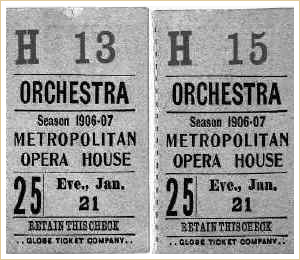
Only 100 years after the country's independence from England, the development of an indigenous musical style was still very much in its infancy (see Focus Box). Orchestras and choral societies appeared in Boston and New York, but serious American composers generally copied European musical styles.
Edward MacDowell (1860-1908), the first full professor of music at Columbia University, lived in Germany for ten years. His musical style, as exemplified by Indian Idyl from his New England Idylls for piano, is a good instance of European Romanticism mixed with original American musical material. During his lifetime, MacDowell envisioned the founding of a sort of creative commune or haven for composers and authors on his estate. To this day, the MacDowell Colony is active in New Hampshire, and many major works in American music and literature have been created there.
Both John Philip Sousa (1854-1932) and Stephen Foster (1826-1864) wrote music that reflects the life of the American people. Sousa wrote marches for band, one of the most popular forms of musical entertainment in the Northeast while, in the South, Foster composed popular songs like I Dream of Jeannie and Camptown Races, which foreshadowed what many consider to be the true American musical art form, jazz.
Composer: Edward MacDowell
-
"New England Idyls, Op. 62: No. 6: Indian Idyl"
Composer: John Philip Sousa
-
"El capitan: March"



