
Overview:
This class will lay the foundation for integrating music in the elementary classroom. Students will explore the purpose of music in the classroom and the teacher’s role in creating and implementing music lessons.
Objectives:
Students will be able to:
- Define arts integration.
- Identify and describe the rationale for integrating music in the elementary classroom.
- Identify the challenges involved when integrating music in the elementary classroom.
- Identify and describe the three common approaches to integrating music into the elementary classroom.
Three Approaches to Music Integration
The main goal or purpose of an integrated curriculum is to find relationships among fragmented learning experiences, i.e. combining curricular goals in music with the other curricular areas. There are many models for integrating curricular areas, however, the key to all approaches is that true integration respects the uniqueness and integrity of each of the disciplines it combines. The three most common approaches used in integrating music into the elementary classroom are:
- Connection
- Correlation
- Immersion
Connection (or connecting) is the most popular, most used, and—depending upon its implementation—least meaningful way of linking disciplines. Materials or concepts from one discipline are used to help teach or reinforce a concept in another curricular area. This procedure is often used in a thematic approach when music is linked to another academic area using a similar topic. The theme becomes the organizer for the curriculum and random samplings of knowledge and skill—the "potpourri" approach—drives the development of curriculum design.
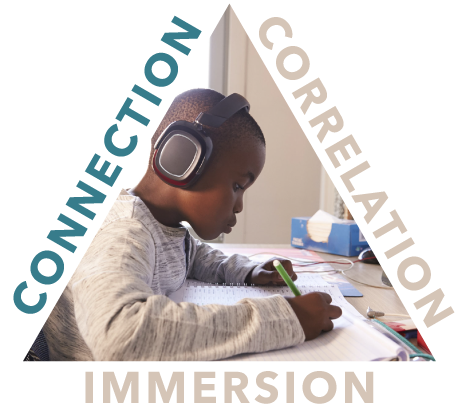
Although connections can be a powerful teaching and learning tool, making connections in this manner is not considered integrated or interdisciplinary learning. Music becomes only the conduit for learning the linked subject and modest or no attempt is made to study music. Examples of implementing this type of integration approach include:
- Students draw pictures while listening to a piece of music
- Students sing a song naming the Presidents of the United States
This procedure, however, is important as a beginning exercise for teachers looking for ways to bring music into other disciplines in the elementary classroom. This first step should be replaced with more in-depth integration as soon as possible.
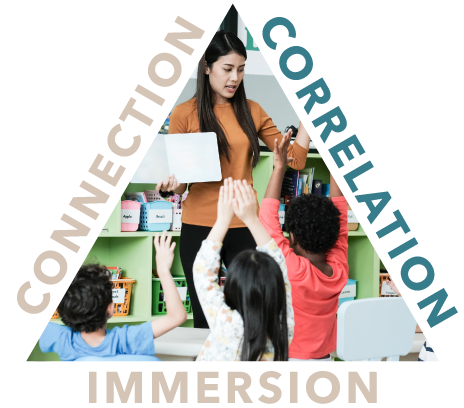
The second approach, correlation (or correlating) occurs when two or more disciplines share activities and materials. In this approach, two or more teachers agree to use the same materials or teach the same topics at the same time. Links are established between knowledge and skills in two or more disciplines. Correlation is attempted only when these links can be made. When activities are correlated, students will notice relationships between disciplines. Instead of being theme-oriented, correlated activities are material-oriented as common elements between the two subjects form the foundation for the lesson or unit.
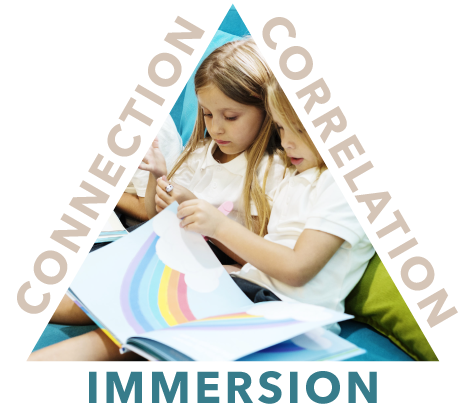
The third stage, immersion, occurs when a broad theme is chosen that encompasses many (or all) disciplines — a multidisciplinary approach. This type of curriculum is the most difficult of the integrated curricula to create because it requires the complete cooperation of a large group of teachers and is driven by student interests. Within this program, each content area explores a central idea in a meaningful way, maintaining the integrity of each intelligence or discipline.
The key ingredient to successful immersion is an examination of a topic through more than one discipline, a higher-level thinking experience. The immersion program should lead students to discover connections that will help them.
- Value independent thinking
- Learn to ask the right questions to find connections
- Establish thought patterns that guide them to seek relationships across the curriculum
- Develop sequential understandings in separate areas of knowledge and skills
Students learn to integrate new information independently with what they have been taught. In this curriculum, students grow both in affective and cognitive learning. [ 3 ]Cornett, C. (2003). <em>Creating Meaning Through Literature and the Arts</em>. 2nd edition. Upper Saddle River, NJ: Merrill Prentice Hall, and Snyder, S. (March, 2001). “Connection, correlation, and integration.” <em>Music Educators Journal</em>, 32-38, 70