
Overview:
This class will lay the foundation for integrating music in the elementary classroom. Students will explore the purpose of music in the classroom and the teacher’s role in creating and implementing music lessons.
Objectives:
Students will be able to:
- Define arts integration.
- Identify and describe the rationale for integrating music in the elementary classroom.
- Identify the challenges involved when integrating music in the elementary classroom.
- Identify and describe the three common approaches to integrating music into the elementary classroom.
Three Approaches to Music Integration (Continued)
Music is most easily integrated with other art forms. Each of the arts has elements that are expressed in different ways, yet these elements have commonalities that can be compared and contrasted. The arts are deeply connected as they:
- Challenge people to grow aesthetically
- Express the emotions, mind, and spirit
- Communicate beyond what humans can express with words or numbers
When combining the arts, teachers need to be sensitive to the commonalities between the arts and to the things that make each unique or different.


Art forms (dance, theatre, painting, literature, etc.) have common rationales and intentions. As a result, the following activities are found in every art form:
- Creation
- Evaluation
- Perception
- Response
- Skills Development
- Understanding
Although each art form is unique, common links can be found among the arts in the aesthetic principles of:
- Tension and release
- Repetition and contrast
- Pattern
- Motive
- Theme and variation
- Balance
- Background and foreground
- Density
To teach the principle of motive, for example, the teacher could emphasize motive as it is found in different art forms.

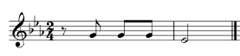
All art forms, including music, are comprised of sub-concepts that may be broken down or separated into discrete qualities. Activities or lessons created to teach the sub-concepts will be more effective if designed using a multi-sensory approach to heighten students’ awareness and understanding. These can include activities that focus on listening, moving, playing instruments, singing, composition, improvisation, and reading. A multi-sensory approach will enable the teacher to reinforce the sub-concept through activities and lessons that highlight visual, aural, kinesthetic, and affective modalities and help students develop, transfer, and retain knowledge as they gain personal meaning from effective learning experiences.