
Learning Objectives
- Learn how to invert triads and to identify inverted triads by putting them back into root position.
- Learn how to use figured bass symbols to indicate chord inversions.
- Learn how to spell inverted triads.
Triads VII: Triad Inversions
Triad Inversions
Another way to rearrange the pitches of a triad without altering its name or underlying quality is to invert it. The key to understanding triad inversions is look at the lowest-sounding note in a chord. If the lowest-sounding note is not the root, then the chord has been inverted.
In all of the triads that we have seen so far, the lowest-sounding note has been the root. When the root of a chord is on the bottom, a triad is said to be in root position. If the lowest-sounding note in a chord is the third ("third on the bottom"), then the triad is in first inversion. If the lowest-sounding note in a chord is the fifth ("fifth on the bottom"), then the triad is in second inversion. Click "Show Me" in the interactive example below to see all of the possible positions of the C major triad.
Triad Inversions
In this example, each triad is inverted by moving the lowest pitch into a higher octave, revealing a new note on the bottom. If we were to try and invert this chord again (by continuing to shift the notes up to higher positions within the C major triad), it would just yield a root position triad an octave higher. Thus, there is no third inversion for triads. Since a triad only has three notes, it can only have three different positions: one root position and two inversions.
| Remember |
|
Listen carefully to the difference in "color" between the root position and the inversions of the triad (by clicking on their names in the example above). As you might expect, a triad in root position is more stable-sounding than an inverted triad. First inversion triads are considered to be weaker than root position triads. Second-inversion triads are much less frequently found than the others, since they are rather weak and unstable.
Here are some other inverted triads for you to examine. Note that for each triad, the same three pitch names are always used, no matter what the inversion. For example, the D triads always use the pitches D, F#, and A, although these occur in different positions on the staff. Again, these inversions do not change the root or quality of a triad. So, there are three D major chords, three E-flat major chords, three F minor chords, and three G-sharp diminished chords here, in different inversions.

Inversions Combined with Spacing and Doubling
All of the chords shown below are C major triads, since they all consist of the pitches C, E, and G, but some of them are inverted and many of them use spacing and doubling. When determining the inversion of a chord, it does not matter what position the upper notes are in or how the pitches are spaced or doubled. The only pitch that matters is the lowest-sounding note. Thus, the first three chords in the example below are in root position because in each case the lowest note is a C. In the next three chords, the lowest-sounding note is an E. Since this is the third of the chord, these chords are in first inversion. The bottom note of the last three chords is a G, so these are all in second inversion.
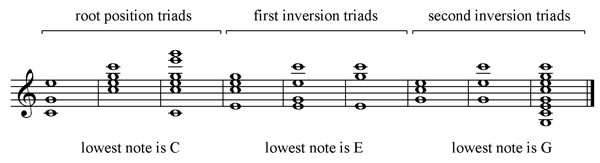
In order to determine the root (and quality) of a triad that has been inverted, it is best to put the chord back into root position, rearraging the pitches so that they are once again stacked in thirds. In doing so, make sure that you do not change the names of the pitches. Inverting a chord will never change the pitch names.
| Remember |
|
Triad Inversion Symbols
When analyzing triads, we can indicate inversions by using figured bass symbols. These symbols have an interesting history. In the Baroque period (1600-1750), keyboard players were often given only a bass line, and they had to figure out what notes to play above that line. Figured bass symbols in the score indicated what intervals should be played above the bass note. For example, if the bass note was a C and there was a "6" written above it, they knew that the chord they played would need to have an A in it (since A is a sixth above C). Musicians today rarely find themselves in the position of having to interpret figured bass symbols in performance, but the symbols have endured as a means of indicating chord inversions by telling us what intervals occur above the bass in inverted chords.
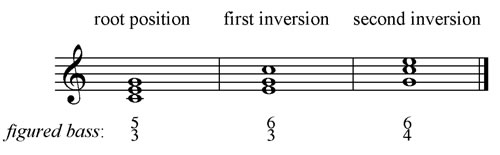
For example, here are some figured bass symbols for triads. The symbol for a root position triad would be "53", since there is a fifth and a third above the bass note C. A first inversion triad consists of a sixth and a third above the bass note (above E) and a second inversion triad contains a sixth and a fourth above the bass note (above G). Be sure not to confuse the bass note (the lowest sounding pitch) with the root (which is the lowest sounding pitch only when a chord is in root position). The root in all of the chords below is C, while the bass note varies.
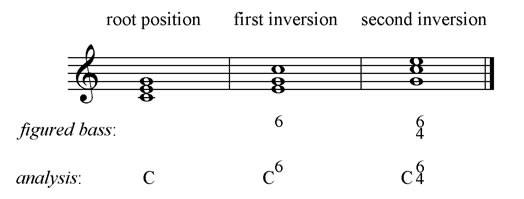
The symbols in the previous example indicated all of the chordal pitches above the bass in each triad. It is traditional, however, to abbreviate figured bass symbols as shown below. Root position chords do not need an inversion symbol. Thus, when no symbol is used, it is assumed that the chord is in root position. First inversion triads are just labeled with a "6" (omitting the 3). Second inversion triads are still labeled with a "64." To provide a complete analysis, the inversion symbols are then combined with the root and quality. Since all of the triads below are C major triads, we use an uppercase letter C, followed by the abbreviated inversion symbols, to represent each chord.
| Remember | ||||
|
Identifying Inverted Chords
To identify a chord that has been inverted, here are the basic steps you should use:
| Identifying Inverted Triads |
|
Here are some practice chords for you to analyze. For each chord, determine the root name, the quality, and the inversion symbol. When you think you know the answers, click "Show Me" to check your work.
Chord identification practice
Chord id Abmaj64
Chord id Bbmaj64
Chord id fshidm6
Spelling Inverted Chords
To spell an inverted chord, you should follow these basic steps:
| Spelling Inverted Triads |
|
Here are some chords for you to practice with. Try to determine how each one would be spelled. When you think you know the answers, click "Show Me" to check your work.
Chord spelling practice
Spell Cmin64 triad
We have now reached the end of the unit on triads. In the quiz that follows, you will need to be able to answer questions about triads, triad qualities, and triad inversions. Take a moment now to review all that you have learned about triads before taking the quiz.