
Objectives
At the end of this section, students will be able to:
- Relate how Romantic poets and artists abandoned traditional subjects, turning instead to the passionate and the fanciful.
- Relate how the Industrial Revolution impacted the technological development and affordability of musical instruments.
- Analyze how the orchestra grew in size and sound as new instruments were introduced and composers demanded greater levels of expression.
- Illustrate how Romantic composers explored nationalistic folklore and exotic subjects.
- Identify the form of romantic period songs, including strophic, through-composed, and the modified strophic forms.
- Examine the German art song (or Lied) as a favored romantic period genre.
- Discuss how the music of Franz Schubert impacted romantic period music.
- Discuss how the music of Frederic Chopin impacted romantic period music.
- Trace the ascendance of program music in relation to absolute music.
- Summarize how political unrest throughout Europe stimulated the formation of schools of musical nationalism in Russia, Scandinavia, Spain, England, and Bohemia among other countries.
- Differentiate between the distinct national styles of romantic opera in France, Germany, and Italy.
- Discuss how the Italian nationalist composer Giuseppe Verdi impacted romantic period music.
- Trace how choral music became a popular artistic outlet for the middle classes.
- Discuss how the Russian composer Pyotr Ilyich Tchaikovsky impacted romantic period music.
Romantic Period (1820-1910): The Early Romantic Period The Virtuosos / Opera / The Rise of Nationalism
Virtuosos
In every age there have been virtuosos. We mentioned earlier that Vivaldi and Bach were considered virtuosos in their time, as were Mozart and Beethoven in theirs. With each raising of the bar, however, someone else would follow and raise it higher still. That constant pushing was the case in the first half of the 19th century, when virtuosos who were capable of unthinkable musical feats appeared.
Paganini (1782-1840)

The virtuoso who set the standard for all performers to follow was violinist Niccoló Paganini...

The virtuoso who set the standard for all performers to follow was violinist Niccoló Paganini (1782-1840). In addition to his ability to play incredibly fast and complicated musical passages, Paganini was a showman extraordinaire. He is said to have commented one time: “I am not handsome, but when I play music, women throw themselves at my feet.” He was also a composer for the violin, and he delighted in writing extremely difficult pieces that only he could play, such as the 1st Caprice from a set of 24 Caprices for the Violin. Wherever he toured in Europe, it was assured that he would perform to a sold-out hall . Allegedly, every performer of the age longed to play his or her instrument with the same excellence and charisma as the infamous Paganini.
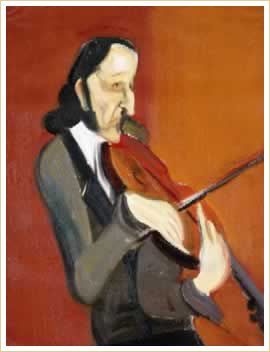
Composer: Niccolò Paganini
-
"Twenty-four Caprices for the violin, Op. 1: Capriccio No. 1 in E major, L'Arpeggio"
The beginning of the 19th century also saw the emergence of the guitar as a popular instrument. Originally, the guitar was dismissed as an instrument for “gypsies” a characterization that was not entirely untrue. The lute had been a favorite instrument in the Renaissance, but, with the development of the harpsichord, a more expressive and versatile instrument, fell into disuse in the Baroque era. With the emergence of a middle class around the turn of the 18th century, people began to show interest in learning how to play an instrument themselves. The guitar and the piano filled that need. As the instrument became more popular, virtuosic performers emerged who doubled as composers and ambassadors for the guitar. Among these figures were Fernando Sor (1778-1839), Mauro Giuliani (1781-1829), and Dionysio Aguado (1784-1849.)
The instrument that captured the musical hearts of audiences more than any other, however, was the piano. Since its development in the 18th century, the piano enjoyed a steady increase in popularity, due in part to the compositions of composers such as Mozart, Clementi, and Beethoven. In the early Romantic era, piano works by Schubert, Mendelssohn and Robert Schumann immediately entered the gallery of masterworks for the instrument.
Frédéric Chopin (1810-1849)
A native of Poland who spent most of his adult life in Paris, Chopin reinvented the way the piano was played...
Born near Warsaw in 1810, the son of a French émigré and a Polish mother, Chopin was one of the first pianists to emerge as a new virtuoso on the instrument. After achieving early fame in the relatively limited circles of his native country, he sought his fortune abroad, in Paris. His departure from Warsaw coincided with the unsuccessful national uprising against Russian domination.
In 1821, Chopin arrived in Paris, and very quickly became closely associated with the most prominent intellectuals, artists, musicians, political activists, and financiers of his day. His circle of friends included the writers Victor Hugo and Balzac, the painter Delacroix, and fellow musicians Liszt and Berlioz.
Despite being widely admired as a performer and improviser, Chopin hardly ever performed in public. When he did, however, it was almost always at small gatherings, or soirées musicales, where he felt that his music was appreciated and understood by a select audience and friends. Much sought after as a teacher, especially by the Parisian upper class, the money he made allowed him to lead a comfortable life, and devote a significant amount of time to composing. A shrewd businessman, he also managed to make advantageous financial deals with his music publishers.
The famous French novelist George Sand (the pen name of Amantine-Aurore-Lucile Dupin) was Chopin's companion and lover until 1847. Sand provided this frail and shy composer with the care and nurturing environment that he needed to produce much of his most important compositions. After she left him, Chopin's health declined drastically. He died of tuberculosis at the age of thirty-nine.
Composer: Frédéric Chopin
-
"Polonaise in A-flat major, Op. 53, Heroic"
His compositions, principally for the piano, make remarkable use of the newly developed instrument, exploring its poetic possibilities while generally avoiding the more obvious flamboyance of the Paris school of performers. It may be argued that Chopin reinvented the way the instrument was played. Listening to Chopin’s works, one questions whether or not it can possibly be played by just two hands. Listen to the Mazurka No. 23 in D major or the Polonaise in A-flat major (Heroic), and note how full the piano voicing is. However, to simply focus on the virtuosic demands of his music is to miss out on his true compositional genius. Melodically brilliant and harmonically complex, Chopin’s music exemplifies all that is daring about Romantic music.
Composer: Frédéric Chopin
-
"Mazurka No. 23 in D major, Op. 33, No. 2"
Chopin created or developed a number of new forms of piano music, vehicles for his own poetic use of the instrument, with its exploration of nuance, original harmonies, and often considerable technical demands. He used the popular form of the Waltz in a score of such compositions, of which the so-called Minute Waltz is probably the best known.
The Polish dance, the Polonaise, elevated from the village to the ballroom, provided the basis for sixteen such works, written between 1817 and 1846. The best known are the Polonaise in A major, Opus 40 No. 1, the Polonaise in A flat, Opus 53, and the Polonaise-Fantaisie, Opus 61. Other Polish dances used by Chopin include the 62 Mazurkas. The four Ballades, supposedly based on patriotic poems by Chopin's friend Mickiewicz, evoke narrative works without any precise, extra-musical association.
The 21 Nocturnes continue an evocative form initiated by the Irish pianist John Field (1782-1837). Chopin wrote 26 Preludes; 24 of them were completed during an ill-fated winter with George Sand in Mallorca along with 27 Studies. Other compositions include four Scherzos, expansions of the earlier form into a more extended virtuoso piece, three Sonatas, a Berceuse, a Barcarolle, four Impromptus and a number of other works. The whole body of Chopin's music, comprised of melodies often of operatic inspiration and harmonies and forms of considerable originality, is of the greatest musical and technical importance.
Franz Liszt (1811-1886
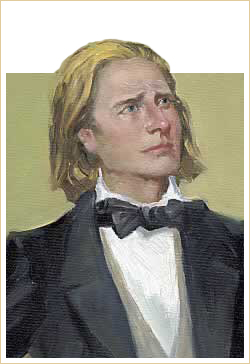
Though associated with virtuosic piano playing in the 19th century, Franz Liszt is often overlooked for his contributions as a composer.
Liszt was born in 1811 in Hungary. Although many think of him as a "Hungarian" composer, and the Hungarians themselves have claimed him as a national treasure, the fact remains that he was very much an international artist, a 'man of the world'. When he was ten, Liszt's family moved to Vienna, where he took lessons in piano from Beethoven's pupil, Czerny, and in composition from Salieri. Two years later, in 1823, Liszt moved to Paris, where he became friends with Chopin, Victor Hugo, and Berlioz.
In 1830, Liszt heard the phenomenal violinist Paganini, and decided that he would develop similar technical wizardry at the keyboard. After three years of near seclusion, he emerged as the most astonishing pianist of his day. From 1835 until 1847, when he gave his last paid public concert, he toured widely from England to Turkey, performing to adoring crowds wherever he went. His dazzling technique and personal magnetism made him into one of the first true performing celebrity artists. Even Clara Schumann, who tended to think of him as a showman, had to admit that "he may be compared to no other virtuoso. He is unique. He arouses fright and astonishment."
Homer, the Bible, Plato, Locke, Byron, Hugo, Lamartine, Chateaubriand, Beethoven, Bach, Hummel, Mozart, and Weber are all about me. I study them, meditate on them, devour them furiously. I also practice from four to five hours of exercises - thirds, sixths, octaves, trills, repeated notes, and cadenzas. Oh, if only I don't go mad, you'll find an artist in me...an artist such as we need today!...
Liszt coined the term 'recital,' which suggests something more important than simply playing an instrument, and is largely responsible for the accepted norm of playing in public from memory. In 1844 he separated from his mistress, the Comtess D'Agoult, mother of his three children, and, in 1848, accompanied by the Princess Carolyne Sayn-Wittgenstein, settled in Weimar as Director of Music. There, he concentrated his efforts on composition, and, in particular, on the creation of a new form, the symphonic poem.
In 1861 Liszt moved to Rome, where in 1866 he took minor religious orders. From 1869 on, he returned regularly to Weimar, where he had many pupils. Later, he accepted similar obligations in Budapest, where he was regarded as a national hero. He died in Bayreuth in 1886, four years after the death of his son-in-law Richard Wagner. As a composer, his work offered a glimpse of the new course that music was to take half a century later.
Composer: Franz Liszt
-
"Hamlet"
Despite the brilliant orchestration, evident when listening to Hamlet, Liszt's symphonic poems met with strong criticism from champions of pure music, who took exception to his attempts to translate into musical terms the greatest works of literature. The best known of the symphonic poems are Ce qu'on entend sur la montagne, based on Victor Hugo, Les préludes, based on Lamartine, Tasso, Mazeppa, and Prometheus based on Byron, the so-called Faust Symphony in Three Character-Sketches after Goethe, and the Symphony on Dante's Divina Commedia. Other orchestral works include two episodes from Lenau's Faust, and the First Mephisto Waltz, to which a second was added twenty years later, in 1881. All these works had a profound influence on a younger generation of composers. Smetana's Ma Vlast, Frank's Psyché, and Tchaikovsky's Francesca da Rimini are just a few examples of pieces that followed the model established by Liszt.
Liszt also wrote two piano concertos, and, among other works for piano and orchestra, a Totentanz (Dance of Death), and a Fantasy on Hungarian Folk-Melodies.
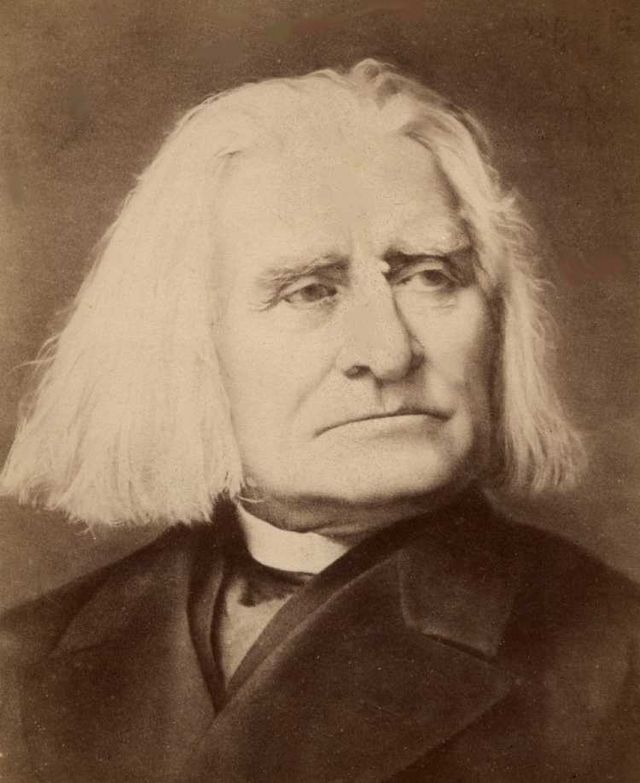
As a composer, Liszt's work offered a glimpse of the new course that music was to take half a century later...
Opera
As we have seen, Italian opera was undergoing changes in the 19th century, beginning with Rossini. In France and Germany, however, new currents were emerging in opera that would fundamentally alter the art form.
In France, serious opera and opera comique, which uses spoken dialogue instead of recitative, were the prevailing forms at the turn of the century. New idioms in the Romantic era arose from these two forms: grand opera and lyric opera.
Grand opera is best represented by the music of one of its first proponents, Giacomo Meyerbeer (1791-1864.) The French, who loved the spectacle associated with opera, were particularly enamored with grand opera, which had all conceivable manner of ballet: chorus, crowd scenes, and a grand and glorious stage production. An example of Meyerbeer’s music is the Coronation March from The Prophet.
With the popularity of grand opera, in retrospect, it seems perfectly logical that opera comique would gravitate toward a hybrid form that incorporated elements of the spectacle of grand opera. The result was lyric opera, an opera comique with the recitative restored and the large setting of the grand opera. One of the best known examples of lyric opera is Faust (1859) by the French composer Charles Gounod (1818-1893). Numerous dances are included in the opera.
The most beloved of the lyric operas, maybe even all of French opera, is Carmen (1875) by the French composer Georges Bizet (1838-1875)...
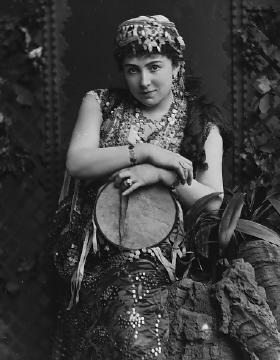
By far the most beloved of the lyric operas, however, maybe even of all French opera, is Carmen (1875) by the French composer Georges Bizet (1838-1875.) The opera is set in Spain and is full of dances and musical idioms drawn from Spanish gypsies, or at least Bizet’s interpretation of them. The Habanera from the opera shows how Bizet effortlessly combines the rhythm of the folk dance with the needs of the opera.
Composer: Georges Bizet
-
"Carmen: Habanera"
The change in German opera may be traced back to the 18th century when some composers began dabbling in singspiel, a kind of folk-opera sung in German. As discussed earlier, the genre gained acceptance with Mozart’s Die Zauberflöte (The Magic Flute). In the 19th century this became the most popular idiom in German opera, and spurred an interest in German folk music that affected everyone from Schubert to Brahms to Wagner. It received a further boost with the work of Carl Maria von Weber (1786-1826). In particular, Der Freischütz stands out as one of the greatest examples of singspiel in the 19th century.
The Rise of Nationalism
As you may have gathered in the discussion of Chopin’s piano music or Carmen, one trend that consistently appears in the Romantic era is the composer’s desire to employ folk melodies, dances, and rhythms as the basis for their compositions. This reoccurring trend was due in part to nationalistic impulses, an artist’s desire to openly praise and publicize his or her respective homeland or chosen nation. There are many reasons for a composer to use folk melodies or rhythms. Some common reasons include: because the program material of the work requires it (Carmen), the artist has an interest in the region or its music (Mendelssohn’s symphonies or the Hungarian Rhapsodies of Liszt), or because the composer feels a strong connection to their home country (Chopin’s polonaises and mazurkas.) This nationalistic trend continued long into the 20th century and occurred throughout Europe and the United States. Almost every major composer from the middle of the 19th century until World War II wrote music that incorporated a certain amount of nationalistic undertones.



In 2016, a manuscript handwritten by Gustav Mahler sold at auction for a record £4.5 millio"
