
Objectives
At the end of this section, students will be able to:
- Relate how Romantic poets and artists abandoned traditional subjects, turning instead to the passionate and the fanciful.
- Relate how the Industrial Revolution impacted the technological development and affordability of musical instruments.
- Analyze how the orchestra grew in size and sound as new instruments were introduced and composers demanded greater levels of expression.
- Illustrate how Romantic composers explored nationalistic folklore and exotic subjects.
- Identify the form of romantic period songs, including strophic, through-composed, and the modified strophic forms.
- Examine the German art song (or Lied) as a favored romantic period genre.
- Discuss how the music of Franz Schubert impacted romantic period music.
- Discuss how the music of Frederic Chopin impacted romantic period music.
- Trace the ascendance of program music in relation to absolute music.
- Summarize how political unrest throughout Europe stimulated the formation of schools of musical nationalism in Russia, Scandinavia, Spain, England, and Bohemia among other countries.
- Differentiate between the distinct national styles of romantic opera in France, Germany, and Italy.
- Discuss how the Italian nationalist composer Giuseppe Verdi impacted romantic period music.
- Trace how choral music became a popular artistic outlet for the middle classes.
- Discuss how the Russian composer Pyotr Ilyich Tchaikovsky impacted romantic period music.
Romantic Period (1820-1910) The Early Romantic Period Clara Wieck and Robert Schumann
The Early Romantic Era
Although there is some disagreement as to when the Romantic era actually begins, there is little doubt that 1830 was a monumental year. By this time, Haydn, Beethoven, and Schubert were no longer alive and Rossini had retired; furthermore, Bellini passed away only five years later. The earliest works of Romanticism (Schubert's lieder, Midsummer Night's Dream, William Tell) had already been written. After surviving the rise and fall of Napoleon, Europe entered the age of the Industrial Revolution.
Amidst economic and political settling, the first major work that stands as a hallmark of Romantic ideals, the Symphonie Fantastique (1830), was written by a French composer named Hector Berlioz (1803-1869). By all measures, this program symphony is an enormous step: It has five movements, following the pattern of Beethoven’s 6th symphony. It uses a massive orchestra with instrumental writing that is so detailed, rich, and colorful that Berlioz is considered today as the first master of the new ‘art’ of orchestration.
Composer: Felix Mendelssohn
-
"A Midsummer Night's Dream: Scherzo, Op. 61, No. 1"
Composer: Gioachino Rossini
-
"William Tell: Overture"

The first major work that stands as a hallmark of Romantic ideals was written by a French composer named Hector Berlioz...

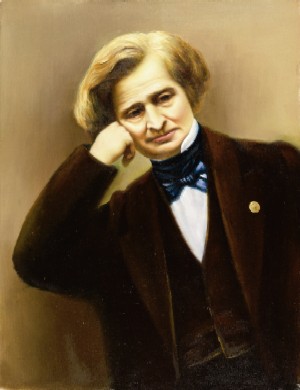
The symphony introduces Berlioz’s idée fixe, an invention whereby a musical motive symbolizes a thing, a concept or, in this case, a person. This is not necessarily a new thought in program music—Vivaldi used melodies to represent birds, wind, or ice in his Four Seasons, and Beethoven’s use of motivic development has layers of symbolism. The idée fixe, however, is new in that it explicitly states that it represents a character while simultaneously acting as a motive. In this work, the idée fixe is used in some form or another in each of the five movements as a unifying device. In this, Berlioz foreshadows Wagner’s use of leitmotifs thirty years later, as well as John Williams’ “Darth Vader theme” by 140 years. Here, in the 4th movement, the ‘hero’ is being marched to the scaffold. Just as the end is imminent, the idéée fixe, representing the hero’s ‘beloved’, returns to mock him as the trap door opens.
Composer: Hector Berlioz
-
"Symphonie Fantastique, Op. 14: IV. March To The Scaffold"
Clara Wieck and Robert Schumann
Clara Wieck (1819-1896) and Robert Schumann (1810-1856) are one of the most famous couples in music history. Of the two, Robert is undoubtedly the better known composer. However, in addition to being a fine composer, Clara was also one of the first women virtuoso performers. Unfortunately, during her marriage to Robert, she gave up her musical career. After his death, she toured extensively as a solo performer with her friend the violinist, Joseph Joachim.
In many ways Robert was a typical product of the age in which he lived, combining a number of the principal characteristics of Romanticism in his music and his life. Born in Zwickau in 1810, the son of a bookseller, publisher, and writer, he showed an early interest in literature. After brief study at university, he was allowed by his widowed mother and guardian to undertake serious study of the piano with Friedrich Wieck, whose favorite daughter Clara was later to become his wife. An injury to his right hand, however, stopped his dreams of becoming a virtuoso pianist.
Both Robert and Clara were greatly influenced by literature. Schumann himself was a writer, and in his mid-20s founded an influential musical periodical, the New Journal of Music, in which he frequently published his own musical criticism. He wrote very favorably about both Johannes Brahms (1833-1897) and Frédéric Chopin (1810-1849).
Clara Wieck and Robert Schumann are one of the most famous couples in music history...
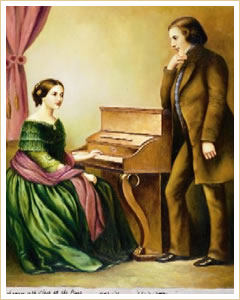
Schumann seems to have been subject to sudden depression, and, on one occasion, attempted to take his own life. After Robert's final mental collapse, around 1854, and his eventual commitment to a local insane asylum, Brahms and Clara developed a deep attachment towards each other, which resulted in a wonderful, enduring friendship.
Piano Music of Robert Schumann
The piano music of Schumann, whether written for himself, for his wife, or, in later years, for his children, offers a wealth of material. In fact, his entire early work as a composer (Opp. 1-23), except his one piano concerto, was written for piano solo.
A master of the miniature, Schumann's piano compositions are, for the most part, loose collections of cycles unified by fanciful literary titles. From the earlier period comes Carnaval, a series of short musical scenes based on the letters of the composer's name and that of the town of Asch, home of Ernestine von Fricken, a fellow-student of Friedrich Wieck, to whom Schumann was briefly engaged. The same period brought the Davidsbündlertänze (Dances of the League of David), a reference to the imaginary league of friends of art against the surrounding Philistines. This decade also brought the first version of the monumental Symphonic Studies, based on a theme by the father of Ernestine von Fricken, and the well known Kinderszenen (Scenes of Childhood). Kreisleriana has its literary source in the Hoffmann character Kapellmeister Kreisler much as Papillons (Butterflies) is based in the work of the writer Jean Paul. Noveletten shows a clear literary reference in the title itself. Later piano music by Schumann includes the Album für die Jugend (Album for the Young) of 1848, Waldszenen (Scenes of the Forest) of 1849 and the collected Bunte Blätter and Albumblätter drawn from earlier work.
Schumann's compositions also include piano, violin, and cello concertos, four symphonies, a piano quintet, and an extensive song output (more than 140), based on the writings of outstanding poets of his time including Goethe, Byron, and Heine among others.
Composer: Robert Schumann
-
"Symphonic Études, Op. 13: Étude No. 3"
Clara published between 20 to 30 compositions, including a piano concerto, a piano trio in G minor, pieces for piano, and songs (lieder).



