
Learning Objectives
- Relate how Romantic poets and artists abandoned traditional subjects, turning instead to the passionate and the fanciful.
- Relate how the Industrial Revolution impacted the technological development and affordability of musical instruments.
- Analyze how the orchestra grew in size and sound as new instruments were introduced and composers demanded greater levels of expression.
- Illustrate how Romantic composers explored nationalistic folklore and exotic subjects.
- Identify the form of romantic period songs, including strophic, through-composed, and the modified strophic forms.
- Examine the German art song (or Lied) as a favored romantic period genre.
- Discuss how the music of Franz Schubert impacted romantic period music.
- Discuss how the music of Frédéric Chopin impacted romantic period music.
- Trace the ascendance of program music in relation to absolute music.
- Summarize how political unrest throughout Europe stimulated the formation of schools of musical nationalism in Russia, Scandinavia, Spain, England, and Bohemia among other countries.
- Differentiate between the distinct national styles of romantic opera in France, Germany, and Italy.
- Discuss how the Italian nationalist composer Giuseppe Verdi impacted romantic period music.
- Trace how choral music became a popular artistic outlet for the middle classes.
- Discuss how the Russian composer Pyotr Ilyich Tchaikovsky impacted romantic period music.
Romantic Period (1820–1910)
Two Composer-Critics
Though their music sounds very different, Robert Schumann and Hector Berlioz both wrote very personal, even autobiographical pieces, often with descriptive titles or programs. Each also wrote in an extraordinarily original style, and both men were critics as well as composers. Robert Schumann founded and edited the Neue Zeitschrift für Musik (New Journal of Music), still published today. He was one of the first to praise Berlioz’s Symphonie fantastique, and he helped make the careers of several other artists, including Chopin and Brahms. It was Schumann who famously proclaimed, in a review of Chopin, “Hats off, gentlemen, a genius!”
Berlioz always struggled to support himself and his family by composing (he married and had a son with the object of his desire portrayed in the Symphonie fantastique), so he supplemented his income by writing music criticism. As it turned out, he was extremely good at it. His mission became educating the Parisian public that music was not mere entertainment but a highly expressive art form. His Memoirs provide a wonderful view into 19th century music and life. He also wrote an influential book on orchestration titled Treatise on Instrumentation, where he lay fundamental concepts for the modern symphony orchestra.
Hector Berlioz
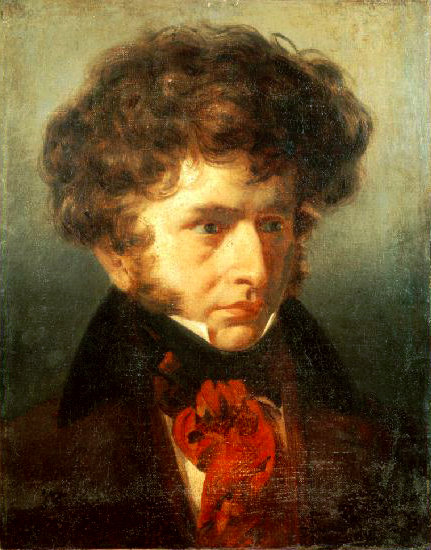
Berlioz was one of the first famous composers who didn't come from a musical family. He was expected to follow in his father's footsteps and become a doctor, but his interest in music quickly surpassed his interest in medicine. Weary of sneaking into the Paris Conservatory Library to study scores—he seems to have been caught a few times—he finally enrolled there, and began a contentious relationship with Conservatory professors that would last until he wrung from them the coveted Prix de Rome in 1830. It seems he finally wrote what they wanted to hear, after years of submitting compositions in his own, less palatable style. In addition to requiring a stint in Rome, the prize came with a five-year pension—a terrific boon for any composer just starting out. Unfortunately, by the time he won the competition, Berlioz no longer wanted to be separated from his beloved Harriet Smithson (the subject of his famous symphony), so the victory was bittersweet.
Berlioz’s idée fixe, representing Smithson, sounds like this.
Composer: Hector Berlioz
-
"Symphonie Fantastique, Op. 14: IV. March To The Scaffold" [ 04:21-04:27 ]00:06
Listen again to the "March to the Scaffold" and notice the moment when, just before the head of the opium-addled artist falls to the guillotine, the idée fixe reappears.