
Learning Objectives
- Outline the social, cultural, and political impact of WWI and WWII.
- Discuss the growth of the United States as a world power.
- Describe the impact of technological advancements on the development of music in the twentieth century.
- Describe, compare and contrast the main stylistic differences of Contemporary music styles including impressionism, post-Romanticism, serialism, and expressionism.
- Summarize the changing nature and application of the concept of tonality throughout the century.
- Discuss the impact of Claude Debussy's "Prelude to the Afternoon of a Faun" in light of the Symbolist movement in literature.
- Illustrate how the Russian composer Igor Stravinsky experimented with rhythm, new instrumental combinations, and the percussive use of dissonance, and discuss the impactof these techniques on contemporary music.
- Describe the impact of Arnold Schoenberg and the Second Viennese School on 20th-century music.
- Distinguish the main stylistic differences of nineteenth- and twentieth-century composers and styles.
- Describe the musical and political impact of “national schools” of composition that developed across Europe during the 20th century.
- Explain the impact of composer Aaron Copland on American contemporary music.
- Describe the impact of Latin American composers on the larger "art music" scene and repertoire.
- Define and analyze the main differences between jazz, ragtime, and blues.
Music of the 20th and 21st Centuries (1900-Present)
Currents in the New World: Latin America
Before 1492, music was created in the New World exclusively by Native American peoples, including the North American tribes; the Incas, Mayans, and Aztecs of Central and South America; and the far-flung tribes of the Amazon rainforest. Within 100 years, the Aztecs had been wiped out, the English and French had established colonies alongside the Spanish and Portuguese, disease brought by the settlers had decimated the native populations, and Africans had been brought in as slave labor, particularly along the eastern seaboard. As a result, the music of the Native American people was replaced in many areas by European or African music. Native American music still exists in its original form in places European settlers could not reach, such as the heights of the Andes Mountains along the western seaboard and deep in the Amazon rainforest. Thus Latin American music has become a mixture of three cultures: Native American, European, and African.
The following dazzling piano piece, often played in concert as an encore, unites modernist sounds with Brazilian folk rhythm and melody. O Polichinelo by Heitor Villa-Lobos is from the first of three collections of Prole do Bebê (The Baby's Family), which captures aspects of a young child's imaginative life. The first collection, composed in 1918, profiles each of the child's dolls. With the doll Polichinelo (also known as Pulcinella or Punch), we encounter another character from the commedia dell'arte. Unlike Schoenberg's pathetic Pierrot, this character seems to be an unfeeling rascal.
Composer: Heitor Villa-Lobos
-
"O Polichinelo"
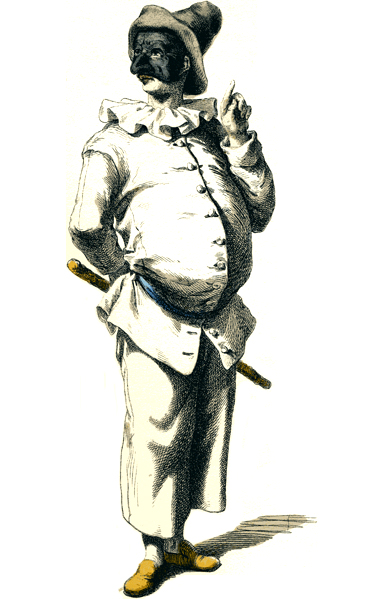
Polichinelo (a.k.a. Pulcinella or Punch)
This drawing is from an 1860 book about the commedia dell’arte by Maurice Sand (1823-1889), son of author George Sand (companion of Chopin). Pulcinella was mostly dumb, disrespectful, and mean. He nevertheless also managed to become the subject of a hit 1920 ballet by Igor Stravinsky.
Heitor Villa-Lobos
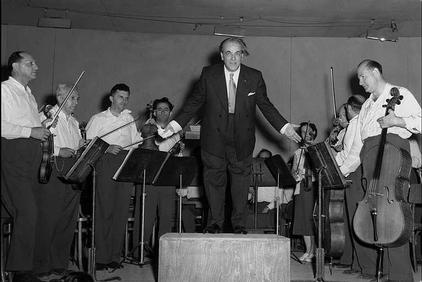
Heitor Villa-Lobos's musical education came from a wide variety of non-academic sources. His father taught him the basics and hosted musical evenings in his home, where Heitor was an avid member of the audience. At the same time, the streets and performance spaces of Rio de Janeiro provided an education in Brazilian popular music. After his father died (when Heitor was just 12), the boy earned money for his family by playing in street bands, in cafes, for parties, and in movie-house and theater orchestras. In the Brazilian countryside, where he traveled extensively, Villa-Lobos absorbed the folk traditions of his country. Villa-Lobos carefully recorded the songs and dances of rural Brazilians, and he incorporated them into his works. At the same time, modernism excited him, and he became a strong advocate for the movement in Brazil.
Though his primary instrument was the cello, he wrote a large number of works for the piano, partly inspired by his wife, Lucília Guimarães, a concert pianist. A second inspiration was the great pianist Arthur Rubinstein (1887–1982), who became a lifelong friend and champion of his music after they met in Brazil in 1918.
In 1923, at Rubinstein's urging, Villa-Lobos set off for Paris, at the time the European musical epicenter. His amalgam of Brazilian and European music found great appeal in a city that was fascinated by African music, music of the East, and all manner of modernist sounds. The years away from Brazil—most of the 1920s—afforded him contact with such influential artists as the painter Pablo Picasso, the composers Aaron Copland, Darius Milhaud, and Edgar Varese, the conductor Leopold Stokowski, and the great guitarist Andrés Segovia, for whom he wrote a set of twelve guitar studies that have become cornerstone pieces of the repertoire.
Indeed, the exceptional quality of Villa-Lobos's guitar music made him one of the most important composers of guitar music of the 20th century. At first, Andrés Segovia found the Etudes unplayable, but afterwards recognized that Villa-Lobos had a deep knowledge of the instrument: "If he chose a particular fingering for the performance of a phrase, we should follow his indications, even at the cost of great technical effort. Villa-Lobos has presented the history of the guitar with the fruits of his talent, as great as that of Scarlatti or Chopin." Villa-Lobos dedicated the Etudes to Segovia in 1953, the year of their publication. The collection is a true catalogue of innovations in its use of styles, ranging from black incantations to the modinha (a Portuguese-Brazilian sentimental song), and its great variety of rhythms. Generally considered as being highly Brazilian in character, the eleventh, one of the most attractive and evocative, is the peak of the series.
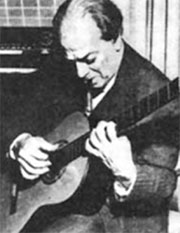
Composer: Heitor Villa-Lobos
-
"12 Etudes: No. 11. Lent"
Soon after his return to Brazil, Getúlio Vargas—the dictator who would become the most important Brazilian political figure of the 20th century—overthrew the Old Republic and embarked on a transformation of Brazilian institutions. In 1932, Villa-Lobos was invited to take charge of music education in Rio de Janeiro. This led him to adopt a compositional style in which Brazilian folk and popular influences are paramount. These influences are most evident in Villa-Lobos's most famous work, the series of nine suites entitled Bachianas Brasileiras, in which he freely applies the forms and compositional procedures found in the music of J. S. Bach to the sounds and rhythms of Brazilian music. They were composed between 1930 and 1945, for various combinations of instruments and voices.
The hauntingly beautiful Bachianas Brasileiras No. 5, for soprano and eight cellos, is the most frequently performed in the series. The first of its two movements, composed in 1938, contains a vocalise (in this case, notes sung on an open "ah" syllable). The more dramatic second section uses lines from a poem by Ruth Valadares Corrêa, who also sang the premiere in 1939. After this section, the vocalise continues in much the same way as it started. Listen for the pizzicato (plucked) cello, which evokes a guitar.
Composer: Heitor Villa-Lobos
-
"Bachianas brasileiras No. 5 (version for piano and cello): I. Aria (Cantilena)"
The Dança (Martelo), composed in 1945, brings to mind the improvised poetry contests once common in northeast Brazil and features the soprano in an imitation of various species of birds.
Composer: Heitor Villa-Lobos
-
"Bachianas Brasileiras No. 5: II. Dança (Martelo)"