
Overview:
Curriculum and the design of effective lesson plans are central to every classroom experience. Students will discover the essential parts of an effective lesson plan and how these elements are influenced by the formal curriculum.
Objectives:
Students will be able to:
- Describe the foundations for curriculum development.
- Define the elements of an effective curriculum.
- Identify and describe age- and grade-appropriate music behaviors for elementary school students.
- Identify the auxiliary components (media, materials, texts) that assist in implementing music activities and curriculum.
- Begin to identify instructional music strategies for younger students.
Closure and Assessment
As closure, the teacher should review the main points of the lesson or plan an activity that brings the learning activities together. In other words, the close of the lesson should "wrap up" what has taken place during the lesson. For example, it might consist of a summary of the main ideas, or questions to the students about specific points in the lesson. It also might be singing through a new song that was learned in its entirety. Closure statements may also include plans for future activities that relate to the lesson. The goal of the final activity is to leave students with positive thoughts about the learning experience.
Assessment and evaluation occur in a wide variety of contexts and settings. Assessment is used to measure progress toward goals and to guide future learning. It may also serve to stimulate effort and produce information helpful in guidance and curriculum revision. In general, assessment can be divided into two categories — informal and formal. Informal evaluation is a natural part of daily instruction; formal evaluation infers testing to measure achievement or aptitude.
Assessment by observation is the most common structure of informal assessment and evaluation. When a student performs in class or answers a question, the teacher's response involves evaluation techniques. These evaluations can be recorded for individual students or for general observations of the entire class. In addition to a verbal response, informal observation includes the results of improvised and other creative endeavors, chalkboard activities, results of cooperative learning activities, and responses to written assignments. When the entire class is observed, its progress could be placed on a simple dated form that shows the objective and describes the teacher's reaction to the students' skills and understanding. The progress of the class could also be noted on the lesson plan, providing evidence for possible adjustments to the plan.
An informal assessment can be effective if combined with a short checklist as in this following example:
Students recited the words to the song with confidence.
YesNo
Students passed the bean bag on the pulse with accuracy.
YesNo
Or, if a more specific assessment of student success would help to determine student growth and development, the statement can be evaluated with a Likert rating scale as in the following example:
Needs Improvement -> Best
Students were able to sing the song “Drummer Hof” on pitch.
1 2 3 4 5
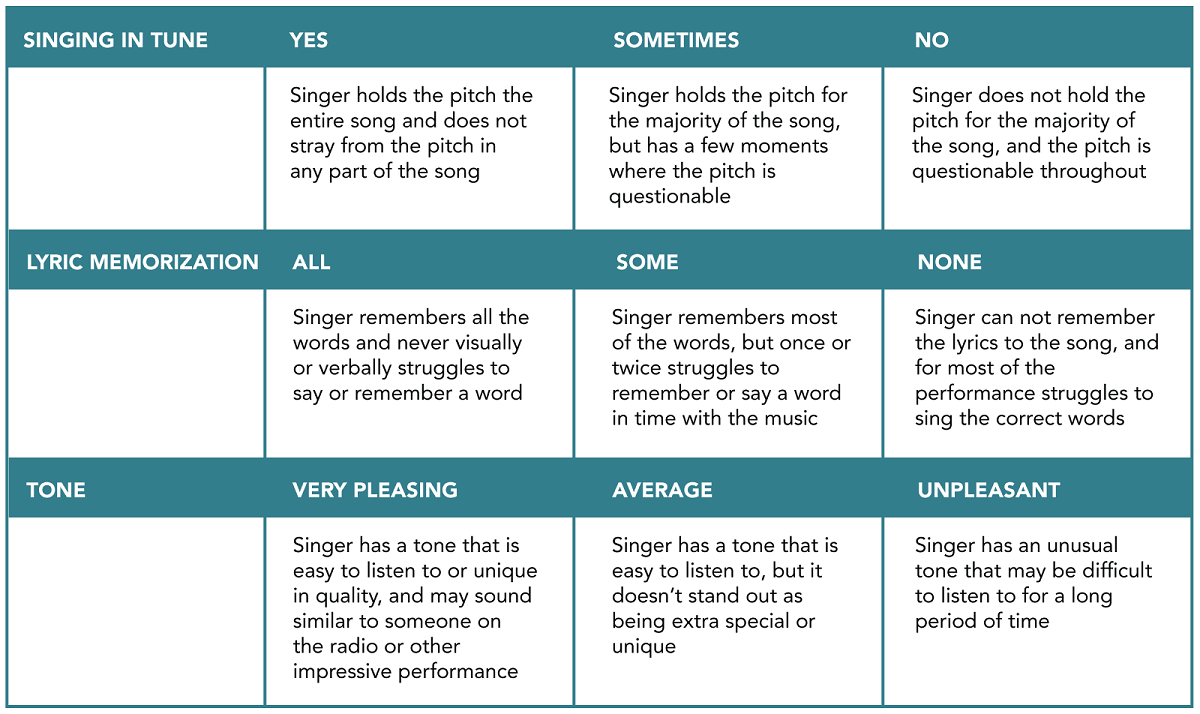
A rubric would also help to make the assessment more objective since it articulates the teacher’s expectations by listing the criteria, or what counts, and describes levels of quality from excellent to poor. Rubrics help the teacher to make dependable judgments and can also be used to help teach by guiding students to develop understanding and skill about the quality of their own work. As part of a formative, student-centered classroom, rubrics can be useful benchmarks for ongoing feedback. Consider the following rubric as a model for the performance of a song.
Formal assessment — written quizzes and tests — has a place in assessing and evaluating student achievement and should be used to balance assessment by observation, especially when letter grades are assigned in the subject.
Regardless of whether the assessment is informal or formal, the teacher should refer to the behavioral objectives when evaluating individual student progress, the progress of the entire class, or the overall success of the lesson. For example, if the behavioral objective is "the student will identify different patterns by selecting the appropriate symbol/label" then the assessment should determine whether the student was able to select the appropriate symbol or label or the degree to which the student could accomplish the task.