
Objectives
- Relate how Romantic poets and artists abandoned traditional subjects, turning instead to the passionate and the fanciful.
- Relate how the Industrial Revolution impacted the technological development and affordability of musical instruments.
- Analyze how the orchestra grew in size and sound as new instruments were introduced and composers demanded greater levels of expression.
- Illustrate how Romantic composers explored nationalistic folklore and exotic subjects.
- Identify the form of romantic period songs, including strophic, through-composed, and the modified strophic forms.
- Examine the German art song (or Lied) as a favored romantic period genre.
- Discuss how the music of Franz Schubert impacted romantic period music.
- Discuss how the music of Frédéric Chopin impacted romantic period music.
- Trace the ascendance of program music in relation to absolute music.
- Summarize how political unrest throughout Europe stimulated the formation of schools of musical nationalism in Russia, Scandinavia, Spain, England, and Bohemia among other countries.
- Differentiate between the distinct national styles of romantic opera in France, Germany, and Italy.
- Discuss how the Italian nationalist composer Giuseppe Verdi impacted romantic period music.
- Trace how choral music became a popular artistic outlet for the middle classes.
- Discuss how the Russian composer Pyotr Ilyich Tchaikovsky impacted romantic period musi
Romantic Period (1820-1910) The Transitional Composers: Franz Schubert - Part I
The Transition Into Romanticism
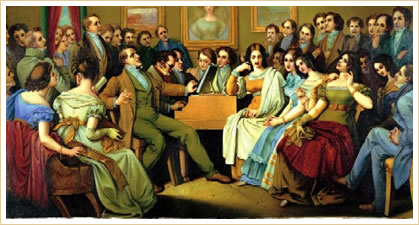
The transition from Classicism to Romanticism begins with Beethoven, a man whose music synthesizes the Viennese Classicism of Haydn and Mozart with the emotional expressionism of Romanticism. During the first three decades of the new century, several other composers also wrote music that exhibited traits of both periods. These "transitional" composers include: Franz Schubert, Felix Mendelssohn, and the Italian opera composers, Gioacchino Rossini, Vincenzo Bellini, and Gaetano Donizetti.
Schubert: The Classic Romanticist
In music, as in all walks of life, there are figures who die prematurely, prompting us to wonder, "what if?" There is no shortage of composers who fall into this category: Mozart, Chopin, Mendelssohn, and Schumann immediately come to mind. Perhaps the question is no more tantalizing, however, than when we consider Franz Schubert.

The transition from Classicism to Romanticism begins with Beethoven. A man whose music synthesizes the Viennese Classicism of Haydn and Mozart with the emotional expressions of Romanticism...

Schubert: Early Life and Works
Franz Peter Schubert was born in Vienna on January 31, 1797. His father was a schoolmaster who, along with Franz' oldest brother, was responsible for the young composer's earliest musical training. Schubert was accepted into the Imperial Chapel-Royal at the age of 11 and became a fixture in the seminary's music program where he was immersed in the religious works of Anton Diabelli, Mozart, Cherubini, and Haydn. His first two compositions, both religious choral works, were written in 1812. The next year he began lessons in composition with Antonio Salieri. Although his father had hoped Franz would follow his footsteps into teaching, Franz turned to composing full-time in 1817.
Although he died at the young age of 31, Schubert wrote nearly 1000 compositions, including over 600 songs. In 1815 alone, at the age of 18, he wrote 144 songs and dozens of larger works.
Gretchen am Spinrade (Gretchen at the Spinning Wheel) is the tale of a young maiden spinning at the wheel, wondering if her lover will come home. The song, written in 1814, is a setting of words by Goethe, the first of Schubert's Goethe settings. Gretchen, seduced by Faust, awaits the return of her lover.
Listen for the depiction of the spinning wheel in the accompaniment and how the wheel comes to a stop when she breaks down emotionally.
Composer: Franz Schubert
-
"Gretchen Am Spinnrade, D.118;"
Meine Ruh' ist hin,
Mein Herz ist schwer,
Ich finde sie nimmer
Und nimmermehr.
Wo ich ihn nicht hab
Ist mir das Grab,
Die ganze Welt
Ist mir vergällt.
Meinarmer Kopf Ist mir verrückt,
Mein armer Sinn
Ist mir zerstückt.
Meine Ruh' ist hin,
Mein Herz ist schwer,
Ich finde sie nimmer
Und nimmermehr.
Nach ihm nur schau ich
Zum Fenster hinaus,
Nach ihm nur geh ich
Aus dem Haus.
Sein hoher Gang,
Sein' edle Gestalt,
Seine Mundes Lächeln,
Seiner Augen Gewalt,
Und seiner Rede
Zauberfluß,
Sein Händedruck,
Und ach, sein Kuß!
Meine Ruh' ist hin,
Mein Herz ist schwer,
Ich finde sie nimmer
Und nimmermehr.
Mein Busen drängt sich
Nach ihm hin.
Ach, dürft ich fassen
Und halten ihn,
Und küssen ihn,
So wie ich wollt,
An seinen Küssen
Vergehen sollt!
Und küssen ihn,
So wie ich wollt,
An seinen Küssen
Vergehen sollt!
Meine Ruh' ist hin,
Mein Herz ist schwer,
Ich finde sie nimmer
Und nimmermehr.
My heart is heavy,
I will find it never
and never more.Where I do not have him,
That is the grave,
The whole world
Is bitter to me.
My poor head
Is crazy to me,
My poor mind
Is torn apart.
My peace is gone,
My heart is heavy,
I will find it never
and never more.
For him only, I look
Out the window
Only for him do I go
Out of the house.
His tall walk,
His noble figure,
His mouth's smile,
His eyes' power,
And his mouth's
Magic flow,
His handclasp,
and ah! his kiss!
My peace is gone,
My heart is heavy,
I will find it never
and never more.
My bosom urges itself
toward him.
Ah, might I grasp
And hold him!
And kiss him,
As I would wish,
At his kisses
I should die!
And kiss him,
As I would wish,
At his kisses
I should die!
My peace is gone,
My heart is heavy,
I will find it never
and never more.
The Erlkönig (Erlking), written in 1815, is one of the best known of all Schubert’s songs. The setting of Goethe's ghostly ballad follows a father carrying his sick child in his arms, lured from him by the sinister elfin king, the Erlkönig of the title. The narrative is adapted from a Danish legend.
The music reflects the terror of the ride, the fears of the father, and the seductive power of the Erlkönig. The boy cries out that the Erlking is trying to hurt him. Schubert has given the sound of the galloping horse to the accompaniment, while setting each of the characters (father, son, and Erlking) in a different vocal range. Also, note how Schubert modulates up by steps (instead of through the circle of fifths) to heighten the terror. Listen to each of the entrances of the boy as his fear turns into panic:
Composer: Franz Schubert
-
"Erlkönig, D. 328"
First entrance / Second entrance / Third entrance
|
Wer reitet so spät durch Nacht und Wind? Es ist der Vater mit seinem Kind; Er hat den Knaben wohl in dem Arm, Er faßt ihn sicher, er hält ihn warm. |
Who's riding so late through night, so wild? It is the father who's holding his child; He's tucked the boy secure in his arm, He holds him tight and keeps him warm. |
|
"Mein Sohn, wa "Siehst, Vater, du den Erlkönig nicht? Den Erlenkönig mit Kron und Schweif?" "Mein Sohn, es ist ein Nebelstreif." |
"My son, why hide you your face in fear?" "See you not, father, the Erlking near? The Erlking in his crown and train?" "My son, 'tis but a foggy strain." |
|
Du liebes Kind, komm, geh mit mir! Gar schöne Spiele spiel ich mit dir; Manch bunte Blumen sind an dem Strand, Meine Mutter hat manch gülden Gewand. |
"Sweet lovely child, come, go with me! What wonderful games I'll play with thee; Flowers, most colorful, yours to behold. My mother for you has garments of gold." |
|
"Mein Vater, mein Vater, und hörest du nicht, Was Erlenkönig mir leise verspricht?" "Sei ruhig, bleibe ruhig, mein Kind: In dürren Blättern säuselt der Wind." |
"My father, my father, and can you not hear What Erlking is promising into my ear?" "Be calm, stay calm, o child of mine; The wind through dried leaves is rustling so fine." |
|
"Willst, feiner Knabe, du mit mir gehn? Meine Töchter sollen dich warten schön; Meine Töchter führen den nächtlichen Reihn Und wiegen und tanzen und singen dich ein." |
"Wouldst thou, fine lad, go forth with me? My daughters should royally wait upon thee; My daughters conduct each night their song fest To swing and to dance and to sing thee to rest." |
|
"Mein Vater, mein Vater, und siehst du nicht dort Erlkönigs Töchter am düstern Ort? "Mein Sohn, mein Sohn, ich seh es genau Es scheinen die alten Weiden so grau." |
My Father, my father, and can you not see Erlking's daughters, there by the tree?" "My son, my son, I see it clear; The ancient willows so grey do appear." |
|
Ich liebe dich, mich reizt deine schöne Gestalt; Und bist du nicht willig, so brauch ich Gewalt." "Mein Vater, mein Vater, jetzt faßt er mich an! Erlkönig hat mir ein Leids getan!" |
"I love thee, I'm aroused by thy beautiful form; And be thou not willing, I'll take thee by storm." "My father, my father, he's clutching my arm! Erlking has done me a painful harm!" |
|
Dem Vater grauset's, er reitet geschwind, Er hält in Armen das ächzende Kind, Erreicht den Hof mit Müh' und Not: In seinen Armen das Kind war tot. |
The father shudders and onward presses; The gasping child in his arms he caresses He reaches the courtyard, and barely inside, He holds in his arms the child who has died. |
Gretchen am Spinrade and The Erlkönig are only two of the hundreds of songs that show Schubert’s unfailing inspiration and his extraordinary coupling of words with music, in which both melody and piano accompaniment serve a dramatic purpose. The poems that he chose, however, vary in quality, with more than seventy settings by Goethe, and other verses by less gifted contemporaries and friends, works that the music has given life and eternity.
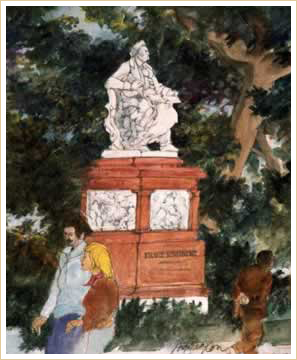
Schubert wrote nearly 1000 compositions, including over 600 songs. In 1815 alone, at the age of 18, he wrote 144 songs and dozens of larger works...
As we have seen, the traits of Romanticism first began to appear in songs. Schubert's genius is first apparent in his lieder of 1814 and 1815. He was equally comfortable writing strophic, modified strophic, or through-composed lieder. But three features stand out, even in his earliest works: Schubert's innate gift for lyricism, his innovative accompaniments, and his harmonic invention. The two songs you have heard, both written in 1815, show all three traits.



Brahms attempted to retire early at age 57, but continued composing until his death seven years later
