
Learning Objectives
- Explore the circle of fifths, which collects the fifteen major keys (including three enharmonic keys) into a single diagram.
- Learn how to create and use the circle of fifths to quickly write scales and key signatures.
Key Signatures V: The Circle of Fifths
The Circle of Fifths
You have likely discovered by this point that each major key has its own unique key signature. There are seven keys that use sharps, seven that use flats, and one that uses neither, for a total of fifteen major keys. The following diagram, known as the circle of fifths, presents a visual representation of all fifteen major keys used in the Western system of tonal harmony, along with their key signatures.
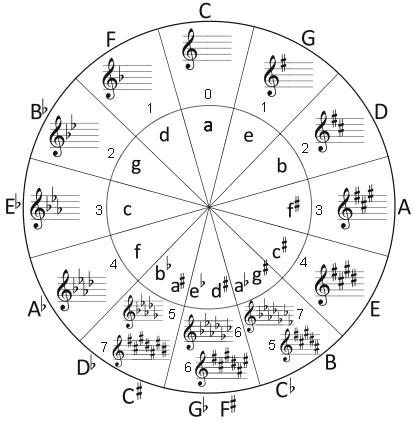
At the top of the circle is C major, which has no sharps or flats. Moving clockwise around the circle, each subsequent key adds one sharp (or removes one flat) until the circle reaches C-sharp major, which has seven sharps. Moving counter-clockwise around the circle, each subsequent key adds one flat (or removes one sharp) until the circle reaches C-flat major, which has seven flats.
The circle is called a circle of fifths because each new key in the circle (moving clockwise) starts on the fifth degree of its predecessor. For example, G is the fifth scale degree in the key of C, D is the fifth scale degree in the key of G, and so on.
| Two Interesting Key Relationships |
If you explore the circle of fifths closely, you can find interesting patterns and relationships, such as the following:
|
Enharmonic Keys
At the bottom of the circle, there are three enharmonic keys, where the sharp side of the circle (clockwise) overlaps with the flat side (counter-clockwise):
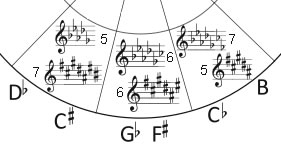
- B major (5 sharps) sounds the same as C-flat major (7 flats)
- F-sharp major (6 sharps) sounds the same as G-flat major (6 flats)
- C-sharp major (7 sharps) sounds the same as D-flat major (5 flats)
In practice, the keys of B major and D-flat major are used more often than the keys of C-flat major and C-sharp major. But pieces in F-sharp major and G-flat major are about equally likely.
Exploring the Circle of Fifths
The interactive diagram below shows all of the major keys (including the enharmonic keys) along the circle of fifths. Explore the circle by clicking on the key names to see their key signatures and hear their corresponding scales played. You can also use the virtual keyboard in the middle of the circle to practice playing each of the major scales.
The Circle of Fifths
| The circle of fifths |
Using the Circle of Fifths
The circle of fifths can be a very useful tool when you are learning about scales and key signatures. If you can quickly sketch a circle of fifths on paper (or refer to it in your mind), you can use it to determine the key signature for any key. And if you know the key signature for a key, you can easily write out its major scale.
Here is one method for constructing a simple circle of fifths from scratch:
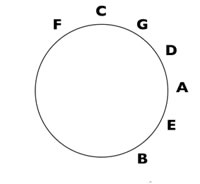
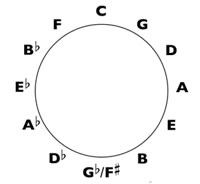
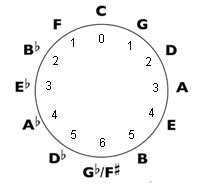
* Note that we added the enharmonic key of F-sharp, but omitted C-sharp and C-flat. You can add them too, if you need them.
Now let's say, for example, that you were asked to write a B major scale (using accidentals rather than a key signature). You could, of course, write a scale starting on B that uses the WWH W WWH pattern. But if you knew the key signature for the key of B major, you could just put those accidentals in the scale. Looking at the circle of fifths, you can see that B has five sharps in it. What are those five sharps? The first five in the order of sharps: F C G D A. Now, starting on B, write out a scale that has an F#, C#, G#, D#, and A# in it, as follows:

Now let's say that you were asked to write an A-flat major scale. Looking at the circle of fifths, you can see that A-flat has four flats in it. What are those four flats? The first four in the order of flats: B E A D. Now, starting on A♭, write out a scale that has a B♭, E♭, A♭ and D♭ in it, as follows:

In other words, simply knowing the number of sharps or flats in a key will allow you to determine its key signature or write down its major scale, as long as you keep in mind the order of sharps and flats.
The worksheets, interactive exercises, and graded quizzes that follow will test your knowledge of major scales and major key signatures. Take a moment to review what you have learned before tackling them.