
Objectives
- Recognize the differences between the Medieval and Renaissance periods in terms of society, religion, art, science, and freedom.
- Explain how Renaissance musicians made their living.
- Use relevant musical vocabulary to analyze Renaissance a cappella singing.
- Distinguish the characteristics of Renaissance music, and differentiate between Renaissance music and Medieval music.
- Illustrate how composers used the motet, a sacred genre with a Latin devotional text, to experiment in musical style and texture.
- Describe how Renaissance composers set texts from the Ordinary of the Mass for their polyphonic Masses.
- Describe how instrumental dance music was performed by professional and amateur musicians.
Instrumental Music in the Renaissance (1450-1600)
During the Renaissance, musicians became increasingly aware of the possibilities of purely instrumental music, as opposed to the use of instruments as mere accompaniment for voices. Popular instruments of this period were woodwinds (shawm, krummhorn, oboe, and recorders of various sizes); strings (the viol family, which is the predecessor of the violin family, and the lute); brass (cornet, trumpet, and trombone); percussion, and keyboard instruments (organ, virginal, harpsichord, and clavichord).
Voices, woodwind, string, and percussion instruments are mixed in the humorous piece Rodrigo Martinez, by an unknown Spanish composer.
Composer: Anonymous
-
"Rodrigo Martinez"
"Rodrigo Martinez"Anonymous
Keyboard instruments
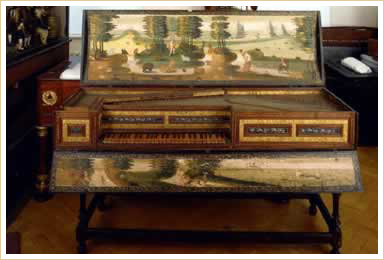
Keyboard instruments, especially the virginal, clavichord, and organ, were also popular during the Renaissance. Keyboard music evolved from accompanying vocal music to dance music, and then to increasingly complex original compositions.
During the Renaissance, the quality and variety of most instruments increased greatly. In particular, keyboard instruments were more skillfully constructed, held pitch better, and had superior sound quality than those of the Middle Ages.
William Byrd (1543-1623)
The greatest English composer of his generation, comparable in stature to his most distinguished continental contemporaries, William Byrd was a versatile composer. Although remaining a Catholic, loyalty that cost him considerable trouble in times of persecution in England, he served as a member of the Chapel Royal, providing music for the liturgy of the Church of England and, on a more private scale, for his fellow-Catholics.
Byrd was well known as a keyboard-player. He wrote a wealth of music for the virginal, including fantasias, pavans, and galliards, the fashionable paired dances of the time, and song variations. Qui passe is a virginal piece that showcases the composer's remarkable compositional skill.
Composer: William Byrd
-
"Qui passe; for my Ladye Nevell"
The Lute
The Lute is one of the oldest musical instruments, dating back to around 2500 BC. The English word lute originally came from the Arabic al-oud, which literally means "branch of wood." Other versions of this instrument that originated in the Middle East, are also known in Japan, and Africa.
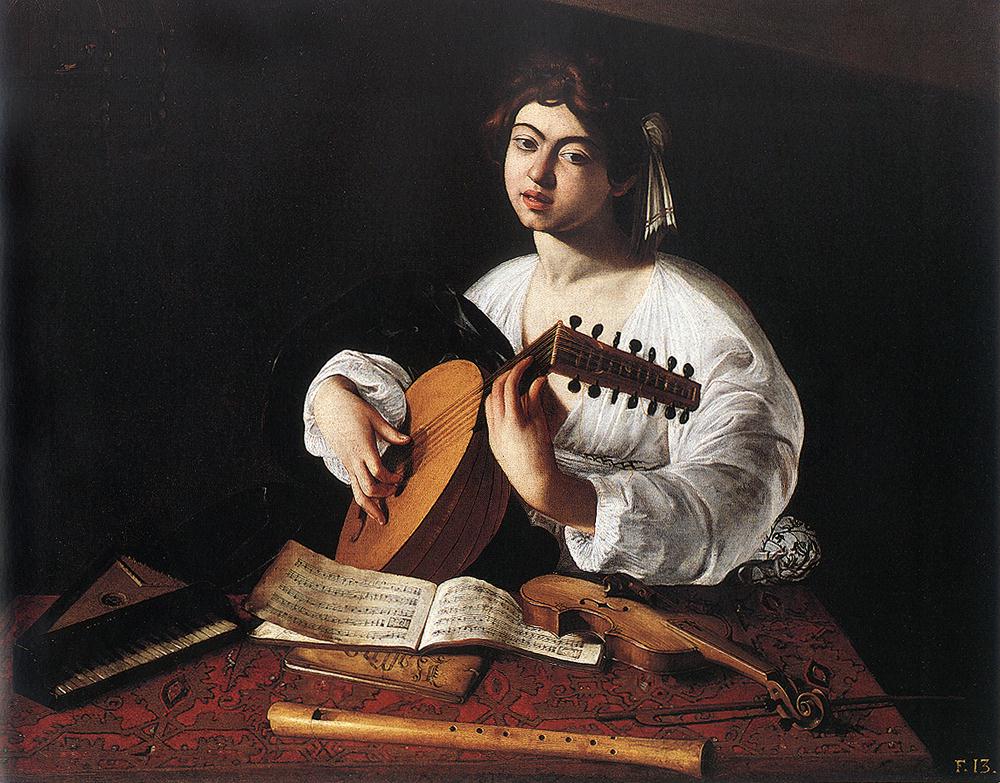

The Lute is one of the oldest musical instruments, dating back to around 2500 BC...

Composer: John Dowland
-
"Greensleeves Divisions"
"Greensleeves"John Dowland
Until the end of the 1700s, the lute was one of the most popular instruments in Europe, but was later replaced by keyboard instruments. Lute music is usually written using a complex system of notation known as "tablature notation" that uses numbers and letters of the alphabet to represent pitches. To this day, there are many societies around the world devoted to the study of the lute, including the Lute Society of America. Other web resources also include a brief history of the lute, among others.
The Vihuela
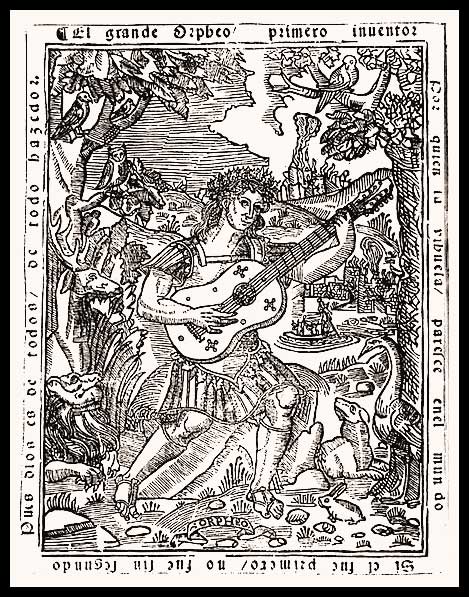
Closely related to the lute—they shared similar stringing and tuning— but differing in shape, the vihuela resembles a delicate 12-string guitar with decorated rosettes instead of a sound hole. It is very strange that so little music of one of the most popular string instruments in 16th-century Spain has survived to the present day. Existing pieces are, however, quite popular among present-day guitarists.
The vihuela or vihuela da mano is one of the most interesting plucked string instruments of the Renaissance. It enjoyed great popularity in Spain during the 16th century, but was also in common use in Italy and Portugal, where it was known as viola da mano.
Compositions for the vihuela constitute an important body of instrumental music from the Renaissance.
The first book of music for the vihuela was El Maestro—a collection of pieces intended for instruction—by Luis Milán (1536). After that came Los seys libros del Delphin by Luys de Narváez (1538), Tres Libros de Música by Alonso Mudarra (1546), Silva de sirenas by Enríquez de Valderrábano (1547), Libro de música de Vihuela by Diego Pisador (1552), Orphénica Lyra by Miguel de Fuenllana (1554), and El Pamasso by Estevan Daça (1576). These few books and manuscripts represent the entire vihuela repertoire that has survived to the present day.
Typical examples of compositions for the vihuela are Tiento 1 by the Spanish Luis de Milán (c.1500-c.1561) and Ya se asienta el Ramiro by his fellow countryman Luys de Narváez (1500-1555). In these compositions, you will hear passages that are played in fast, repetitive patterns designed to show off the instrument's expressive capabilities and the player's skill.
Composer: Luis de Milán
-
"Tiento No. 1"
"Tiento I"Luis de Milán (c.1500-c.1561)
Composer: Luys de Narvaez
-
"Ya se Asienta el Ramiro"
"Ya se asienta el Ramiro"Luys de Narváez (1500-1555)
Instrumental Ensembles
In the Renaissance period, instrumental ensembles were called consorts. Very often, a consort consisted of instruments from the same family. For example, there were consorts of recorders, consorts of viols, etc. Galliard a 5, by John Dowland (1563-1626), exemplifies a string consort.
Still, most instrumental music was created for dancing, a popular activity during the Renaissance. The types of dances, which varied from region to region, included the galliard, allemande, courante, passamezzo, saltarello, and the pavan. Each dance has its own distinctive rhythmic structure or pattern.
Composer: John Dowland
-
"Galliard a5"
John Dowland (1563-1626)
As well as being one of the most published composers of his time, Dowland's First Book of Songs or Ayres (1597) was the most often reprinted music book of its time. Dowland was also a lutenist and singer, who many consider one of the most important musicians as well as one of the greatest songwriters of all time. He also traveled extensively. He worked in Paris and Germany, and, from 1598 to 1606, he was a lutenist to Christian IV of Denmark. In 1612, after many failed attempts, he was finally appointed as one of the English king's lutenists, a post he held until his death. Like so many other great composers, Dowland, despite his fame, died neglected and in poverty.
Tablature Notation
Even though notation for voices had improved considerably since 1300, Renaissance methods of notation for instruments were still in their infancy. Some instruments, such as the lute, used tablature, a shortcut method of writing notes that could not be transferred to another instrument. It told the performer little about the musical construction of the piece, only where to put their fingers. Tablature for the guitar is still used today, and may be found in print and at numerous sites on the Internet.
Renaissance composers did not generally specify which instruments were to be used on a particular piece. Often, the only distinction noted was between loud instruments for outdoor performances and soft ones for indoors.
New instrumental forms emerged, such as the ricercare and the canzona, which featured compositional techniques that, until then, had only been used in vocal music. Both forms were patterned on vocal forms, but used improvisation and instrumental embellishment.
Orlando Gibbons (1583-1625)
Composer: Orlando Gibbons
-
"Pavan for 6 viols"
"Pavan for 6 viols"Orlando Gibbons (1583-1625)
Orlando Gibbons belongs to the generation of English composers that followed that of William Byrd, forty years his senior, who died in 1623. He was a chorister at King's College, Cambridge, where his elder brother was Master of the Choristers, and later became a gentleman of the Chapel Royal, where he served as an organist. Later, he was appointed organist at Westminster Abbey. Gibbons wrote music for the Church of England, madrigals, consort music, and keyboard works.
Examples for Renaissance Period Listening Test
- Ockeghem: Agnus Dei from Missa Prolationum
Composer: Johannes Ockeghem
-
"Missa Prolationum: Agnus Dei" [ 01:21-01:54 ]00:33
2. Josquin: Absolom fili mi
Composer: Josquin des Prez
-
"Absalon fili mi"
3. Palestrina: Kyrie from Pope Marcellus mass
Composer: Giovanni da Palestrina
-
"Kyrie from Pope Marcellus mass"
4. Victoria: Ave Maria
Composer:
-
"Ave Maria"
5. Weelkes: When David Heard
Composer: Thomas Weelkes
-
"When David Heard" [ 03:01-03:57 ]00:57
6. Gesualdo: O vos omnes
Composer: Tomás Luis de Victoria
-
"O vos omnes" [ 00:00-00:41 ]00:41
7. Weelkes: As Vesta was
Composer: Thomas Weelkes
-
"As Vesta was descending" [ 00:39-01:22 ]00:42
8. Monteverdi: Canzonnete d'amore
Composer: Claudio Monteverdi
-
"Canzonette d'Amore; Monteverdi, Claudio" [ 01:41-02:36 ]00:56
9. Gibbons: Pavan for 6 viols
Composer: Orlando Gibbons
-
"Pavan for 6 viols"
10. Byrd: Qui passe for virginal
Composer: William Byrd
-
"Qui passe; for my Ladye Nevell" [ 00:57-01:52 ]00:55
11. Dowland: A Shepherd in a Shade, lute song
Composer: John Dowland
-
"A Shepherd In A Shade" [ 00:19-01:01 ]00:41



