
Objectives
- Outline the social, cultural, and political impact of WWI and WWII.
- Discuss the growth of the United States as a world power.
- Describe the impact of technological advancements on the development of music in the twentieth century.
- Describe, compare and contrast the main stylistic differences of Contemporary music styles including impressionism, post-Romanticism, serialism, and expressionism.
- Summarize the changing nature and application of the concept of tonality throughout the century.
- Discuss the impact of Claude Debussy's "Prelude to the Afternoon of a Faun" in light of the Symbolist movement in literature.
- Illustrate how the Russian composer Igor Stravinsky experimented with rhythm, new instrumental combinations, and the percussive use of dissonance, and discuss the impactof these techniques on contemporary music.
- Describe the impact of Arnold Schoenberg and the Second Viennese School on 20th-century music.
- Distinguish the main stylistic differences of nineteenth- and twentieth-century composers and styles.
- Describe the musical and political impact of “national schools” of composition that developed across Europe during the 20th century.
- Explain the impact of composer Aaron Copland on American contemporary music.
- Describe the impact of Latin American composers on the larger "art music" scene and repertoire.
- Define and analyze the main differences between jazz, ragtime, and blues.
Contemporary Period: Schoenberg, Berg, and Webern
Atonality
One distinctive feature of early 20th-century music is the disagreement among composers regarding the correct approach to composition. As a result, the compositional styles of 1910 and 1940 are shockingly dissimilar. Furthermore, although they worked at the same time, composers of different nationalities who wrote during the early part of the 20th century were influenced by a variety of discrete ideas, influences, and outcomes.
Nonetheless, we can place early 20th-century composers into three categories, which roughly correspond to the three main trends of the late Romantic period: German Post-Romanticism, which led to the atonal music of Arnold Schoenberg and his followers, the French/Russian music of Debussy and Rimsky-Korsakov, which gave rise to the music of Igor Stravinsky, and finally, the nationalistic music of the Romantic era which influenced a host of 20th century artists, most notably, Béla Bartók.
A long period of experimentation with tonal harmony culminated in the music of the German post-Romantics. Compositions by Wagner and Mahler aptly illustrate this expansion—a restless harmony that almost entirely disregards the standard qualities of tension and resolution found in music after Palestrina. Strauss and Scriabin understood that, if music was to remain new and progressive, the antiquated system of harmony was no longer an option. Along with Debussy, they created music that was tonal only in its use of new scales or chordal structures.
Arnold Schoenberg (1874-1951)
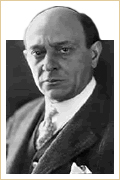
Arnold Schoenberg was a young Viennese musician with little training in composition. His first efforts, like the string sextet Verklärte Nacht (Transfigured Night), reflect the advanced tonality of Richard Strauss and Hugo Wolf. In fact, all of his early works (those written before 1905) are essentially Post-Romantic.
After 1905, however, Schoenberg began to distance himself from the music of his German and Austrian contemporaries. He created smaller works for chamber orchestra, quartet, and solo piano that contained more solo passages and fewer large, Romantic gestures. These works featured more counterpoint than the contemporary Romantic music, as well as greater melodic fragmentation and variety. Also evident in these works is atonality, a term which refers not to ‘absence of tonality,’ but rather to a lack of a tonal center. In atonal music, no single note emerges as tonic; all twelve notes are treated more or less equally, with no discernible hierarchy of pitches.
The resulting music can often sound chaotic and extremely dissonant, as is the case in this excerpt from the second of his Six Little Piano Pieces, op. 19. Schoenberg theorized that the concept of consonance and dissonance, derived from the traditional tonal system of Western music, was archaic and inadequate.
When World War I broke out, Schoenberg served in the German army. For six years he did not write new music; he did, however, formulate theories of atonality. His theories led to serialism, one of the most innovative and controversial concepts in music history.
Serialism (or twelve-tone music) originated with the premise that the major/minor tonal system was musically outdated,and that all twelve pitches in the chromatic scale should be accorded the same importance. One of Schoenberg's first works to employ serialism was his Op. 23 entitled Five Piano Pieces of which this is No. 2. Schoeberg also realized that his earlier approach to atonality could lead to musical anarchy. An admirer of the thematic development of Beethoven and the leitmotifs of Wagner, he sought for a unifying device within the freedom of atonality.
Composer: Arnold Schoenberg
-
"Six Little Piano Pieces, Op. 19: II. Langsam"

Serialism (or twelve-tone music) originated with the premise that the major/minor tonal system was musically outdated, and that all twelve pitches in the chromatic scale should be accorded the same importance...

In serialism, the composer places all twelve notes of the chromatic scale (A, A#, B, C, C#, D, D#, E, F, F#, G, G#) in a selected order, called a row (for instance: B, G, F#, G#, E, C, D, A, A#, C#, F, D#). This row functions as the ‘theme’ for the piece, and may be manipulated in the same way Bach manipulated his thematic subjects, i.e., forwards (original), backwards (retrograde), upside-down (inversion), the backward version of the inversion (retrograde inversion), as well as in chords, melodies, etc. Schoenberg’s music differs from Bach’s in that it does not have a tonal center, and, therefore, is atonal.
Schoenberg continued to use this compositional technique for the rest of his career, applying it to works for piano, orchestra, chamber ensembles, and even part of an opera, Moses and Aaron.
Like Mahler, to escape the stigma of being an intellectual Jew in Germany, Schoenberg converted to Catholicism. In 1933, as Hitler’s regime brought further persecution, he moved to the United States, where he spent the rest of his career, eventually settling in Los Angeles.
Alban Berg (1885-1935) and Anton Webern (1883-1945)
Schoenberg is one of the few 20th century composers who inspired a "school" of followers devoted to his music and ideals. Individuals in this school included Alban Berg (1885-1935) and Anton Webern (1883-1945).
Berg employed a unique brand of serialism that at times appears tonal. He often arranged the twelve tones in a row, giving the listener the false impression of major and minor triads. Perhaps his greatest works are two operas: Wozzeck and Lulu. Due to its musical construction, as well as its dramatic and disturbing portrayal of psychological disorder, Wozzeck is recognized as a masterpiece of 20th century opera.
Webern’s use of serial techniques is considerably different. Taking Schoenberg’s melodic fragmentation to its limits, he often divided the twelve notes of a melodic row between numerous different instruments, as in his masterpiece Symphony, Op. 21 (1928). His Piano Variations, Op. 27 illustrates his approach to melodic fragmentation. Furthermore, he applied serial techniques to other musical elements as well, including the dynamics and the rhythmic value of the notes. Webern’s music was a catalyst for the more complicated serial techniques that developed following World War II.
Schoenberg is one of the few 20th century composers who inspired a ‘school’ of followers devoted to his music and ideals...



Ralph Vaughan Williams was the great-nephew of Charles Darwin and the great-great-grandson of Josiah Wedgwood
