
Objectives
At the end of this section, students will be able to:
- Relate how Romantic poets and artists abandoned traditional subjects, turning instead to the passionate and the fanciful.
- Relate how the Industrial Revolution impacted the technological development and affordability of musical instruments.
- Analyze how the orchestra grew in size and sound as new instruments were introduced and composers demanded greater levels of expression.
- Illustrate how Romantic composers explored nationalistic folklore and exotic subjects.
- Identify the form of romantic period songs, including strophic, through-composed, and the modified strophic forms.
- Examine the German art song (or Lied) as a favored romantic period genre.
- Discuss how the music of Franz Schubert impacted romantic period music.
- Discuss how the music of Frederic Chopin impacted romantic period music.
- Trace the ascendance of program music in relation to absolute music.
- Summarize how political unrest throughout Europe stimulated the formation of schools of musical nationalism in Russia, Scandinavia, Spain, England, and Bohemia among other countries.
- Differentiate between the distinct national styles of romantic opera in France, Germany, and Italy.
- Discuss how the Italian nationalist composer Giuseppe Verdi impacted romantic period music.
- Trace how choral music became a popular artistic outlet for the middle classes.
- Discuss how the Russian composer Pyotr Ilyich Tchaikovsky impacted romantic period music.
Romantic Period: The Traditionalists
By the mid-19th century, only a handful of composers remained to dominate the musical landscape. Schubert, Schumann, Mendelssohn, and Chopin died prematurely, Rossini retired, and Berlioz and a few others were left to toil under the long shadow of Beethoven. If there was one dominant figure in Europe in 1850, it was Franz Liszt, whose charismatic personality and programmatic approach to composition introduced new musical ideas and expressions and attracted many followers.
A number of young composers who emerged from this time period shared several traits: a reverence for the music of the masters, a commitment to established tradition, and an unparalleled knack for expanding traditional forms without discarding them. We have already discussed one of these composers, Antonin Dvorák, (remember the second movement of his 9th Symphony?) whose works are expansive odes to Classical form alongside traditional Czech folk elements. Johannes Brahms (1833-1897), Giuseppe Verdi (1813-1901), Peter Ilyich Tchaikovsky (1840-1893), and Anton Bruckner (1824-1896), whose late-Romantic symphonies are among the most powerful of the era, are four of the most important composers of the period.
Composer: Antonín Dvorák
-
"Symphony No. 9 in E minor, Op. 95, From The New World: II. Largo"
The Traditionalists
Johannes Brahms (1833-1897)
Johannes Brahms was a firm believer in preserving the musical traditions of Bach, Haydn, Mozart, Beethoven, and Schubert. By focusing on thematic development, choral voicing, and orchestration, he expanded traditional Classical forms. At the same time, his startling changes in harmonic structure and rhythmic variety distinguish him as one of the most original composers of this era. In spite of the changes, tradition remains intact in Brahms’ music. He even returned to pre-Classical forms and harmony at times, employing Baroque forms such as the passacaglia, and using modal harmonies reminiscent of Renaissance choral music.
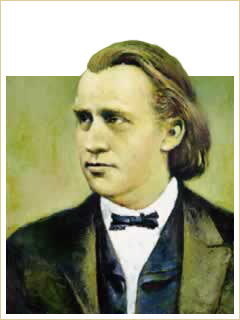

Johannes Brahms was a firm believer in preserving the musical traditions of Bach, Haydn, Mozart, Beethoven, and Schubert...

Even as a young child of ten, Brahms played the piano for money in the bars and brothels of his native Hamburg. During this time, a prominent violinist, Joseph Joachim, befriended the young Brahms and arranged for him to meet Robert and Clara Schumann. This meeting was a defining moment in Brahms' life. Schumann immediately recognized the young pianist’s ability and charisma and offered him direction and support. Clara, a brilliant pianist and composer in her own right, also became a guiding force in Brahms’ life.
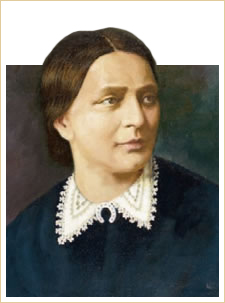
When Robert Schumann (1810-1856) suffered a mental collapse and was subsequently placed in an asylum in 1854, Brahms helped Clara and her seven children in her husband’s absence. By the time Robert died in 1856, Brahms had fallen deeply in love with Clara, a woman 14 years his senior. Although there is no conclusive evidence that their love was consummated or even mutual, Clara and Johannes remained very close friends for the rest of their lives. Clara died in May of 1896; Brahms followed just ten months later.
Brahms' work
Brahms' interest in German folk music is manifested in his early choral works, including the Liebeslieder Waltzes (Love-Song Waltzes), and his early songs. Despite its title, the German Requiem (1868)—a seven-movement work with texts taken from the Luther German Bible—is not folk-based.
Composer: Johannes Brahms
-
"A German Requiem, Op. 45: V. Ihr Habt Nun Traurigkeit"
Composer: Johannes Brahms
-
"Piano Quintet in F Minor, Op. 34: III. Scherzo: Allegro - Trio"
Composer: Johannes Brahms
-
"Symphony No. 4 in E minor, Op. 98: IV. Allegro energico e passionato - Piu allegro"
His greatest contribution to the choral repertoire is his masterpiece, A German Requiem (1868), a seven-movement work with text from the German Bible. The Requiem is not in the same vein as Mozart’s or Berlioz’ setting of the traditional Latin text, but rather a highly personal work created to memorialize his mother. In contrast to the Dies irae (Day of Wrath) text found in the Latin version, the texts are meant to console and to illustrate the redemptive power of death. In the peaceful fifth movement, Brahms shows a masterful treatment of harmony that shifts through unexpected keys and cadences. In his later choral works, as evidenced in his motet Der Heilland Reiss, Brahms experimented with modal harmonies and canonic structures.
It is in his chamber and symphonic music that his traditional tendencies become most apparent. The Piano Quintet, Op. 34 (1864) illustrates a feature common to many of Brahms’ compositions: a complex texture or ‘thickness’ that comes from the composer’s interest in thematic integration.
In his chamber music and symphonies, Brahms is the true descendent and inheritor of the “Beethoven tradition.” Extremely self-critical, Brahms was hesitant to finish his first symphony because he felt an overwhelming responsibility to match Beethoven’s symphonic greatness. Thus, his First Symphony, one of only four that he composed, was not completed until 1876. All four symphonies, however, are massive achievements in the genre, unparalleled in scope and execution, in perfect Classical form. The final movement of the Fourth Symphony in E minor is a passacaglia with 32 variations. A work based on such a demanding form would be daunting to most composers. In the hands of Brahms, however, it is one of the most compelling movements in the symphonic repertoire.
Giuseppe Verdi (1813-1901)
Giuseppe Verdi’s devoted his life to refining and expanding traditional Italian opera; his music embodies the grandest and most elaborate Romantic gestures. After growing up in relative poverty in northern Italy, Verdi studied in Milan before returning home and, at the age of 23, getting married. His first opera, which met with encouraging success, was produced at Milan’s famous La Scala Theater in 1839. At the urging of the theater director, he composed Nabucco, the story of the Babylonian King Nebuchadnezzar. At the time, Italy was struggling to free itself from Austrian rule; the story of the Jews’ struggle for freedom from Babylon, and their desire to return to their homeland struck a nerve with the Italian public. The chorus Va pensiero sull' ali dorate became a de facto national anthem, and the opera turned Verdi into a national hero.
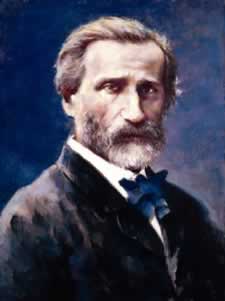
Composer: Giuseppe Verdi
-
"Nabucco: Va, Pensiero - Chorus Of Hebrew Slaves"
Despite occasional retirements, most notably between 1871 and 1887, Verdi’s artistic success continued until his death at age 87. Although Verdi’s style at times trespasses into Grand Opera (Don Carlos), he more often retains the traditional Italian forms of opera seria and opera buffa (comic opera).
Verdi's works retain the typical Italian forms of chorus, aria, recitative, and ensemble even in his late operas...
Unlike the opera/music dramas of German composers such as Weber and Wagner, or French composers like Berlioz and Bizet, Verdi’s works, even in his late operas, retain the typical Italian forms of chorus, aria, recitative, and ensemble. While the dramatic aspect of his operas becomes increasingly important, it remains subservient to the melodic line and traditional form, allowing the aria, recitative, and ensemble to maintain a sense of completeness. The independence of such musical numbers can be heard in the recitative Ebben? Che diavol fate? from La Traviata, the famous aria La donna e mobile from Rigoletto, and the duet, Desdemona rea, si, per ciel, that closes the first act of Otello.
Composer: Giuseppe Verdi
-
"La Traviata: Act I: "Ebben? Che Diavol Fate?""
Composer: Giuseppe Verdi
-
"Rigoletto: La donna e mobile"
Composer: Giuseppe Verdi
-
"Otello: Desdemona rea, si, per ciel"
Peter Illych Tchaikovsky (1840-93)
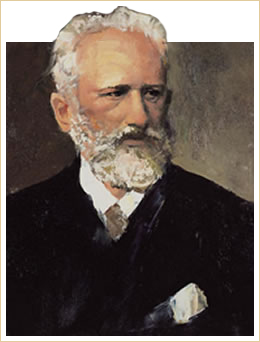
For the most part, Tchaikovsky is considered a conservative composer. Younger than Brahms, Verdi, and Wagner, he continued to write four-movement symphonies and fairly traditional music long after many composers had moved on to other realms. He was not a true nationalist and, at times, seemed more intent upon paying homage to the music of the German Classicists than incorporating Russian folk music into his works. This reprioritization placed him at odds with the goals of the “Mighty Five.” Despite this discrepancy, because of his brilliant orchestration, beautiful melodies, and eloquent harmonies, Tchaikovsky remains one of the significant composers of his era.
Because of his brilliant orchestration, beautiful melodies, and eloquent harmonies, Tchaikovsky remains one of the major composers of his era...
In many texts, Tchaikovsky appears as a tragic figure wracked with guilt over his homosexuality, hampered by bouts of depression, and haunted by rumors of suicide and scandal. Indeed, to some, his highly emotional Symphony No. 6, the Pathetique (the last he wrote) resembles a musical suicide note.
The Pathetique Symphony aside, Tchaikovsky’s musical output is not characterized by overt sadness, melancholy, or depression. On the whole, his music is full of joy and color. He felt a special affinity for ballet, a dance form that had been popular in Paris since the 18th century. Although ballet had clearly worked its way into the hearts of Russian audiences, until Tchaikovsky, no significant composer had written music for the ballet. His best known ballets are Swan Lake (1876), Sleeping Beauty (1890), and The Nutcracker (1892). In all three, Tchaikovsky employs popular dances such as the waltz, the march, and Russian folk dances.
Composer: Pyotr Ilyich Tchaikovsky
-
"The Sleeping Beauty, Op. 66: Waltz"
Composer: Pyotr Ilyich Tchaikovsky
-
"The Nutcracker Suite, Op. 71a: II. Marche"
Composer: Pyotr Ilyich Tchaikovsky
-
"The Nutcracker Suite, Op. 71a, TH 35: IV. Russian Dance, "Trepak""
Further Listening: Romantic Period
- Liszt: Hamlet
- Dvorak: 9th symphony, From The New World, 2nd movement
- Smetana: Moldau from Ma Vlast
- Macdowell: Indian Idyl from New England Idyls
- Brahms: German Requiem 5th movement
- Brahms: Piano Quintet, Op. 34
- Verdi: Desdemona rea, si, per ciel, duet from Otello
- Tchaikovsky: Trepak from The Nutcracker
- Saint-Saëns: Danse macabre
- Faure: Requiem, 1st movement
- Leoncavallo: Vesti la giubba from I Pagliacci
Composer: Antonín Dvorák
-
"Symphony No. 9 in E minor, Op. 95, From The New World: II. Largo"
Composer: Bedrich Smetana
-
"Ma Vlast (My Country): No. 2. Vltava (Moldau)"
Composer: Johannes Brahms
-
"A German Requiem, Op. 45: V. Ihr Habt Nun Traurigkeit"
Composer: Johannes Brahms
-
"Piano Quintet in F Minor, Op. 34: III. Scherzo: Allegro - Trio"
Composer: Giuseppe Verdi
-
"Otello: Desdemona rea, si, per ciel"
Composer: Camille Saint-Saëns
-
"Danse macabre: Danse macabre, Op. 40"
Composer: Gabriel Fauré
-
"Requiem, Op. 48: Introit et Kyrie"
Composer: Frederick Edward Weatherly
-
"Pagliacci: Vesti la giubba"



Each of Elgar's fourteen 'Enigma' Variations has a cryptic subtitle that relates to a particular person (or animal) in his life
